




























Iazuddin Ahmed: Caretaker government and state of emergency—how true are the allegations of dictatorship?
Explore Iajuddin Ahmed’s role during Bangladesh’s 2007 state of emergency and caretaker government, examining allegations of dictatorship and the complex realities of crisis governance.

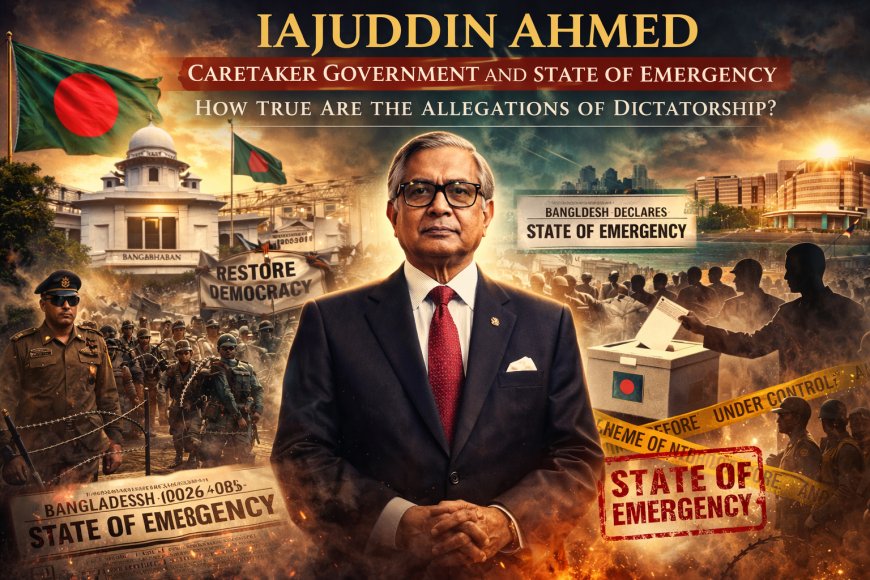
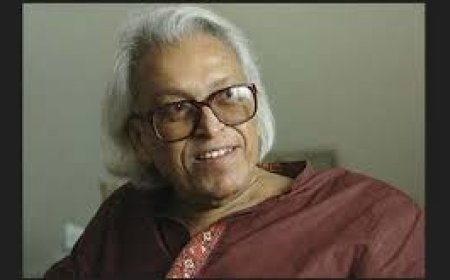
In the complex journey of Bangladesh’s democratic evolution, few chapters spark as much debate as the tenure of Iajuddin Ahmed during the 2006 to 2008 political crisis. A respected academic turned head of state, his leadership unfolded at a time of intense political confrontation, electoral disputes, and growing public unrest. When he assumed the role of Chief Adviser to the caretaker government while serving as President, the move triggered sharp national and international scrutiny.
The period that followed witnessed the declaration of a state of emergency, the postponement of elections, and sweeping anti corruption drives. Supporters described these measures as necessary interventions to stabilize a polarized political environment. Critics, however, raised concerns about executive overreach and the weakening of democratic norms.
More than a decade later, the debate remains layered and nuanced. Was this an episode of temporary constitutional adjustment in extraordinary times, or did it edge dangerously close to authoritarian governance? To understand the truth behind the allegations of dictatorship, one must examine the political context, institutional dynamics, and legal framework that shaped those turbulent years.
Personal Information Table
| Field | Information |
|---|---|
| Full Name | Iajuddin Ahmed |
| Nickname | Not widely known |
| Father Name | Not publicly documented |
| Mother Name | Not publicly documented |
| Son & Daughter | 1 son |
| Date of Birth | 1 February 1931 |
| Place of Birth | Munshiganj District, Bengal Presidency, British India |
| Height | Not publicly documented |
| Color | Not publicly documented |
| Life Partner | Anwara Begum |
| Marriage | Married |
| Assets | Not publicly disclosed |
| Education | University of Dhaka, University of Wisconsin |
| Profession | Academic, Political Leader |
| Position | President of Bangladesh, Chief Adviser of Caretaker Government |
| Title | Former President |
| Company | Government of Bangladesh |
| Business | Public Service |
Unpacking the Layers of Iajuddin Ahmed: Caretaker Government and State of Emergency
Iajuddin Ahmed assumed the presidency in 2002, a period marked by fierce rivalry between major political parties. According to the Constitution of Bangladesh, a non partisan caretaker government was mandated to oversee parliamentary elections. In October 2006, amid escalating tensions, he controversially took on the additional role of Chief Adviser after disputes over the appointment process.
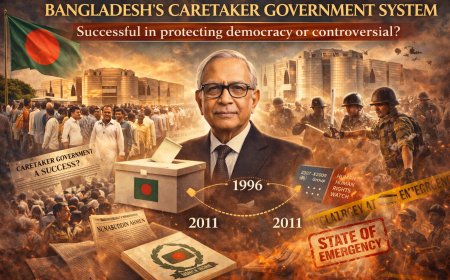
The political standoff deepened. Protests intensified, opposition groups alleged electoral manipulation, and international observers expressed concern. On 11 January 2007, a state of emergency was declared. Elections were postponed. A new technocratic caretaker administration, backed by the military, began implementing anti corruption reforms and voter list revisions.
The Encyclopaedia Britannica and reports by Human Rights Watch detail how this period combined reformist zeal with restrictions on political activities and media freedoms. While some analysts argue the emergency facilitated institutional restructuring and cleaner elections in 2008, others question whether constitutional limits were tested beyond intent.
Understanding this phase requires balancing constitutional necessity with democratic ideals, and examining how crisis governance interacts with public accountability.
Navigating the Challenges and Debates
The primary controversy surrounding Iajuddin Ahmed centers on allegations of authoritarian drift. Critics argued that assuming the dual role of President and Chief Adviser concentrated too much power in one office. Questions were raised about neutrality, transparency, and adherence to constitutional spirit.
International organizations such as the International Crisis Group observed that while the emergency administration aimed to restore order and reform electoral systems, restrictions on political gatherings and arrests of party leaders created anxiety about democratic backsliding.
Supporters counter that Bangladesh at the time faced a potential breakdown of governance. Violent clashes and institutional paralysis threatened national stability. From this perspective, emergency provisions were constitutional tools used to prevent escalation.
This tension highlights a broader democratic dilemma. How should states respond when electoral legitimacy is contested? At what point do corrective interventions risk undermining the very democracy they seek to protect? The debate continues to shape discussions on constitutional reform, civil military relations, and electoral safeguards in Bangladesh.
Real world Echoes: Case Studies and Applications
The 2007 to 2008 emergency period offers a powerful case study in crisis management and electoral reform. One notable outcome was the comprehensive updating of voter lists using photographic identification, which enhanced transparency in the December 2008 elections. Observers described the election as significantly more credible than previous polls.
Anti corruption drives targeted high profile political figures across party lines. While some prosecutions later faltered, the campaign signaled growing public demand for accountability.
Comparatively, political scientists often reference Bangladesh’s caretaker experiment when studying transitional governance models. The system itself was later abolished through constitutional amendment in 2011, reflecting lessons learned and changing political consensus.
The episode demonstrates that crisis governance can yield both reforms and controversies. It underscores the delicate interplay between executive authority, military influence, judicial oversight, and civil society vigilance. For emerging democracies, the experience remains instructive in balancing stability with civil liberties.
Conclusion
Iajuddin Ahmed’s presidency during Bangladesh’s caretaker crisis remains one of the most debated periods in the nation’s political history. His actions unfolded within a volatile environment shaped by mistrust, rivalry, and constitutional ambiguity. Whether viewed as a stabilizing intervention or an overextension of executive authority, the era illustrates the fragile equilibrium between order and democratic openness. As Bangladesh continues to evolve, revisiting this chapter encourages thoughtful dialogue about institutional safeguards, accountability, and the enduring quest for credible elections.
For professional biography writing, research, or digital profile services, contact https://biography.com.bd/ and bring history to life with accuracy and depth.
Q&A Section
1. Why did Iajuddin Ahmed assume the role of Chief Adviser in 2006?
The Constitution required a neutral caretaker administration to oversee elections. Political disagreement over appointments led him, as President, to temporarily assume the position. Critics saw this as controversial, while supporters argued it was a constitutional response to deadlock.
2. Was the 2007 state of emergency unconstitutional?
Emergency provisions were constitutionally recognized. However, debates focus on their scope and impact on civil liberties. Reports by Human Rights Watch and the International Crisis Group provide deeper analysis of these concerns.
3. Did the emergency period improve election credibility?
Many observers state that reforms introduced during the emergency, including updated voter rolls and administrative restructuring, contributed to the relatively credible 2008 elections.
4. Why is this period still debated today?
It represents a clash between stability and democratic freedom. Scholars and policymakers continue to analyze it when discussing constitutional amendments and governance reforms in Bangladesh.
For further reading, explore:
-
Encyclopaedia Britannica
-
Human Rights Watch
-
International Crisis Group
What's Your Reaction?
 Like
0
Like
0
 Dislike
0
Dislike
0
 Love
0
Love
0
 Funny
0
Funny
0
 Angry
0
Angry
0
 Sad
0
Sad
0
 Wow
0
Wow
0