










Kazi Nazrul Islam | The Flame of Rebellion and Harmony
Nazrul was born on 24 May 1899 in the quiet village of Churulia. The air of rural Bengal carried the echoes of azan, folk songs, and temple bells—sounds that later blended beautifully in his poetry. Poverty followed him closely. After his father’s death, young Nazrul had to support his family, working as a muezzin, bakery worker, and even joining a traveling theatrical group known as a leto troupe.

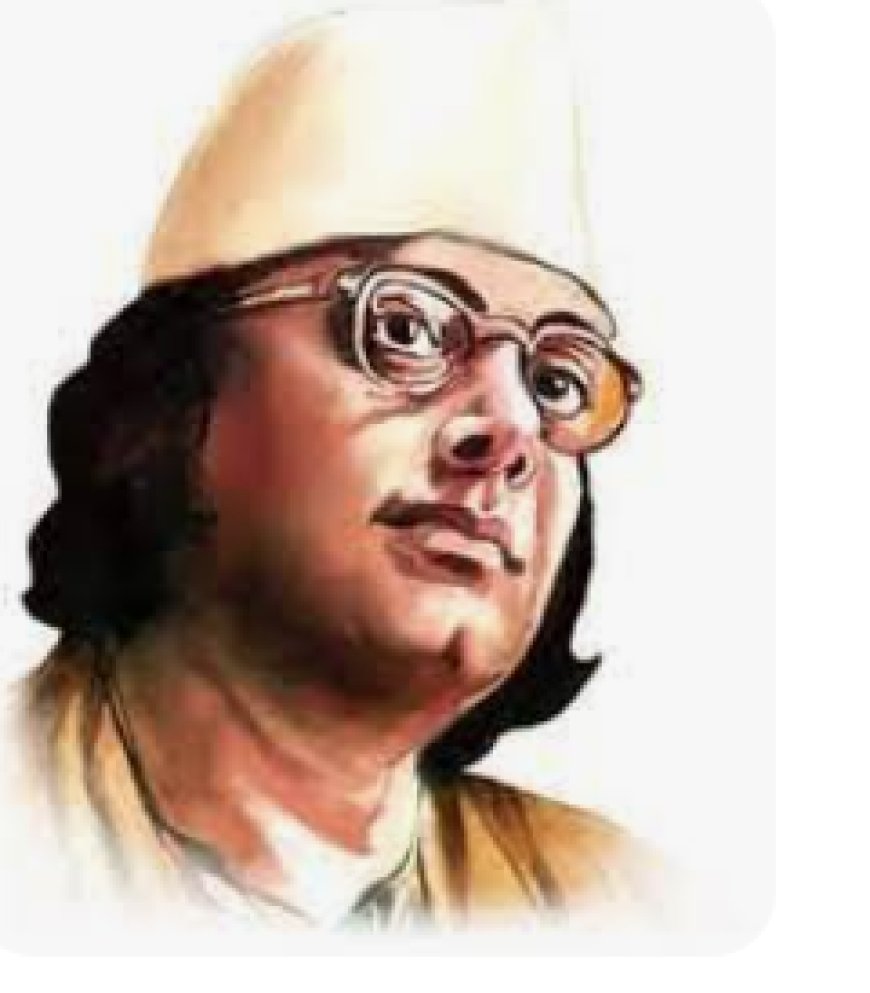
There are poets who write verses—and then there are poets who become verses themselves. Kazi Nazrul Islam was the latter. He was thunder in a colonial sky, melody in a divided land, and fire in the heart of oppression. His life was not a quiet river; it was a restless ocean—rising, roaring, and refusing to submit.
Born into modest circumstances, Nazrul transformed pain into poetry and struggle into song. His words marched like soldiers, yet embraced like lovers. He remains one of the most electrifying figures in South Asian literary history.
📌 Information Summary
| Field | Details |
|---|---|
| Full Name | Kazi Nazrul Islam |
| Nickname | Dukhu Mia |
| Father Name | Kazi Fakir Ahmed |
| Mother Name | Zahida Khatun |
| Son & Daughter | Four sons – Kazi Sabyasachi, Kazi Aniruddha, Kazi Krishna Mohammed, and Kazi Arindam Khaled |
| Date of Birth | 24 May 1899 |
| Place of Birth | Churulia, Asansol, Burdwan District, Bengal Presidency (now West Bengal, India) |
| Height | Approximately 5 feet 4 inches (estimated) |
| Color | Brown complexion |
| Life Partner | Pramila Devi |
| Marriage | Married in 1924 |
| Assets | Primarily literary works and musical compositions |
| Education | Maktab education; later studied at Searsole Raj High School |
| Profession | Poet, writer, musician, journalist, soldier |
| Position | Editor of the newspaper Dhumketu |
| Title | The Rebel Poet; National Poet of Bangladesh |
| Company | Associated with literary magazines and recording companies |
| Business | No formal business; involved in publishing and music recording |
🌄 Early Life: A Childhood Forged in Hardship
Nazrul was born on 24 May 1899 in the quiet village of Churulia. The air of rural Bengal carried the echoes of azan, folk songs, and temple bells—sounds that later blended beautifully in his poetry. Poverty followed him closely. After his father’s death, young Nazrul had to support his family, working as a muezzin, bakery worker, and even joining a traveling theatrical group known as a leto troupe.
Those early struggles did not harden him; they sharpened him.
🎓 Education: Learning Beyond Walls
His formal education was interrupted by financial hardship, yet Nazrul’s mind was unstoppable. He studied Persian, Arabic, Bengali, and Sanskrit literature. He read deeply—absorbing Islamic theology, Hindu mythology, and Western romanticism. His classroom was life itself, and his library was the world.
⚔️ Soldier Turned Poet
During World War I, Nazrul joined the British Indian Army. In the barracks, between drills and discipline, he wrote poems and songs. War did not silence his creativity; it intensified it. After returning, he stepped into literature with explosive force.
In 1922, his poem Bidrohi (The Rebel) shook the literary world. From that moment, he became known as “The Rebel Poet.”
📰 Voice of Resistance
As editor of the revolutionary newspaper Dhumketu (The Comet), Nazrul fearlessly criticized British colonial rule. His writings led to imprisonment. Even behind bars, he wrote defiantly, beginning a hunger strike to protest injustice. His pen was sharper than chains.
💍 Love and Marriage
In 1924, he married Pramila Devi, a Hindu woman. Their union symbolized his lifelong belief in communal harmony. Their marriage was not merely personal—it was philosophical. Love, for Nazrul, transcended religion.
They were blessed with four sons, though the loss of children brought immense sorrow to his life.
🎵 Music and Literary Wealth
Nazrul composed nearly 4,000 songs—now known as Nazrul Geeti. His music embraced Islamic devotion, Shyama Sangeet, patriotic anthems, and romantic ballads. He blended ragas with revolutionary rhythm.
Though he did not accumulate material wealth, his true assets were his poems, songs, essays, and plays. His creativity was his fortune.
🏆 Titles and Recognition
Nazrul earned the immortal title “The Rebel Poet.” Later, he was honored as the National Poet of Bangladesh, where he spent his final years.
🌅 Final Chapter
In the later part of his life, Nazrul suffered from a mysterious neurological illness that silenced his voice. The rebel who once roared like thunder was reduced to silence. Yet even silence could not erase his echo.
He passed away on 29 August 1976 in Dhaka and was buried beside the mosque of the University of Dhaka—resting where knowledge and faith meet.
🌟 Legacy: A Flame That Still Burns
Kazi Nazrul Islam was more than a literary genius. He was a bridge between religions, a warrior against oppression, and a poet of humanity. His life teaches us that rebellion can be beautiful, that love can be revolutionary, and that poetry can be power.
He did not just write history.
He ignited it. 🔥
What's Your Reaction?
 Like
0
Like
0
 Dislike
0
Dislike
0
 Love
0
Love
0
 Funny
0
Funny
0
 Angry
0
Angry
0
 Sad
0
Sad
0
 Wow
0
Wow
0