































Bangladesh's caretaker government system: Successful in protecting democracy or controversial.
Explore Bangladesh’s caretaker government system, examining whether it successfully protected democracy or became a controversial constitutional experiment.

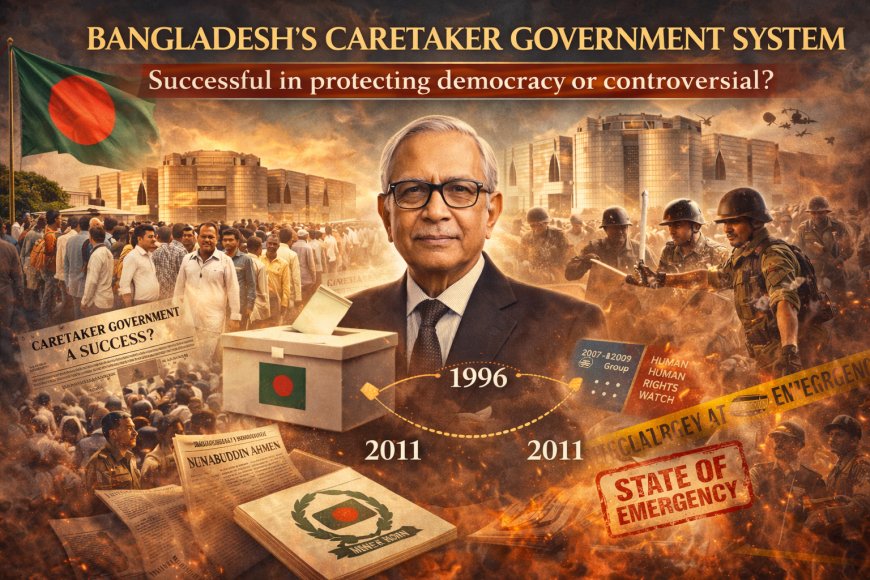
In democratic systems, few moments are as sensitive as national elections. In Bangladesh, where political rivalry has often been intense, the question of who oversees elections became a defining issue. Out of this tension emerged a unique constitutional innovation: the caretaker government system. Designed to ensure neutrality during parliamentary elections, this mechanism sought to protect public trust in the ballot.
Introduced through the 13th Amendment to the Constitution in 1996, the caretaker government system was hailed by many as a safeguard against partisan influence. It placed temporary executive authority in the hands of a non party interim administration tasked solely with organizing elections. For years, it became an integral part of Bangladesh’s political framework.
Yet its legacy remains contested. While some argue it strengthened electoral credibility, others point to controversies, especially during the 2006 to 2008 crisis, which ultimately led to its abolition through the 15th Amendment in 2011. Today, as democratic institutions worldwide face scrutiny, Bangladesh’s caretaker experiment continues to provoke debate about neutrality, constitutional design, and the evolving meaning of democratic protection.
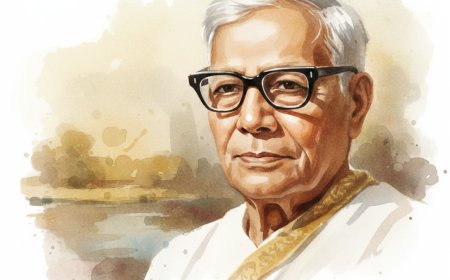
Key Figures Information Table
| Field | Justice Shahabuddin Ahmed |
|---|---|
| Full Name | Shahabuddin Ahmed |
| Nickname | Not widely known |
| Father Name | Talukdar Abdur Rashid |
| Mother Name | Not publicly documented |
| Son & Daughter | 2 sons |
| Date of Birth | 1 February 1930 |
| Place of Birth | Madaripur District, Bengal Presidency |
| Height | Not publicly documented |
| Color | Not publicly documented |
| Life Partner | Anwara Begum |
| Marriage | Married |
| Assets | Not publicly disclosed |
| Education | University of Dhaka |
| Profession | Jurist |
| Position | Chief Adviser of Caretaker Government, President of Bangladesh |
| Title | Former President |
| Company | Supreme Court of Bangladesh |
| Business | Public Service |
Unpacking the Layers of Bangladesh's Caretaker Government System: Successful in Protecting Democracy or Controversial
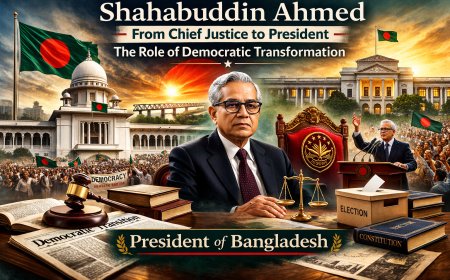
The caretaker government system formally emerged in 1996 after sustained opposition demands for neutral election oversight. It institutionalized a practice previously seen in 1990, when Shahabuddin Ahmed led an interim government that oversaw credible elections.
Under the system, the outgoing Prime Minister would hand over authority to a non partisan Chief Adviser, typically the last retired Chief Justice. The interim cabinet would govern for a limited period, focusing solely on electoral arrangements. According to Encyclopaedia Britannica and Banglapedia, elections in 1991, 1996, and 2001 conducted under caretaker administrations were widely regarded as competitive and participatory.
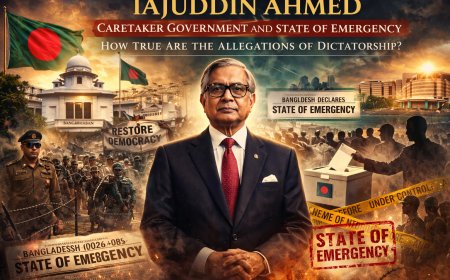
However, the 2006 caretaker transition exposed vulnerabilities. Disputes over appointments and allegations of bias triggered political unrest. The subsequent declaration of a state of emergency in 2007 altered the character of the system, extending its duration and expanding its authority.
Thus, the caretaker framework embodied both innovation and fragility. It demonstrated how constitutional mechanisms can attempt to mediate mistrust, yet it also revealed how extraordinary circumstances can stretch intended limits.
Navigating the Challenges and Debates
The debate surrounding the caretaker system revolves around constitutional legitimacy and democratic sustainability. Supporters argue that in deeply polarized political contexts, neutral interim administrations help ensure electoral fairness. This perspective highlights the importance of public confidence in democratic outcomes.
Opponents contend that transferring executive power to unelected figures, even temporarily, disrupts parliamentary continuity. The Supreme Court of Bangladesh later declared the system unconstitutional, arguing that it conflicted with democratic principles, though it allowed transitional use for a limited period.
Human rights groups and international observers have noted both the successes and complications of the system, especially during the prolonged emergency government of 2007 to 2008. The ethical question remains central. Can temporary suspension of partisan authority strengthen democracy, or does it risk undermining representative governance?
This tension reflects broader global conversations about electoral neutrality, institutional trust, and constitutional experimentation.
Real World Echoes: Case Studies and Applications
The 1996 election stands as a significant example of the caretaker system’s perceived success. After months of political agitation, the introduction of a neutral administration restored voter participation and public confidence. Turnout increased, and the election outcome was broadly accepted.
Conversely, the 2007 to 2008 period illustrates the system’s potential complications. The extended emergency phase blurred the line between neutral oversight and technocratic governance. Anti corruption campaigns and electoral reforms were implemented, yet civil liberties were constrained.
Comparative scholars have referenced Bangladesh’s experience when analyzing other transitional governance models. Few countries institutionalized such a mechanism constitutionally, making it a unique case study in democratic innovation.
The caretaker system’s life cycle offers lessons about institutional safeguards, political culture, and the challenges of sustaining trust in adversarial democratic environments.
Conclusion
Bangladesh’s caretaker government system remains one of the most intriguing constitutional experiments in modern democratic history. Born from mistrust yet designed to protect electoral legitimacy, it achieved notable successes while exposing structural tensions. Its abolition does not erase its legacy. Instead, it invites continued reflection on how democracies can safeguard fairness without compromising representative continuity. The story underscores that democratic resilience often depends not just on laws, but on shared trust and accountability.
For detailed research based articles and professional historical documentation, contact https://biography.com.bd/ to preserve political narratives with clarity and depth.
Q&A Section
1. Why was the caretaker government system introduced in Bangladesh?
It was introduced to ensure neutral oversight of parliamentary elections amid intense political rivalry. The 13th Amendment institutionalized the framework in 1996.
2. Was the caretaker system successful?
Many observers consider elections under caretaker governments credible, especially in 1996 and 2001. However, controversies during the 2007 emergency period complicated its reputation.
3. Why was it abolished?
The Supreme Court ruled it inconsistent with the Constitution’s democratic structure. The 15th Amendment in 2011 formally removed the system.
4. Is Bangladesh unique in adopting this system?
Yes, Bangladesh’s constitutional caretaker mechanism was relatively unique, making it a notable case in comparative democratic studies.
Further reading:
-
Encyclopaedia Britannica
-
Banglapedia
-
Supreme Court of Bangladesh judgments
What's Your Reaction?
 Like
0
Like
0
 Dislike
0
Dislike
0
 Love
0
Love
0
 Funny
0
Funny
0
 Angry
0
Angry
0
 Sad
0
Sad
0
 Wow
0
Wow
0