
































Military rule in Bangladesh (1975–1990): Dictatorship or political reality.
Explore military rule in Bangladesh from 1975 to 1990, examining whether it was dictatorship or political necessity in a turbulent era of national transformation.

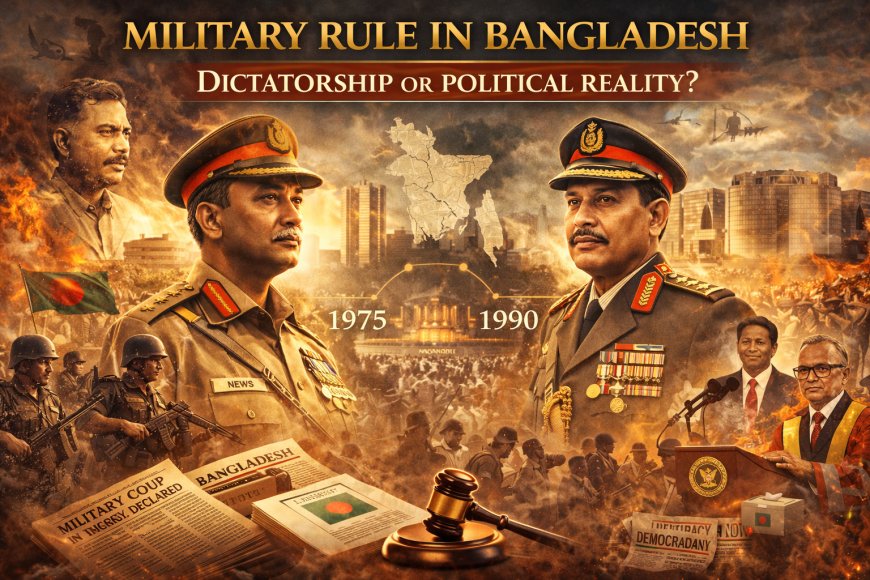
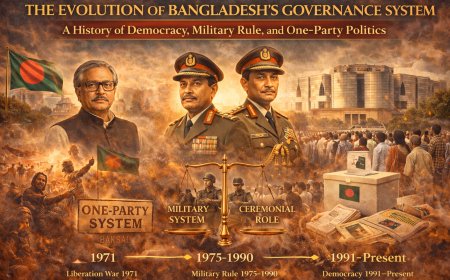
Between 1975 and 1990, Bangladesh experienced one of the most transformative and contested phases of its political history. Born from the Liberation War of 1971 with aspirations of parliamentary democracy, the young nation soon faced turbulence that reshaped its constitutional and institutional foundations. A series of coups, counter coups, and military interventions altered the political landscape, ushering in a period often described as military rule.
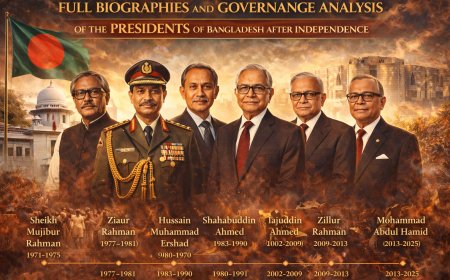
This era saw the rise of leaders such as Ziaur Rahman and Hussain Muhammad Ershad, whose governance continues to generate debate. Was this period an outright dictatorship marked by suppression and centralized authority, or was it a political reality shaped by instability and nation building challenges?
Today, as democracies worldwide confront questions about civil military relations and constitutional resilience, Bangladesh’s experience offers a compelling case study. The answers are layered, shaped by competing narratives of reform, repression, stability, and resistance. Understanding this chapter is essential not only for historians but also for anyone exploring the fragile balance between order and democratic ideals.
Key Figures Information Table
| Field | Ziaur Rahman | Hussain Muhammad Ershad |
|---|---|---|
| Full Name | Ziaur Rahman | Hussain Muhammad Ershad |
| Nickname | Zia | Ershad |
| Father Name | Mansur Rahman | Moulavi Mustafizur Rahman |
| Mother Name | Jahanara Begum | Mazida Khatun |
| Son & Daughter | 2 sons | 1 son |
| Date of Birth | 19 January 1936 | 1 February 1930 |
| Place of Birth | Bogura District, Bengal Presidency | Cooch Behar, British India |
| Height | Not publicly documented | Not publicly documented |
| Color | Not publicly documented | Not publicly documented |
| Life Partner | Khaleda Zia | Raushan Ershad |
| Marriage | Married | Married |
| Assets | Not publicly disclosed | Not publicly disclosed |
| Education | Pakistan Military Academy | Dhaka University |
| Profession | Military Officer, Politician | Military Officer, Politician |
| Position | President of Bangladesh | President of Bangladesh |
| Title | Former President | Former President |
| Company | Government of Bangladesh | Government of Bangladesh |
| Business | Public Service | Public Service |
Unpacking the Layers of Military Rule in Bangladesh (1975–1990): Dictatorship or Political Reality?
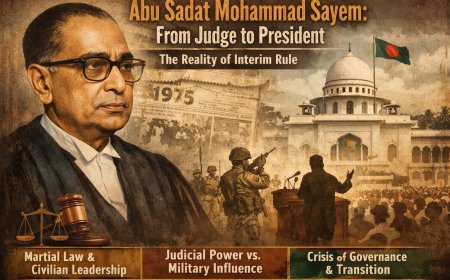
The political upheaval began with the assassination of Sheikh Mujibur Rahman in August 1975. The event triggered a cascade of power shifts within the military and political elite. Ziaur Rahman eventually consolidated authority, introducing constitutional amendments, lifting bans on political parties, and promoting market oriented reforms.
After Zia’s assassination in 1981, Hussain Muhammad Ershad seized power in 1982. He suspended parts of the Constitution and declared martial law. Supporters argue that both administrations sought stability and economic progress during times of fragility. Critics point to constraints on political opposition, curbs on media, and limitations on civil liberties.
According to Encyclopaedia Britannica and academic analyses available through institutions like the Wilson Center, this era blended authoritarian governance with selective political participation. Elections were held, but opposition groups often questioned their fairness.
The complexity lies in this duality. Reform initiatives coexisted with centralized control. Development programs advanced alongside restrictions on dissent. The period resists simple categorization, demanding careful historical examination rather than rhetorical labels.
Navigating the Challenges and Debates
The core debate centers on whether military intervention preserved the state or undermined democratic evolution. Political theorists highlight that emerging nations sometimes experience institutional weakness that invites non civilian oversight. Yet long term democratic consolidation depends on civilian supremacy and rule of law.
Human rights organizations have documented concerns regarding detentions and political suppression during martial law periods. Meanwhile, economic analysts note growth initiatives and rural development schemes introduced during these years.
Another enduring issue is constitutional alteration. Amendments introduced during military regimes reshaped national identity, governance structures, and electoral processes. Some of these changes were later reversed, illustrating ongoing tension between reform and restoration.
The ethical dilemma persists. Can stability justify authoritarian methods? Or does reliance on military leadership delay democratic maturity? The Bangladesh experience remains central to broader South Asian discussions about civil military balance and institutional endurance.
Real World Echoes: Case Studies and Applications
The mass uprising of 1990 offers a defining case study. Public protests, student movements, and cross party alliances pressured the Ershad regime to step down. This movement demonstrated the enduring strength of civil society and the electorate.
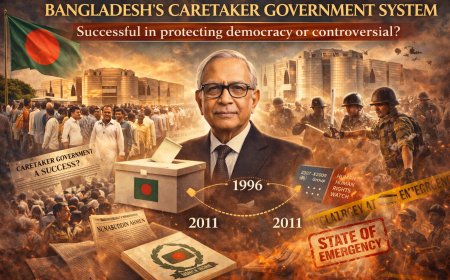
The transition that followed, under a neutral caretaker arrangement, restored parliamentary governance and became a reference point for democratic renewal. Scholars often compare this trajectory with similar transitions in Pakistan and Thailand, where civil military relations have also oscillated.
The lessons resonate today. Democratic systems require robust institutions, independent judiciary structures, and accountable executive authority. Bangladesh’s path illustrates how societal mobilization can recalibrate governance even after prolonged military dominance.
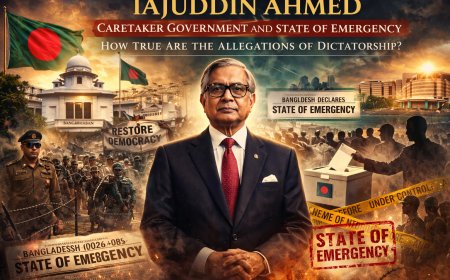
This period also influences present debates about emergency powers, constitutional safeguards, and electoral fairness.
Conclusion
Military rule in Bangladesh between 1975 and 1990 remains a defining and contested chapter. It embodied both governance consolidation and democratic disruption. The era challenges simplistic narratives, revealing a tapestry of reform, resistance, and recalibration. By revisiting this period with nuance, citizens and scholars alike can better understand the delicate architecture of democracy and the enduring importance of institutional accountability.
For comprehensive and professionally crafted historical profiles, contact https://biography.com.bd/ and preserve Bangladesh’s political history with clarity and depth.
Q&A Section
1. Was military rule in Bangladesh entirely authoritarian?
The period involved martial law and centralized authority. However, it also included elections and administrative reforms. Historians often describe it as hybrid governance rather than purely monolithic dictatorship.
2. How did the 1990 uprising change Bangladesh?
Mass civic mobilization led to the resignation of President Ershad and restored parliamentary democracy, marking a major democratic milestone.
3. What long term effects did this era have?
Constitutional amendments, party realignments, and institutional precedents shaped subsequent political developments. Some amendments were later revised, showing ongoing constitutional evolution.
4. Where can readers explore more?
-
Encyclopaedia Britannica
-
Wilson Center Digital Archive
-
Academic research journals on South Asian politics
What's Your Reaction?
 Like
1
Like
1
 Dislike
0
Dislike
0
 Love
0
Love
0
 Funny
0
Funny
0
 Angry
0
Angry
0
 Sad
0
Sad
0
 Wow
0
Wow
0