






















Balance of power between the Prime Minister and the President of Bangladesh: What does the Constitution say.
Explore the constitutional balance of power between the Prime Minister and President of Bangladesh, examining executive authority, ceremonial roles, and democratic safeguards.

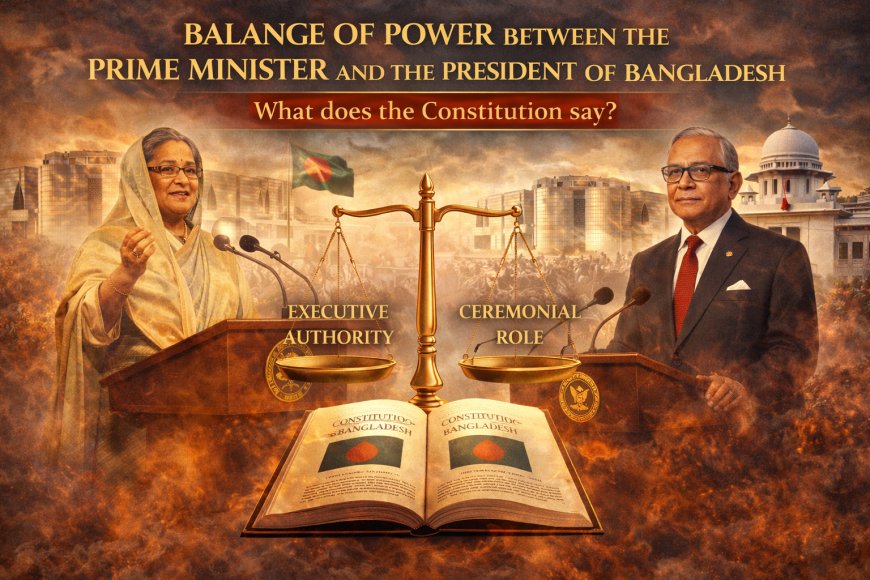
In any parliamentary democracy, the distribution of power between the head of government and the head of state defines the rhythm of governance. In Bangladesh, this balance has evolved through coups, constitutional amendments, judicial rulings, and political transitions. The Constitution outlines a structure where executive authority is exercised primarily by the Prime Minister, while the President serves as the constitutional head of state. Yet the practical application of these provisions has often sparked debate.
Since independence in 1971, Bangladesh has experienced both presidential and parliamentary phases. Early amendments concentrated executive power in the presidency, while later reforms restored parliamentary supremacy. Today, questions occasionally arise during political uncertainty. Does the President hold discretionary power in times of crisis? Can the Prime Minister operate without presidential oversight? These questions continue to generate scholarly and public interest.
Understanding the constitutional framework behind this balance is not merely an academic exercise. It reveals how democratic accountability, institutional restraint, and constitutional safeguards interact to shape political stability in Bangladesh.
Key Office Holders Information Table
| Field | Prime Minister (Example: Sheikh Hasina) | President (Example: Mohammad Abdul Hamid) |
|---|---|---|
| Full Name | Sheikh Hasina | Mohammad Abdul Hamid |
| Nickname | Hasina | Not widely known |
| Father Name | Sheikh Mujibur Rahman | Haji Tayeb Uddin |
| Mother Name | Sayera Khatun | Tomiza Khatun |
| Son & Daughter | 1 son, 1 daughter | 3 sons, 1 daughter |
| Date of Birth | 28 September 1947 | 1 January 1944 |
| Place of Birth | Tungipara, Gopalganj | Kishoreganj |
| Education | University of Dhaka | University of Dhaka |
| Profession | Politician | Politician |
| Position | Prime Minister of Bangladesh | President of Bangladesh |
| Title | Head of Government | Head of State |
| Company | Government of Bangladesh | Government of Bangladesh |
| Business | Public Service | Public Service |
Unpacking the Layers of Balance of Power Between the Prime Minister and the President of Bangladesh: What Does the Constitution Say
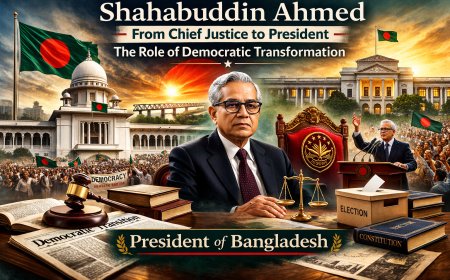
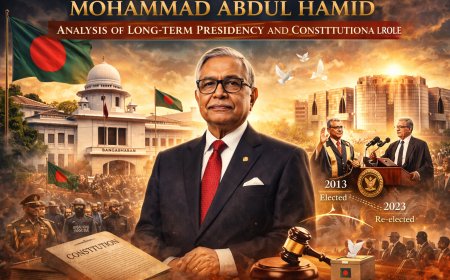
Sheikh Hasina serves as the head of government and exercises executive authority under Article 55 of the Constitution. Mohammad Abdul Hamid, during his tenure as President, functioned as the ceremonial head of state under Articles 48 and 50.
The Constitution states that the President acts on the advice of the Prime Minister in most matters. This means that while the President formally appoints the Prime Minister, assents to bills, and issues ordinances, these actions are generally guided by executive advice.
However, limited discretionary powers exist. For example:
-
Appointment of a Prime Minister when no party holds a clear majority.
-
Seeking reconsideration of parliamentary bills before granting assent.
-
Exercising authority during states of emergency.
Authoritative references such as Banglapedia and the official Constitution of Bangladesh provide detailed explanations of these provisions. The structure reflects the Westminster model, adapted to Bangladesh’s historical context.
Navigating the Challenges and Debates
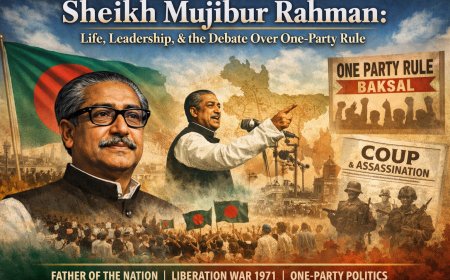
The balance of power between the Prime Minister and President has been tested during political crises. During the early 1970s, constitutional amendments shifted the system toward presidential governance. Later reforms restored parliamentary supremacy.
Critics sometimes argue that strong parliamentary majorities can reduce checks on executive authority. Others counter that constitutional safeguards, judicial review, and parliamentary accountability provide adequate balance.
Debates also emerge when presidents exercise symbolic or moral authority. Should the President remain strictly neutral and procedural, or occasionally guide political actors during tension? Legal scholars emphasize that overstepping advisory boundaries could disrupt democratic equilibrium.
Comparative constitutional studies often examine Bangladesh alongside India and the United Kingdom, where presidents or monarchs operate within clearly defined ceremonial parameters. These discussions show that effective balance depends less on textual wording and more on constitutional culture and respect for institutional limits.
Real World Echoes: Case Studies and Applications
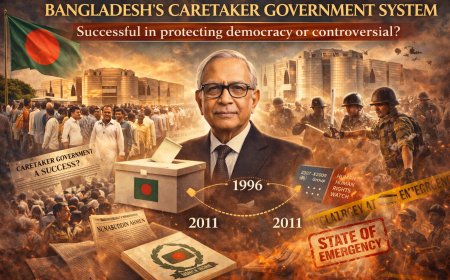
One illustrative moment occurred during the 1990 democratic transition, when presidential authority facilitated the appointment of a neutral interim leadership. This demonstrated how constitutional roles can adapt in extraordinary situations.
Another example involves legislative assent. While presidents rarely reject bills, the power to request reconsideration serves as a constitutional safeguard, reinforcing dialogue between branches.
In routine governance, the Prime Minister leads policymaking, cabinet formation, and administrative execution. The President, meanwhile, represents the state in diplomatic and ceremonial contexts, ensuring continuity and non partisan symbolism.
The interplay between these roles underscores the importance of clarity, restraint, and constitutional fidelity in sustaining democratic governance.
Conclusion
The balance of power between the Prime Minister and the President of Bangladesh reflects a carefully structured parliamentary framework shaped by historical experience. While executive authority lies primarily with the Prime Minister, the President remains a constitutional guardian and symbol of unity. The strength of this arrangement depends not only on legal provisions but also on political culture and institutional respect. As Bangladesh continues to evolve, understanding this balance offers valuable insight into the foundations of democratic stability.
For professionally researched biographies and constitutional analysis, contact https://biography.com.bd/ to document governance with clarity and precision.
Q&A Section
1. Does the President of Bangladesh have executive power?
The President holds formal executive authority but exercises it on the advice of the Prime Minister under the Constitution. Practical decision making rests primarily with the cabinet.
2. Can the President refuse to sign a bill?
The President may return a bill to Parliament for reconsideration. However, if Parliament passes it again, assent is generally required.
3. What happens if there is no clear parliamentary majority?
The President has limited discretion to appoint a Prime Minister who is most likely to command majority support.
4. Where can I read the constitutional provisions?
-
Constitution of Bangladesh official text
-
Banglapedia
-
Comparative studies on Westminster parliamentary systems
What's Your Reaction?
 Like
0
Like
0
 Dislike
0
Dislike
0
 Love
0
Love
0
 Funny
0
Funny
0
 Angry
0
Angry
0
 Sad
0
Sad
0
 Wow
0
Wow
0