
































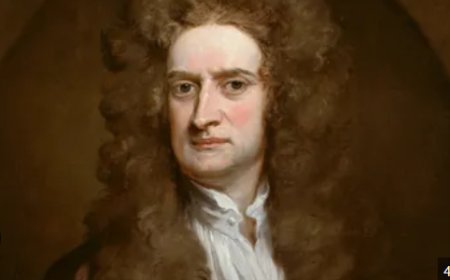

Isaac Newton: The Life of a Genius Who Changed Science
Discover the life and legacy of Isaac Newton, the genius who revolutionized physics with his laws of motion, gravity, and groundbreaking scientific ideas.

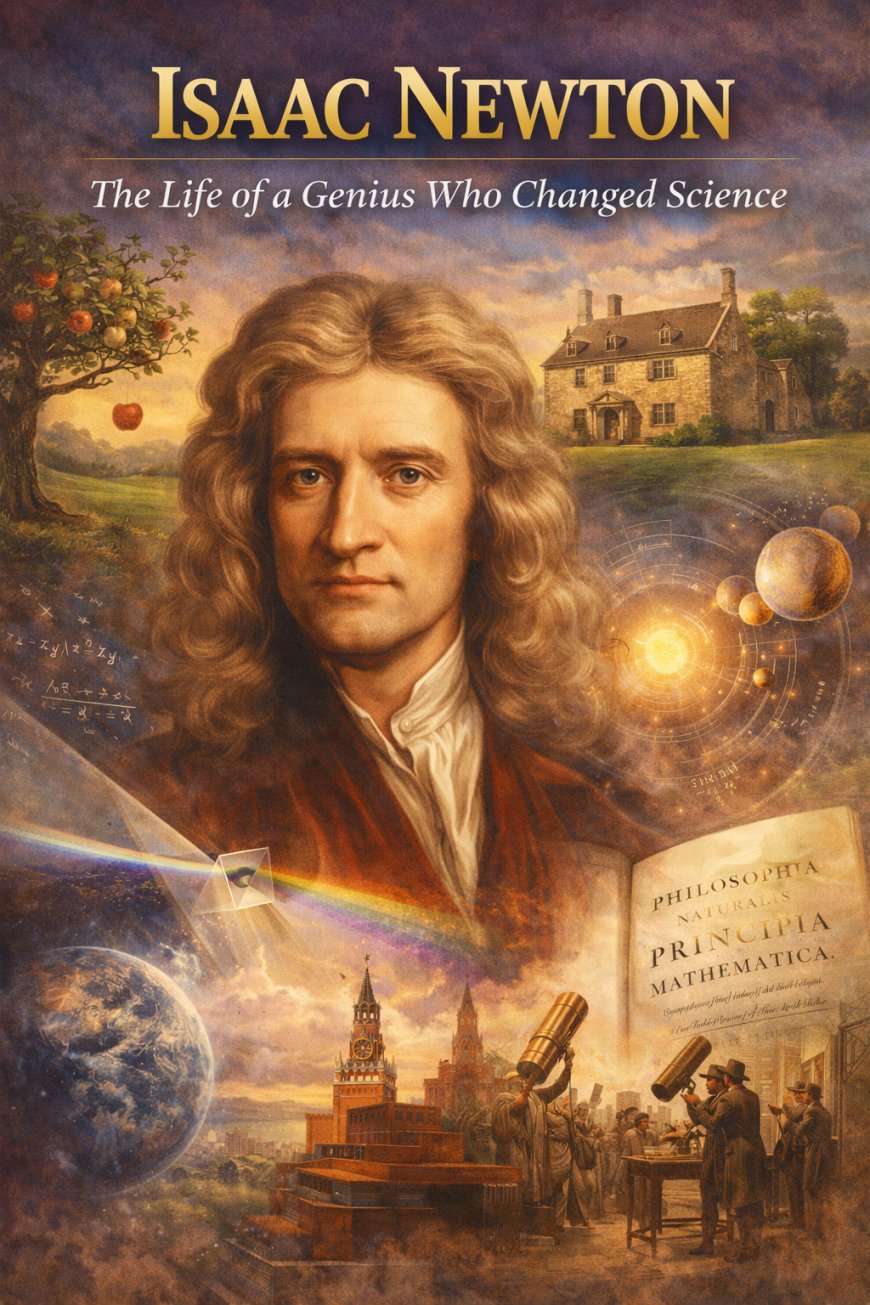
Few names in the history of science carry the weight and wonder of Isaac Newton. In classrooms, laboratories, and even space agencies, his laws of motion and universal gravitation remain foundational. In a world propelled by satellites, artificial intelligence, and interplanetary exploration, it is remarkable that many of the guiding principles behind modern physics trace back to a seventeenth century thinker working by candlelight.
Born in 1643 in rural England, Newton lived during a time of political upheaval and scientific awakening. The Scientific Revolution was reshaping humanity’s understanding of nature, challenging ancient authorities and encouraging experimentation. Today, scholars revisit Newton not only as a physicist but as a mathematician, alchemist, theologian, and complex personality. His story invites curiosity about how genius emerges and how groundbreaking ideas can reshape civilization.
Understanding Newton means exploring not only his celebrated discoveries but also the debates, rivalries, and philosophical questions that surrounded his life and work.
Unpacking the Layers of Isaac Newton: The Life of a Genius Who Changed Science
The Architect of Classical Physics
Isaac Newton’s most influential work, Philosophiæ Naturalis Principia Mathematica, laid out the laws of motion and universal gravitation. Published in 1687, it provided a mathematical framework that explained everything from falling apples to planetary orbits. The original texts and related manuscripts are preserved by the Royal Society, where Newton once served as president.
His three laws of motion became the backbone of classical mechanics, shaping engineering, astronomy, and later technological innovation. Resources from the NASA often highlight how Newtonian physics continues to guide spacecraft trajectory calculations and orbital predictions.
Master of Light and Mathematics
Beyond mechanics, Newton made pioneering contributions to optics. His prism experiments demonstrated that white light is composed of a spectrum of colors. The British Library offers digitized collections of Newton’s notes, revealing his meticulous approach to experimentation.
Newton also developed calculus independently, a mathematical tool essential to physics and engineering. This achievement positioned him among history’s most influential mathematicians. His intellectual versatility illustrates how interconnected scientific breakthroughs often are, with progress in one field fueling discoveries in another.
Navigating the Challenges and Debates
The Calculus Controversy
One of the most famous disputes in scientific history involved Newton and the German mathematician Gottfried Wilhelm Leibniz. Both developed calculus independently, but questions over priority led to a bitter rivalry. The controversy divided European scholars and highlighted the competitive nature of scientific recognition.
Historians today generally acknowledge that both men made crucial contributions. Archival research at the Leibniz University Hannover sheds light on documents that help clarify this parallel discovery.
Alchemy and Theology
Another layer of debate surrounds Newton’s extensive writings on alchemy and theology. While modern readers may associate him primarily with rational science, Newton devoted significant time to biblical interpretation and alchemical research. Scholars at the Cambridge University Library continue to analyze these manuscripts, exploring how Newton’s spiritual beliefs intersected with his scientific worldview.
These complexities challenge the simple image of a purely rational scientist. They remind us that historical figures often defy modern categories, blending curiosity, ambition, and faith in ways that reflect their times.
Real World Echoes: Case Studies and Applications
Space Exploration and Engineering
Newton’s laws remain essential in aerospace engineering. Satellite launches, rocket trajectories, and even climate modeling rely on principles he formalized centuries ago. Agencies like European Space Agency apply Newtonian mechanics daily when calculating orbital paths and mission design.
Education and Scientific Method
Newton’s emphasis on observation and mathematical rigor shaped the scientific method. Modern physics curricula around the world begin with his laws before advancing to relativity and quantum mechanics. His legacy can be seen in university laboratories, research institutions, and technological innovation hubs.
-
Engineering bridges and vehicles relies on force and motion calculations.
-
Astronomy programs model planetary systems using gravitational equations.
-
Computer simulations incorporate Newtonian principles for physical realism.
These real world applications demonstrate that Newton’s insights are not confined to textbooks. They are woven into the infrastructure of contemporary society, from transportation systems to space missions.
Conclusion
Isaac Newton’s life stands at the crossroads of curiosity and calculation. His laws transformed humanity’s understanding of motion, gravity, and light, laying the groundwork for centuries of scientific advancement. Yet his story also reveals rivalry, spiritual inquiry, and intellectual complexity. By examining his achievements and controversies, we gain a richer appreciation of how science evolves. Newton’s enduring influence reminds us that discovery is rarely simple, but always transformative. Exploring his legacy encourages both admiration and thoughtful reflection on the nature of genius and progress.
If you are seeking professional biography writing or historical research services, contact https://biography.com.bd/ for expert support.
Q&A Section
1. Why is Isaac Newton considered one of the greatest scientists?
Newton formulated the laws of motion and universal gravitation, which became foundational to physics. The Royal Society archives provide insight into his groundbreaking research.
2. Did Newton really discover gravity because of an apple?
The apple story likely symbolizes his reflections on gravity rather than a sudden moment of discovery. Historical accounts preserved at institutions like the British Library explore the origins of this popular tale.
3. What was the calculus dispute about?
Newton and Gottfried Wilhelm Leibniz independently developed calculus, leading to a priority conflict that shaped European mathematics for decades.
4. Where can I learn more about Newton’s work?
Consider visiting:
-
Royal Society Digital Collections: https://royalsociety.org
-
Cambridge University Library Newton Papers: https://cudl.lib.cam.ac.uk
-
NASA Educational Resources: https://www.nasa.gov
These platforms offer primary sources and expert analysis to deepen your understanding
What's Your Reaction?
 Like
0
Like
0
 Dislike
0
Dislike
0
 Love
0
Love
0
 Funny
0
Funny
0
 Angry
0
Angry
0
 Sad
0
Sad
0
 Wow
0
Wow
0