

























Mao Tse Tung: The Rise and Legacy of China's Revolutionary Leader
Explore Mao Tse Tung’s rise, revolutionary leadership, major campaigns, controversies, and lasting global impact. A balanced look at China’s transformative leader.

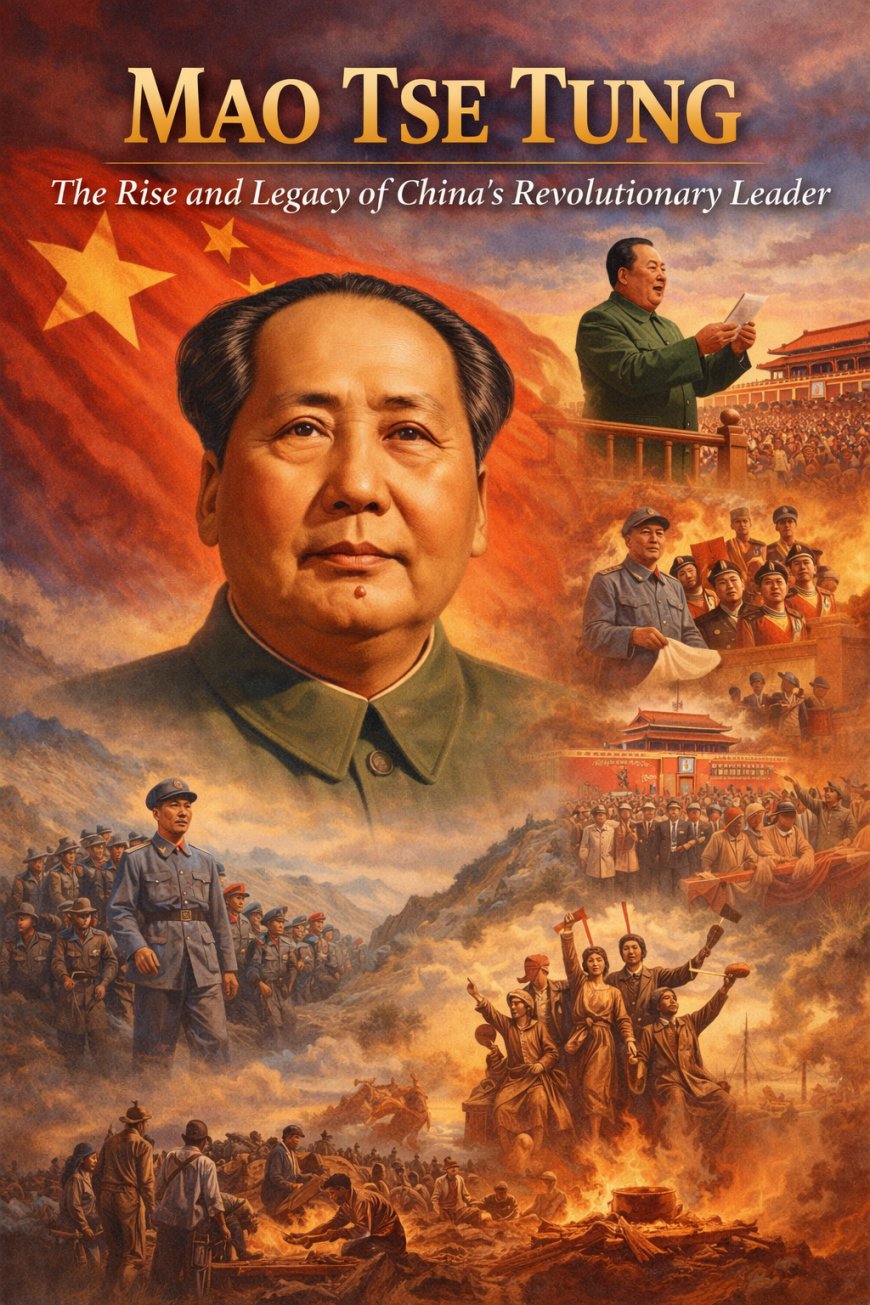
Few political figures of the twentieth century have shaped their nation’s trajectory as profoundly as Mao Tse Tung. In today’s world, where China stands as a major global power, conversations about its political foundations often return to Mao’s revolutionary vision. His image still presides over Tiananmen Square, and his writings continue to influence political thought, both within China and beyond.
Born in 1893 during the waning years of the Qing Dynasty, Mao witnessed the collapse of imperial rule and the turbulence of early republican China. His leadership in the Chinese Communist Revolution transformed a war torn nation into the People’s Republic of China in 1949. Yet his legacy is layered with both sweeping transformation and intense controversy. As scholars and policymakers assess China’s rise, Mao’s ideological framework and governance decisions remain central to understanding the country’s past and present.
Exploring Mao’s life invites readers into a complex narrative of revolution, ideology, social change, and human cost. It is a story that continues to resonate in debates about leadership, development, and historical memory.
Unpacking the Layers of Mao Tse Tung: The Rise and Legacy of China’s Revolutionary Leader
Revolutionary Beginnings and Ideological Foundations
Mao Tse Tung emerged as a key figure within the Chinese Communist Party during a period of fragmentation and foreign intervention. Drawing on Marxist and Leninist principles, he adapted communist theory to China’s largely agrarian society, emphasizing the revolutionary potential of the peasantry rather than the urban working class.
The Long March of 1934 to 1935 became a defining episode in his ascent. This strategic retreat solidified Mao’s leadership within the party and fostered a narrative of resilience that remains embedded in Chinese political culture. The Stanford University Hoover Institution provides digitized documents and analysis that shed light on this formative era.
Founding the People’s Republic of China
On October 1, 1949, Mao proclaimed the establishment of the People's Republic of China. His government launched sweeping reforms, including land redistribution and campaigns aimed at consolidating state power. Mao’s political philosophy, often referred to as Maoism, shaped domestic governance and inspired revolutionary movements abroad.
For further academic perspectives, readers can explore resources from the Harvard University Fairbank Center for Chinese Studies, which examines the political and cultural shifts of modern China.
Navigating the Challenges and Debates
The Great Leap Forward
One of the most debated chapters of Mao’s rule is the Great Leap Forward, initiated in 1958. Intended to rapidly industrialize China and transform its agricultural system, the campaign led to widespread economic disruption and famine. Estimates of the human toll vary, and historians continue to analyze archival materials to better understand the scale and causes of the crisis.
Research published through institutions such as the Columbia University Weatherhead East Asian Institute examines how policy miscalculations, local reporting pressures, and environmental factors intersected during this period. This episode remains central to assessments of Mao’s leadership and governance style.
The Cultural Revolution
Launched in 1966, the Cultural Revolution sought to purge perceived ideological impurities and reinforce socialist values. It mobilized millions of young people, disrupted education and cultural institutions, and reshaped political life. The social and economic consequences were profound, affecting generations.
Debates about the Cultural Revolution are not confined to academic circles. They influence contemporary discussions about historical accountability, collective memory, and political reform. The United States Holocaust Memorial Museum offers comparative studies of mass movements and state driven campaigns, providing broader context for understanding such events.
These challenges underscore the dual nature of Mao’s legacy as both transformative and contentious.
Real World Echoes: Case Studies and Applications
Rural Development and Political Mobilization
Mao’s emphasis on rural mobilization fundamentally altered China’s social structure. Land reforms dismantled traditional hierarchies and redistributed property to peasants. While these efforts aimed to promote equality, they also involved intense political campaigns and social upheaval.
Modern Chinese governance still reflects some organizational principles developed under Mao, including centralized party leadership and mass mobilization strategies. Observers at the Brookings Institution analyze how Mao era institutions laid groundwork for later reforms under Deng Xiaoping.
Global Influence of Maoism
Mao’s writings, particularly the Little Red Book, influenced movements across Asia, Africa, and Latin America. Revolutionary groups adopted elements of Maoist strategy, especially the focus on guerrilla warfare and rural insurgency.
Today, Mao’s portrait remains a symbol of national unity for some and a reminder of turbulent decades for others. Museums, academic programs, and policy debates continue to engage with his impact, reflecting both pride in national sovereignty and reflection on historical suffering.
Conclusion
Mao Tse Tung’s life reflects the dramatic upheavals of twentieth century China. As a revolutionary leader, he reshaped a vast nation and altered the global balance of power. At the same time, the human and economic consequences of his policies remain subjects of serious examination. Understanding Mao requires holding together these multiple threads of ambition, ideology, achievement, and tragedy. His legacy continues to inform conversations about governance, development, and historical accountability. By approaching this complex history with curiosity and openness, readers can better appreciate the enduring influence of one of the modern era’s most consequential leaders.
If you are interested in professional biography writing or historical research services, contact https://biography.com.bd/ for expert assistance.
Q&A Section
1. Why is Mao Tse Tung considered a transformative leader?
Mao led the communist revolution that established the People’s Republic of China in 1949. His policies reshaped land ownership, governance, and China’s global position. The Chinese Communist Party archives provide insights into his ideological contributions.
2. What were the main consequences of the Great Leap Forward?
The Great Leap Forward aimed at rapid industrialization but resulted in widespread famine and economic disruption. Scholars at the Columbia University Weatherhead East Asian Institute continue to study newly available data to understand its full impact.
3. How did the Cultural Revolution affect Chinese society?
It disrupted education, governance, and cultural institutions while mobilizing youth in political campaigns. Its social effects continue to shape generational experiences and national conversations.
4. Where can I learn more about Mao and modern Chinese history?
Consider exploring:
-
Hoover Institution Digital Archives: https://www.hoover.org
-
Fairbank Center for Chinese Studies: https://fairbank.fas.harvard.edu
-
Brookings Institution China Studies: https://www.brookings.edu
These resources provide research based analysis and diverse perspectives.
What's Your Reaction?
 Like
0
Like
0
 Dislike
0
Dislike
0
 Love
0
Love
0
 Funny
0
Funny
0
 Angry
0
Angry
0
 Sad
0
Sad
0
 Wow
0
Wow
0