






























Thomas Alva Edison: A Unique Story from Failure to Success
Discover the inspiring journey of Thomas Alva Edison, from repeated failures to groundbreaking success, and explore how his inventions shaped modern technology and innovation.

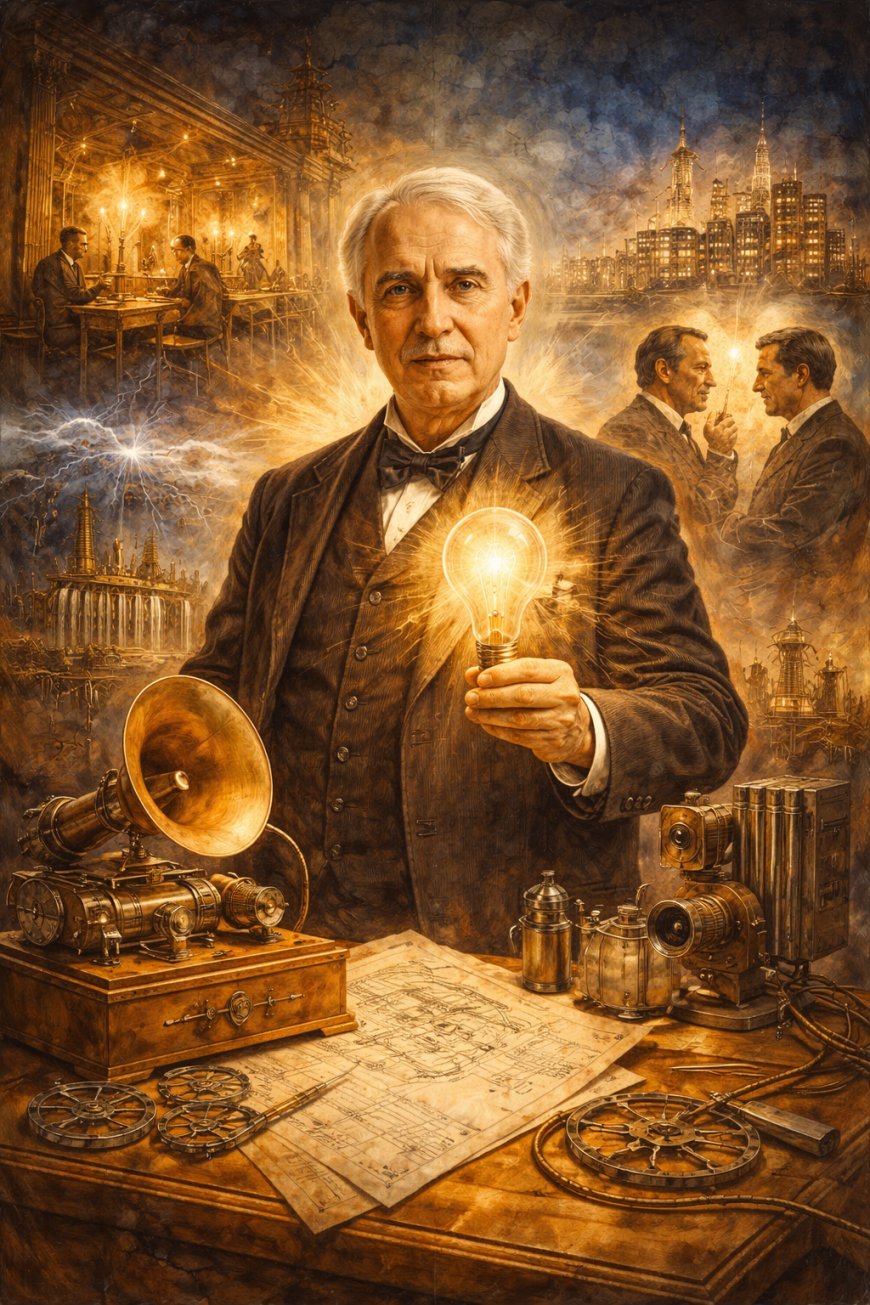
In today’s innovation driven economy, where startups rise and fall at remarkable speed, the story of Thomas Alva Edison feels strikingly relevant. His name is nearly synonymous with invention, perseverance, and the transformative power of persistence. Yet behind the glowing image of the electric light bulb lies a more nuanced narrative filled with experiments that failed, business risks that faltered, and debates that continue to shape how we define success.
Born in 1847 in Ohio, Edison showed curiosity from an early age. Largely self educated, he developed a habit of relentless experimentation. At a time when electricity was still a developing field, Edison envisioned illuminated cities and practical technological systems that could serve everyday life. His laboratory in Menlo Park became a symbol of organized innovation.
In a world that celebrates overnight success, Edison’s journey reminds us that breakthroughs often emerge from repeated setbacks. His life invites us to explore the complex relationship between creativity, commerce, and resilience.
Unpacking the Layers of Thomas Alva Edison
Edison’s reputation rests on more than one invention. With over one thousand patents to his name, his work ranged from telegraph systems to motion picture technology. His development of a practical incandescent light bulb in 1879 revolutionized urban life, allowing factories and homes to operate beyond daylight hours.
However, Edison did not simply invent devices. He refined them, improved existing concepts, and created integrated systems. His phonograph astonished the public by recording and replaying sound, marking one of the earliest milestones in audio technology.
The United States National Park Service provides a detailed overview of his Menlo Park laboratory and innovations:
https://www.nps.gov/edis/index.htm
The Library of Congress also archives primary documents related to his inventions:
https://www.loc.gov/collections/thomas-edison-papers/
Edison famously stated that genius is one percent inspiration and ninety nine percent perspiration. This philosophy shaped his laboratory culture, where teams of researchers worked collectively. His model anticipated modern research and development departments.
Understanding Edison requires balancing admiration for his ingenuity with recognition of the collaborative networks that supported his work.
Navigating the Challenges and Debates
Edison’s career was not free from controversy. The War of Currents placed him in direct competition with Nikola Tesla and George Westinghouse. Edison supported direct current systems, while Tesla promoted alternating current. The rivalry involved public demonstrations and aggressive campaigning.
Critics argue that Edison’s tactics sometimes blurred ethical lines. Public demonstrations highlighting the dangers of alternating current sparked debate about responsible scientific communication. Some historians also question how credit was distributed among his research team members.
At the same time, supporters emphasize Edison’s entrepreneurial skill and his role in building practical infrastructure for electric lighting. These debates continue to shape conversations about intellectual property, teamwork, and the commercialization of innovation.
They also raise an important question. How do we fairly evaluate historical figures whose achievements coexist with controversial strategies? Edison’s story illustrates the complex interplay between vision, business strategy, and ethical responsibility.
Real World Echoes: Case Studies and Applications
Edison’s influence remains deeply embedded in modern life. Urban skylines illuminated at night are a direct descendant of his electric lighting systems. His early work in motion pictures laid groundwork for the global film industry.
Research and development departments in technology companies reflect Edison’s Menlo Park model. Structured experimentation, prototyping, and commercialization have become hallmarks of modern innovation.
Electric power distribution systems, though now largely based on alternating current, still operate within a framework shaped by early pioneers like Edison and his contemporaries. The evolution of these systems demonstrates how scientific rivalry can drive progress.
Edison’s journey from repeated failures to impactful success serves as a case study in resilience. It reminds entrepreneurs and students alike that setbacks often precede breakthroughs.
Conclusion
Thomas Alva Edison’s life story weaves together invention, perseverance, and debate. His achievements transformed communication, entertainment, and urban infrastructure. Yet his legacy is also layered with ethical questions and competitive rivalries.
By examining both his triumphs and challenges, we gain a richer understanding of how innovation unfolds. Edison’s narrative encourages persistence while reminding us to consider the broader social impact of technological progress.
To discover more inspiring biographies or seek professional biography writing services, connect with https://biography.com.bd/ and continue exploring the lives that shaped our world.
Q and A Section
1. What is Thomas Edison best known for?
Edison is best known for developing a practical incandescent light bulb and establishing electric lighting systems. He also invented the phonograph and contributed to motion picture technology.
2. Did Edison invent electricity?
No. Electricity was studied long before Edison’s time. His contribution was in creating practical systems that made electric lighting widely usable and commercially viable.
3. What was the War of Currents?
The War of Currents was a competition between direct current systems supported by Edison and alternating current systems promoted by Tesla and Westinghouse. It shaped the early development of electric power distribution.
4. Why is Edison considered a symbol of perseverance?
Edison conducted thousands of experiments before achieving success with the light bulb. His willingness to learn from failure became central to his public image and inspirational legacy.
For further reading:
https://www.nps.gov/edis/index.htm
What's Your Reaction?
 Like
0
Like
0
 Dislike
0
Dislike
0
 Love
0
Love
0
 Funny
0
Funny
0
 Angry
0
Angry
0
 Sad
0
Sad
0
 Wow
0
Wow
0