




























Pablo Picasso: Revolutionary of Modern Art
Explore how Pablo Picasso revolutionized modern art through Cubism, political expression, and bold experimentation. Discover his legacy, controversies, and lasting global impact.

Walk into any major museum of modern art and the influence of Pablo Picasso is impossible to ignore. His fractured faces, bold forms, and restless experimentation continue to challenge viewers more than a century after they first appeared. In today’s visual culture, where images are filtered, reshaped, and reimagined daily, Picasso feels strikingly contemporary.
Born in 1881 in Málaga, Spain, Picasso lived through wars, revolutions, and seismic shifts in politics and culture. Across his long career, he moved through distinct artistic periods, constantly reinventing himself. From the melancholy tones of his Blue Period to the radical fragmentation of Cubism, Picasso did not merely respond to modernity. He helped define it.
Yet his legacy is layered and complex. He is celebrated as a pioneer who shattered artistic conventions. At the same time, debates about his personal life and ethical choices have prompted renewed scrutiny. Picasso remains a figure who inspires admiration, discomfort, and curiosity in equal measure. In a world still grappling with innovation, identity, and responsibility, his story invites deeper reflection.
Unpacking the Layers of Pablo Picasso: Revolutionary of Modern Art
To understand Picasso’s revolutionary status, it helps to explore the multiple dimensions of his career.
1. The Birth of Cubism
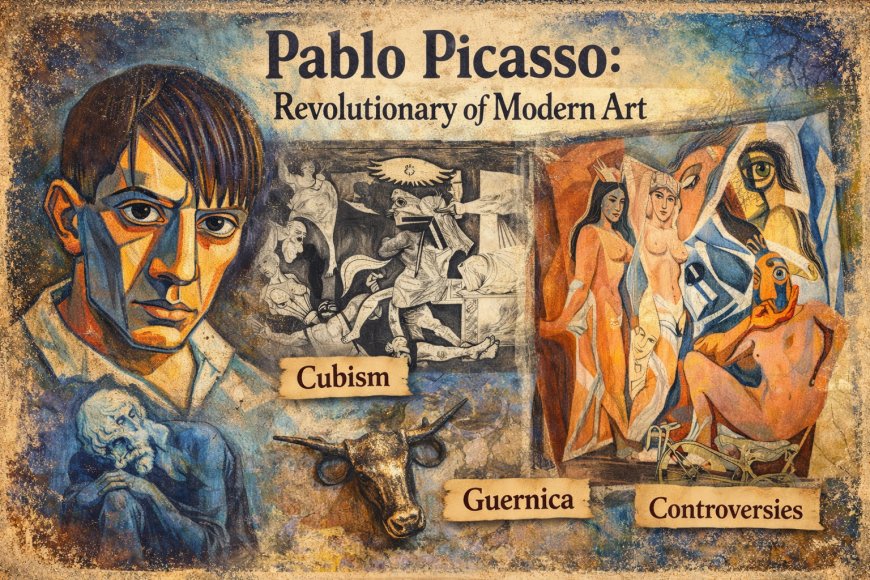
Perhaps Picasso’s most lasting contribution is the development of Cubism alongside Georges Braque. Works such as Les Demoiselles d’Avignon shattered traditional perspective by presenting multiple viewpoints simultaneously. This radical approach transformed how artists thought about space and representation.
The Museum of Modern Art offers further insights into Cubism and Picasso’s early experiments at https://www.moma.org.
2. Political Voice Through Art
Picasso’s monumental painting Guernica stands as one of the most powerful anti war artworks ever created. Inspired by the bombing of a Spanish town during the Spanish Civil War, it confronts viewers with anguish and chaos. Today, Guernica is housed at the Museo Reina Sofía in Madrid. The museum provides extensive background at https://www.museoreinasofia.es.
3. Endless Reinvention
Picasso’s career includes:
-
The Blue Period, marked by somber tones and themes of poverty
-
The Rose Period, featuring warmer hues and circus performers
-
Surrealist influences
-
Sculpture, ceramics, and printmaking
The Metropolitan Museum of Art provides a comprehensive overview of his artistic evolution at https://www.metmuseum.org.
Picasso was not confined to one style. His willingness to disrupt his own success is a key reason he remains central to conversations about innovation.
Navigating the Challenges and Debates
Picasso’s influence is undeniable, but so are the controversies surrounding him.
One ongoing debate concerns cultural appropriation. Scholars have noted the influence of African masks and non Western art on early Cubism. Critics argue that European modernists often borrowed from colonized cultures without acknowledgment or proper context. Others counter that cross cultural exchange has always shaped artistic progress. These discussions are essential in reassessing how art history is written and taught.
Another major conversation revolves around Picasso’s personal relationships. Biographers and historians have documented turbulent dynamics with several women in his life. Contemporary critics question whether institutions should separate artistic achievement from personal conduct. Museums now grapple with how to present such legacies transparently.
There are also disputes about authenticity and market value. Picasso remains one of the most traded artists in the global art market. As prices soar, so does the incentive for forgery. Institutions and researchers must constantly authenticate works and maintain scholarly rigor.
These debates matter because they reflect broader societal shifts. Questions about accountability, cultural respect, and institutional responsibility extend far beyond the art world. Picasso’s life offers a lens through which we examine how we celebrate creative genius in the modern era.
Real-world Echoes: Case Studies and Applications
Picasso’s revolutionary impact extends into education, design, and public culture.
A compelling case study is the global educational use of Cubism to teach visual literacy. Art programs often ask students to create self portraits inspired by Cubist techniques. By breaking subjects into geometric shapes and multiple perspectives, students learn to question singular viewpoints. This approach aligns with contemporary discussions about diversity of perspective in media and communication.
In the design world, Picasso’s fragmentation techniques have influenced architecture, graphic design, and fashion. Brands frequently reference Cubist aesthetics in campaigns, demonstrating how avant garde art movements become mainstream visual language over time.
Major exhibitions continue to draw record crowds. Retrospectives at institutions such as the Museum of Modern Art and the Museo Reina Sofía show that public interest remains strong. These exhibitions often pair masterpieces with contextual information that addresses both artistic innovation and personal controversy, offering a more holistic perspective.
Picasso’s story also informs entrepreneurial thinking. His relentless productivity and brand building illustrate how creative identity can evolve while retaining core vision. Yet his life equally reminds us that success does not exempt one from ethical examination.
Conclusion: A Legacy Still in Motion
Pablo Picasso redefined the boundaries of art and left an imprint that continues to shape modern visual culture. From Cubism to political expression, his work challenges viewers to reconsider how reality can be represented. At the same time, contemporary debates surrounding cultural influence and personal conduct add necessary complexity to his legacy.
Picasso’s story is not static. It evolves as new generations reinterpret his contributions and confront difficult questions. By engaging with both his brilliance and his controversies, we gain a richer understanding of modern art and our own cultural values.
To explore more compelling biographies or to create a professionally crafted life story, contact https://biography.com.bd/ and discover how powerful narratives can be brought to life.
Q and A Section
1. Why is Pablo Picasso considered a revolutionary artist?
Picasso co founded Cubism, which fundamentally changed how space and form are represented in art. By rejecting traditional perspective, he opened new pathways for modern and contemporary artists. The Museum of Modern Art provides further exploration at https://www.moma.org.
2. What is the significance of Guernica?
Guernica is a large scale anti war painting responding to the bombing of a Spanish town during the Spanish Civil War. It remains a symbol of artistic protest and political expression. Learn more at https://www.museoreinasofia.es.
3. How do critics view Picasso today?
While widely celebrated for innovation, Picasso is also examined critically for cultural borrowing and personal relationships. Museums increasingly provide balanced narratives that address both artistic achievement and historical context.
4. Where can I see Picasso’s work?
Major collections are housed at institutions such as the Metropolitan Museum of Art, the Museum of Modern Art in New York, and the Museo Reina Sofía in Madrid. Many offer digital archives online for virtual exploration.
What's Your Reaction?
 Like
0
Like
0
 Dislike
0
Dislike
0
 Love
0
Love
0
 Funny
0
Funny
0
 Angry
0
Angry
0
 Sad
0
Sad
0
 Wow
0
Wow
0