




































Julius Caesar: Rome's Empire in the Game of Power
Explore Julius Caesar’s rise, reforms, assassination, and lasting legacy. Discover how Rome’s empire evolved through power, politics, and controversy.

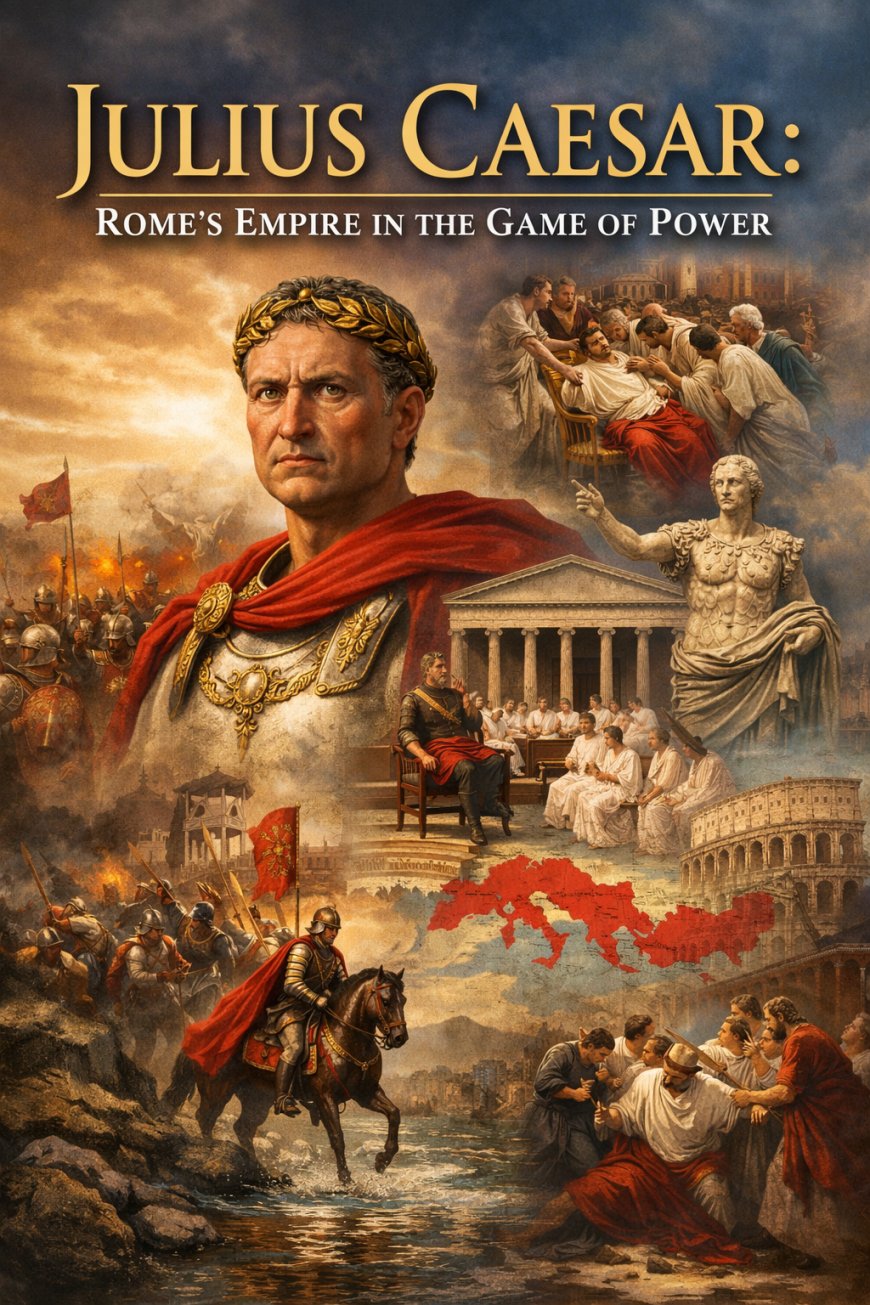
Few names from the ancient world resonate as strongly today as Julius Caesar. His life bridges the gap between republic and empire, between idealism and ambition, and between public duty and personal power. In boardrooms, political arenas, and popular culture, the phrase "crossing the Rubicon" still echoes, reminding us that decisions made in moments of tension can reshape history.
In the first century BCE, Rome stood at a crossroads. Its Republic had grown powerful through conquest, yet internal divisions threatened to unravel its institutions. Into this charged atmosphere stepped a charismatic general and astute politician who would alter the course of Western civilization. The story of Julius Caesar is not simply about military triumph. It is about strategy, loyalty, propaganda, reform, and ultimately, vulnerability.
Today, historians continue to debate whether Caesar was a visionary reformer or an ambitious autocrat. His legacy sits at the heart of discussions about leadership, democracy, populism, and state power. As modern societies grapple with similar tensions, Caesar’s life remains a compelling case study in the complex game of power.
Unpacking the Layers of Julius Caesar: Rome's Empire in the Game of Power
Political Strategist and Military Commander
Born in 100 BCE, Julius Caesar rose through Rome’s competitive political ranks with careful alliances and bold campaigns. His partnership with Pompey and Marcus Licinius Crassus formed the First Triumvirate, a strategic pact that consolidated influence in an unstable Senate.
Caesar’s conquest of Gaul expanded Rome’s territory dramatically and elevated his personal popularity. His own account, Commentarii de Bello Gallico, provides insight into both his military brilliance and his mastery of narrative. For deeper exploration, resources such as the Encyclopaedia Britannica offer extensive analysis:
https://www.britannica.com/biography/Julius-Caesar
Reform and Power Consolidation
After crossing the Rubicon River in 49 BCE, Caesar effectively declared civil war against the Republic. Following his victory, he implemented reforms addressing debt, land redistribution, and calendar standardization. The Julian calendar became one of his most enduring contributions.
His appointment as dictator perpetuo raised profound constitutional questions. Was he stabilizing a broken system or dismantling centuries of republican governance? Academic discussions, such as those found through the Perseus Digital Library at Tufts University, shed light on this debate:
http://www.perseus.tufts.edu/
Navigating the Challenges and Debates
Republic versus Autocracy
The central controversy surrounding Caesar’s legacy concerns the fate of the Roman Republic. Critics argued that his accumulation of offices undermined checks and balances. His image appeared on coins, an unprecedented move that suggested monarchical ambition. Scholars frequently debate whether his assassination on the Ides of March was an act of tyranny prevention or political miscalculation. The Stanford Encyclopedia of Philosophy explores classical republicanism in depth:
https://plato.stanford.edu/entries/republicanism/
Ethical and Political Implications
The conspirators, including Brutus, believed they were safeguarding liberty. Yet the assassination triggered further civil wars, ultimately leading to the rise of Augustus and the formal establishment of the Roman Empire.
Modern historians examine this period not as a simple clash between good and evil, but as a convergence of systemic weakness, elite rivalry, and popular unrest. The ethical dilemma persists. When institutions falter, does concentrated leadership restore order or erode freedom? Caesar’s story highlights how fragile political systems can be when ambition intersects with instability.
Real-world Echoes: Case Studies and Applications
Cultural Legacy and Leadership Lessons
Caesar’s legacy extends far beyond ancient Rome. William Shakespeare’s play Julius Caesar transformed the assassination into a timeless exploration of loyalty and betrayal. Political theorists reference Caesar when analyzing executive power, while leadership scholars examine his communication skills and adaptability.
In governance studies, Caesar’s career serves as a case study in:
-
Coalition building and strategic alliances
-
Military leadership and morale management
-
Public image control and narrative shaping
-
Institutional reform under crisis conditions
Modern leadership programs often compare historical figures like Caesar to contemporary executives or political leaders. His rise illustrates how charisma and competence can unify a divided population, while his downfall underscores the risks of perceived overreach.
Educational institutions such as Harvard’s Center for the Ancient Mediterranean provide interdisciplinary research connecting Roman history to modern governance frameworks:
https://camd.fas.harvard.edu/
The complexity of Caesar’s trajectory invites ongoing inquiry. His success was undeniable, yet his consolidation of power produced lasting structural change, some intended, others unforeseen.
Conclusion: The Enduring Puzzle of Power
Julius Caesar’s story is not a relic of distant antiquity. It is a living dialogue about authority, reform, loyalty, and the limits of ambition. His life reflects the tension between personal vision and institutional stability, between public good and private influence.
As we revisit the fall of the Roman Republic and the birth of empire, we are reminded that history rarely offers simple lessons. Caesar’s legacy continues to evolve through scholarship, cultural reinterpretation, and political reflection. The true value of examining his life lies not in choosing sides, but in understanding complexity.
To explore more insightful biographies and in-depth historical analysis, connect with https://biography.com.bd/ for professional services and curated content that brings history to life.
Q&A Section
1. Was Julius Caesar responsible for ending the Roman Republic?
Caesar played a significant role in accelerating the Republic’s collapse. However, many historians argue that systemic weaknesses, economic inequality, and prolonged civil wars had already destabilized Rome. His actions intensified these dynamics rather than creating them alone. For balanced historical analysis, Britannica offers detailed perspectives:
https://www.britannica.com/event/Roman-Republic
2. Why was Julius Caesar assassinated?
Members of the Senate feared he aimed to become king, a title deeply unpopular in Rome. They believed removing him would restore republican governance. Instead, his death led to further instability and paved the way for imperial rule under Augustus.
3. What were Caesar’s most lasting contributions?
Among his enduring reforms were the Julian calendar, debt relief initiatives, and administrative restructuring of provincial governance. His influence also shaped Roman law, military organization, and political communication.
4. Why does Julius Caesar remain relevant today?
Caesar’s life illustrates the delicate balance between leadership and liberty. His story informs modern debates about executive authority, populism, and constitutional resilience. Academic archives such as the Perseus Digital Library provide access to primary sources for deeper study:
http://www.perseus.tufts.edu/
What's Your Reaction?
 Like
0
Like
0
 Dislike
0
Dislike
0
 Love
0
Love
0
 Funny
0
Funny
0
 Angry
0
Angry
0
 Sad
0
Sad
0
 Wow
0
Wow
0