Inventor · United States
Thomas Edison
Thomas Edison was an American inventor, scientist, and businessman best known for developing the practical incandescent electric light bulb, the phonograph, and early motion-picture technology. He held more than 1,000 patents in the United States and became one of the most influential inventors of the modern industrial age.
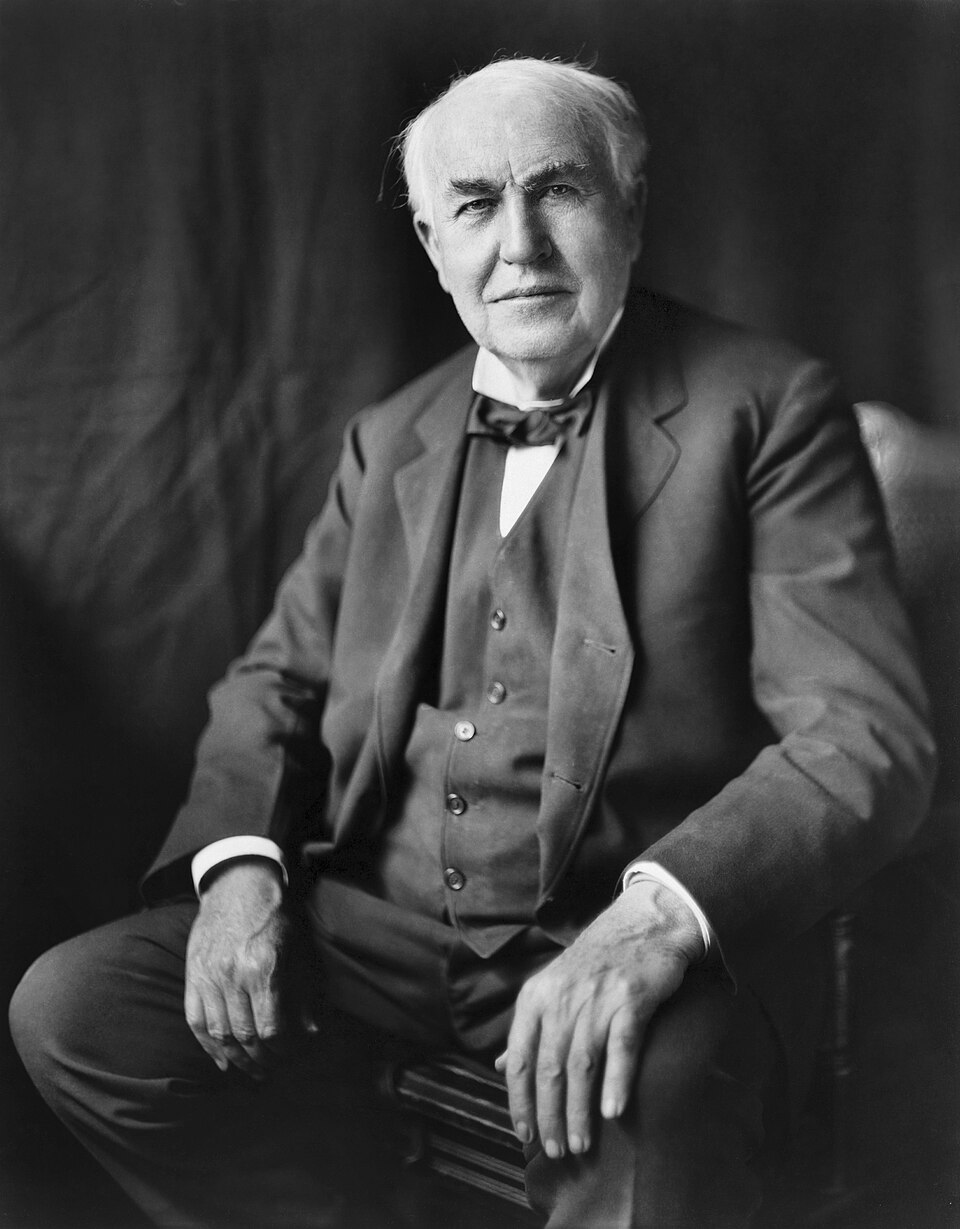 Wikimedia Commons
Thomas Edison: Full Biography
Biography
1. Introduction
Thomas Alva Edison (February 11, 1847 – October 18, 1931) was an American inventor, scientist, and entrepreneur whose inventions helped transform everyday life. Widely recognized for his contributions to electric lighting, sound recording, and motion pictures, Edison became one of the most prominent inventors in history.
He was known for his practical approach to invention and his ability to turn scientific ideas into commercially useful technologies. His work helped shape modern electricity systems, entertainment, and communication.
2. Early Life and Family Background
Thomas Edison was born on February 11, 1847, in Milan, Ohio, United States. He was the youngest of seven children of Samuel Ogden Edison Jr. and Nancy Matthews Elliott.
When he was young, his family moved to Port Huron, Michigan. Edison showed curiosity about science and technology from an early age. He enjoyed conducting experiments and learning how things worked.
Edison attended school for only a short time. His mother, who had worked as a teacher, took responsibility for much of his early education. He later developed a strong habit of independent reading and experimentation.
3. Education and Early Career
Edison had little formal schooling, but he was an enthusiastic self-learner. As a teenager, he worked as a newspaper seller and candy seller on trains.
He also began experimenting with chemistry and electrical equipment. His experience working on the railway gave him opportunities to explore telegraph technology.
Edison eventually became a telegraph operator. This work introduced him to electrical communication systems and helped him develop the technical knowledge that influenced his later inventions.
4. Beginning of His Inventing Career
Edison began his professional inventing career by developing improvements to telegraph systems. In 1869, he received a patent for an electric vote recorder.
He later worked on stock tickers, telegraph equipment, and other communication technologies. These inventions helped establish his reputation as a practical inventor.
In 1876, Edison established a research laboratory in Menlo Park, New Jersey. The facility became famous for its organized approach to invention and experimentation.
5. Major Inventions and Achievements
The Phonograph
In 1877, Edison invented the phonograph, one of his most remarkable early achievements. It was the first device capable of recording and reproducing sound.
The invention attracted international attention and earned Edison the nickname "The Wizard of Menlo Park."
The Practical Incandescent Light Bulb
Edison is widely associated with the development of the practical incandescent electric light bulb. Although other inventors had developed earlier forms of electric lighting, Edison and his team improved the technology and developed a commercially practical lighting system.
In 1879, Edison demonstrated a successful incandescent lamp that could operate for an extended period. His work also involved electricity distribution systems that made electric lighting more useful in homes and businesses.
Electric Power Distribution
Edison played an important role in developing early electric power systems. In 1882, his Pearl Street Station in New York City began supplying electricity to customers.
This project helped demonstrate how centralized electricity generation and distribution could support urban lighting.
Motion-Picture Technology
Edison and his research team contributed significantly to the development of early motion-picture technology.
The Kinetograph was an early motion-picture camera, while the Kinetoscope allowed individuals to view moving images through a viewing device.
These inventions helped establish the foundations of the motion-picture industry.
Improvements to Communication Technology
Edison also worked on telegraph and telephone technology. His carbon-button transmitter improved telephone performance and contributed to the development of more effective voice communication.
6. Business Ventures and Companies
Edison was not only an inventor but also a successful businessman. He established laboratories and companies to develop, manufacture, and commercialize his inventions.
His electric-lighting businesses eventually became part of the larger corporate developments that contributed to the formation of General Electric in 1892.
Did you know?
**Did You Know?** - Thomas Edison received more than 1,000 U.S. patents during his lifetime. - He invented the phonograph in 1877, which could record and reproduce sound. - His Menlo Park laboratory became famous as an early organized industrial research facility. - Edison was nicknamed "The Wizard of Menlo Park." - His work on electric lighting included developing systems for generating and distributing electricity.