Scientist · Old Swiss Confederacy
Leonhard Euler
**Leonhard Euler** (1707–1783) was a Swiss mathematician, physicist, and astronomer widely regarded as one of the most influential mathematicians in history. He made groundbreaking contributions to calculus, number theory, geometry, mechanics, graph theory, and mathematical notation. Euler introduced or popularized several symbols still used in mathematics today, including \(f(x)\), \(e\), and the notation for the imaginary unit. His extensive research and publications helped shape modern mathematics and physics.
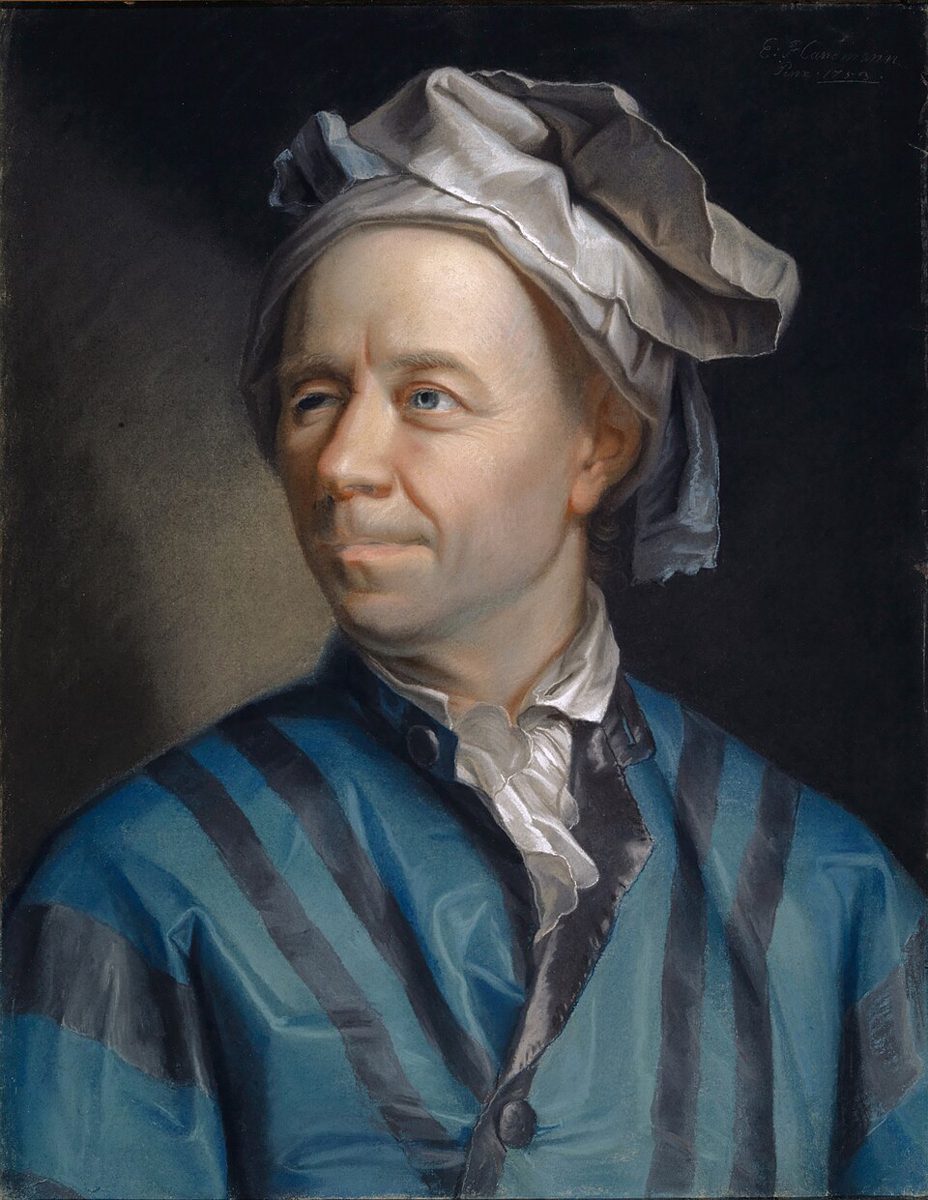 Wikimedia Commons
Leonhard Euler: Biography, Mathematical Discoveries, and Legacy
Biography
1. Introduction
Leonhard Euler was a Swiss mathematician, physicist, and astronomer whose discoveries transformed mathematics and its applications to science and engineering.
He is considered one of the most productive mathematicians in history. His work covered an extraordinary range of subjects, including calculus, algebra, number theory, geometry, mechanics, astronomy, and mathematical physics.
Euler also helped establish much of the mathematical notation used today. His research and textbooks influenced generations of mathematicians and contributed to the development of modern scientific disciplines.
2. Early Life and Family Background
Leonhard Euler was born on April 15, 1707, in Basel, Switzerland.
His father, Paul Euler, was a Protestant minister who had studied mathematics under the Swiss mathematician Jacob Bernoulli. His mother, Marguerite Brucker, came from a family with an academic background.
Euler spent much of his childhood in the nearby town of Riehen, where his father served as a pastor.
His father recognized his mathematical ability and encouraged his education. Euler developed a strong interest in mathematics at an early age and demonstrated exceptional talent for solving mathematical problems.
3. Education and Academic Training
Euler enrolled at the University of Basel in 1720 when he was only 13 years old.
Although his father initially hoped he would become a minister, Euler's interest in mathematics became increasingly clear.
He received private mathematical instruction from Johann Bernoulli, one of the leading mathematicians of the period. Bernoulli recognized Euler's exceptional abilities and encouraged him to pursue advanced mathematical research.
Euler earned his master's degree in philosophy in 1723. He continued studying mathematics and scientific subjects while developing the foundations of his future career.
4. Early Scientific Career in Saint Petersburg
In 1727, Euler accepted a position at the Saint Petersburg Academy of Sciences in Russia.
The academy had been established by Peter the Great to promote scientific research and education.
Euler initially worked in the medical and physical sciences sections before moving into mathematics.
His early research included work on mechanics, astronomy, differential equations, and mathematical analysis.
He quickly became one of the academy's leading researchers and developed an international reputation for his mathematical abilities.
5. Contributions to Calculus and Mathematical Analysis
Euler made major contributions to calculus and mathematical analysis.
He expanded the techniques of differential and integral calculus and applied them to problems in mechanics, astronomy, and geometry.
His book Introductio in analysin infinitorum, published in 1748, became one of the most influential mathematical texts of the eighteenth century.
Euler helped develop the systematic use of functions and mathematical expressions. His work made mathematical analysis more organized and accessible to future researchers.
He also contributed to the development of infinite series and the study of exponential and logarithmic functions.
6. Euler's Number and Mathematical Notation
Euler introduced or popularized several mathematical symbols that remain widely used.
Some important examples include:
- e: The base of the natural logarithm, now known as Euler's number.
- f(x): A notation for representing a function.
- i: The imaginary unit, defined by the property (i^2=-1).
- π: Euler helped popularize the use of the Greek letter pi for the ratio of a circle's circumference to its diameter.
- Σ: He helped establish the use of this symbol for summation.
His influence on mathematical notation helped create a more consistent language for expressing complex ideas.
7. Euler's Formula and Identity
One of Euler's most famous contributions is Euler's formula, which connects exponential functions with trigonometric functions:
[
e^{ix}=\cos x+i\sin x
]
A particularly famous result follows when (x=\pi):
[
e^{i\pi}+1=0
]
This equation is known as Euler's identity. It connects five fundamental mathematical constants and operations in a single elegant expression.
It is widely celebrated for demonstrating the deep relationships between different areas of mathematics.
8. Contributions to Number Theory
Euler made important contributions to number theory, the branch of mathematics concerned with integers and their properties.
He expanded the study of prime numbers, divisibility, and mathematical sequences.
One of his important results is Euler's theorem, which generalizes Fermat's little theorem.
He also introduced the totient function, often written as (\varphi(n)), which counts the positive integers up to a given number that are relatively prime to it.
His work helped establish number theory as a major area of mathematical research and influenced later mathematicians.
9. Contributions to Geometry and Graph Theory
Euler also made lasting contributions to geometry and topology.
In 1736, he published a solution to the famous Seven Bridges of Königsberg problem.
The problem asked whether it was possible to cross each of the seven bridges of Königsberg exactly once in a single walk.
Euler demonstrated that such a route was impossible under the conditions of the problem.
His analysis introduced a new way of studying connections and paths between locations. It is widely considered one of the starting points of graph theory.
Euler also developed important relationships between the numbers of vertices, edges, and faces in certain polyhedra.
10. Work in Physics and Astronomy
Euler applied mathematics to many problems in physics and astronomy.
His research included:
- The motion of rigid bodies.
- Fluid mechanics.
- Planetary motion.
- The movement of celestial objects.
- The mathematical description of rotating systems.
- The behavior of vibrating strings.
His equations of motion and contributions to fluid dynamics became important foundations for classical mechanics and engineering.
He also worked on problems involving the motion of ships, the design of machines, and the calculation of astronomical orbits.
11. Years in Berlin
In 1741, Euler accepted an invitation from Frederick the Great of Prussia to join the Berlin Academy of Sciences.
He spent approximately 25 years in Berlin, where he conducted extensive research and published many influential works.
During this period, he wrote important books on mathematical analysis, mechanics, astronomy, and physics.
Although he had a productive career in Berlin, his relationship with Frederick the Great became less comfortable over time.
In 1766, Euler returned to Saint Petersburg at the invitation of Catherine the Great.
12. Personal Life
Euler married Katharina Gsell in 1734. They had 13 children, although several died during childhood.
His family life was important to him, and he continued working despite personal difficulties and health problems.
Euler was deeply religious and maintained an interest in theology alongside his scientific research.
He was also known for his remarkable memory and ability to perform complicated mathematical calculations mentally.
13. Blindness and Continued Research
Euler experienced serious vision problems throughout his life.
He lost sight in his right eye during his early career, and his vision deteriorated further in later years.
By approximately 1771, he was completely blind.
Despite this condition, Euler continued his mathematical work with the help of assistants, family members, and students who wrote down his calculations and dictated material.
His ability to continue producing important research after losing his sight remains one of the most remarkable aspects of his life.
14. Death
Leonhard Euler died on September 18, 1783, in Saint Petersburg, Russian Empire, at the age of 76.
He reportedly suffered a brain haemorrhage while spending time with his family.
At the time of his death, he was still actively involved in mathematical thinking and discussion.
His passing was widely regarded as a major loss to the international scientific community.
15. Major Publications and Achievements
Euler produced an enormous body of mathematical and scientific work.
Some of his major publications include:
- Introductio in analysin infinitorum (1748): A major work on mathematical analysis and functions.
- Institutiones calculi differentialis (1755): A systematic treatment of differential calculus.
- Institutiones calculi integralis (1768–1770): A major work on integral calculus.
- Mechanica (1736): An influential mathematical treatment of mechanics.
- Letters to a German Princess (1768–1772): A collection of scientific and philosophical explanations written for a young German princess.
His publications helped make advanced mathematical knowledge more systematic and accessible.
16. Legacy and Historical Importance
Leonhard Euler's influence can be seen across mathematics, physics, engineering, and computer science.
His most important contributions include:
- Advancing calculus and mathematical analysis.
- Developing important results in number theory.
- Establishing widely used mathematical notation.
- Formulating Euler's formula and Euler's identity.
- Helping establish graph theory through the Seven Bridges of Königsberg problem.
- Developing mathematical approaches to mechanics and fluid dynamics.
- Producing influential textbooks and scientific publications.
Many mathematical concepts, equations, functions, and theorems are named after him.
His work remains essential to university-level mathematics and continues to influence scientific and technological research.
17. Conclusion
Leonhard Euler was one of the most productive and influential mathematicians in history. His contributions transformed mathematical analysis, number theory, geometry, mechanics, and many other fields.
His ability to continue researching despite severe visual impairment demonstrated extraordinary dedication to science.
Through his discoveries, publications, and mathematical notation, Euler helped establish the foundations of modern mathematics. His legacy remains visible in scientific research, education, engineering, and technology around the world.
Did you know?
**Did You Know?** 1. Leonhard Euler entered the University of Basel at just 13 years old. 2. He received private mathematics lessons from the famous mathematician Johann Bernoulli. 3. Euler's identity, \(e^{i\pi}+1=0\), connects five fundamental mathematical constants. 4. He helped establish graph theory through his solution to the Seven Bridges of Königsberg problem. 5. Euler lost the sight in his right eye early in his career and became completely blind later in life. 6. Despite blindness, he continued producing important mathematical research with assistance. 7. He had 13 children with his first wife, Katharina Gsell. 8. Many mathematical concepts, including Euler's number, Euler's formula, and Euler's theorem, are named after him.