Scientist · Kingdom of England
Francis Bacon
**Francis Bacon** (1561–1626) was an English philosopher, statesman, scientist, and writer who played a major role in the development of modern scientific thought. He is best known for promoting the empirical method, emphasizing observation, experimentation, and systematic investigation as foundations of knowledge. His influential works, including *Novum Organum* and *The Advancement of Learning*, helped shape the development of modern philosophy and scientific methodology. He also served as Lord Chancellor of England under King James I.
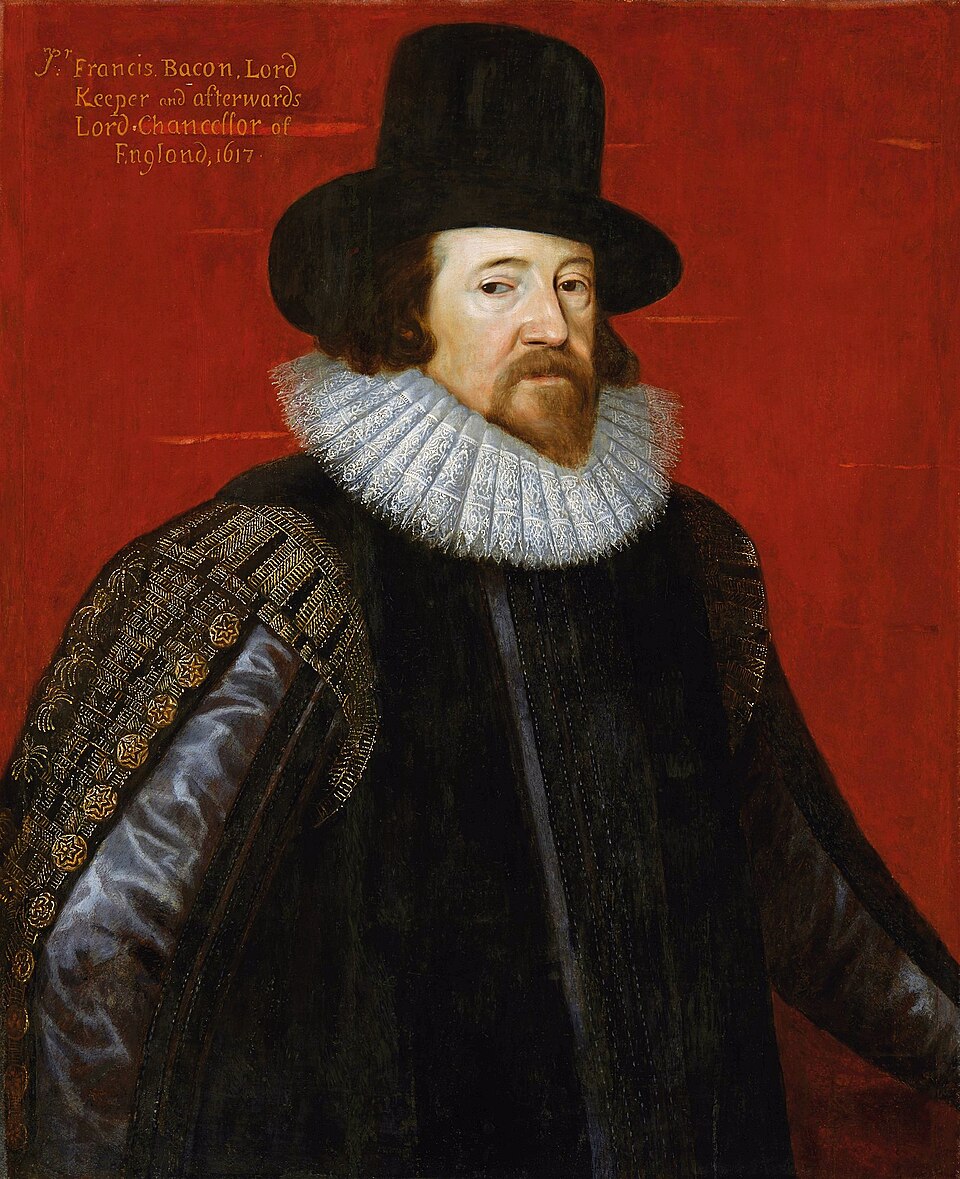 Wikimedia Commons
Francis Bacon: Biography, Philosophical Ideas, and Scientific Legacy
Biography
1. Introduction
Francis Bacon was an English philosopher, statesman, essayist, and intellectual whose ideas helped transform the way people approached the study of nature and the pursuit of knowledge.
He is widely associated with the development of modern empiricism and the scientific method. Bacon argued that reliable knowledge should be built through observation, experimentation, evidence, and careful reasoning rather than relying entirely on traditional authorities or abstract speculation.
Alongside his philosophical work, he pursued a successful political career and held several important government positions during the reign of King James I.
2. Early Life and Family Background
Francis Bacon was born on January 22, 1561, in London, England.
His father, Sir Nicholas Bacon, was Lord Keeper of the Great Seal under Queen Elizabeth I. His mother, Anne Cooke Bacon, was a well-educated woman known for her interest in theology and classical languages.
Bacon grew up in a politically influential and intellectually active family. His father's position introduced him to the world of government and public affairs, while his mother's education helped encourage his interest in learning.
These early influences contributed to his later ambitions in philosophy, politics, and public service.
3. Education and Academic Training
Bacon entered Trinity College, Cambridge, in 1573, when he was 12 years old. He studied there with his older brother Anthony.
He later entered Gray's Inn in London to study law. During his education, Bacon became critical of traditional academic methods, particularly the reliance on ancient authorities without sufficient examination through observation and experience.
His dissatisfaction with conventional approaches to knowledge helped shape his later arguments for a more systematic and evidence-based study of nature.
4. Early Political Career
Bacon began his political career during the reign of Queen Elizabeth I.
He entered Parliament in 1584 and served in the House of Commons for several years. He also worked as a lawyer and developed connections with influential political figures.
Although he sought high government office, his progress was sometimes limited by political disagreements and his relationship with powerful court figures.
His political ambitions eventually advanced significantly after James I became king in 1603.
5. Contributions to Philosophy and Scientific Method
Francis Bacon is particularly famous for promoting a systematic approach to scientific investigation.
He argued that knowledge should be developed through careful observation, controlled experiments, and the collection of evidence.
Bacon criticized the tendency to accept established beliefs without testing them. He believed that researchers should examine nature directly and gradually develop general principles from particular observations.
This approach is commonly associated with inductive reasoning: moving from specific observations toward broader conclusions.
Although Bacon did not invent experimental science or establish every element of the modern scientific method, his writings helped promote a more organized and evidence-based approach to research.
6. The Four Idols of the Mind
One of Bacon's important philosophical contributions was his discussion of the four idols, which he believed could distort human understanding.
He described them in Novum Organum:
- Idols of the Tribe: Errors arising from common human tendencies, including the tendency to see patterns where none exist.
- Idols of the Cave: Individual biases shaped by personal experiences, education, and habits.
- Idols of the Marketplace: Confusion caused by language, words, and careless communication.
- Idols of the Theatre: Errors resulting from unquestioned philosophical systems and established intellectual traditions.
Bacon argued that recognizing these sources of bias was necessary for developing reliable knowledge.
7. Major Philosophical Works
Bacon produced several influential works that helped communicate his ideas about knowledge, science, and human understanding.
Novum Organum (1620)
This work presented his proposed approach to scientific investigation. It challenged the traditional Aristotelian methods of reasoning and emphasized systematic observation and induction.
The Advancement of Learning (1605)
In this book, Bacon examined the state of human knowledge and argued for the expansion and organization of intellectual study.
De Augmentis Scientiarum (1623)
This expanded Latin work developed ideas from The Advancement of Learning and discussed the classification and progress of knowledge.
Essays (1597, expanded editions later)
Bacon's essays covered topics such as friendship, ambition, studies, truth, and human behavior. They remain among his best-known literary works.
New Atlantis (published posthumously in 1627)
This unfinished philosophical work described an imaginary society organized around scientific investigation and the advancement of knowledge.
8. Political Achievements and Government Positions
Bacon's political career reached its height during the reign of King James I.
He received several important appointments, including:
- Solicitor General in 1607.
- Attorney General in 1613.
- Lord Keeper of the Great Seal in 1617.
- Lord Chancellor in 1618.
In 1618, he was also granted the title Baron Verulam, and in 1621 he became Viscount St Alban.
As Lord Chancellor, he occupied one of the highest legal and political offices in England.
9. Downfall and Corruption Scandal
Bacon's political career ended abruptly in 1621.
He was accused of accepting gifts from people involved in legal cases before him. He admitted receiving gifts but argued that they had not influenced his
Did you know?
**Did You Know?** 1. Francis Bacon entered Trinity College, Cambridge, at the age of 12. 2. He served as Lord Chancellor of England under King James I. 3. His book *Novum Organum* promoted observation, experimentation, and inductive reasoning. 4. He identified four sources of intellectual error known as the Four Idols of the Mind. 5. His political career ended after Parliament found him guilty of corruption in 1621. 6. Bacon wrote *New Atlantis*, an unfinished work describing an imaginary society devoted to scientific research. 7. He died after becoming ill during an experiment involving the preservation of meat with snow. 8. He is widely regarded as an important figure in the development of modern empirical philosophy.