Scientist · Sweden
Alfred Nobel
**Alfred Nobel** (1833–1896) was a Swedish chemist, engineer, inventor, and industrialist best known for inventing dynamite and establishing the Nobel Prizes. He held more than 350 patents during his lifetime and made important contributions to explosives technology. Concerned about how his wealth and inventions would be remembered, Nobel left most of his fortune to establish awards recognizing outstanding achievements in physics, chemistry, medicine, literature, and peace. His legacy continues through the internationally respected Nobel Prizes.
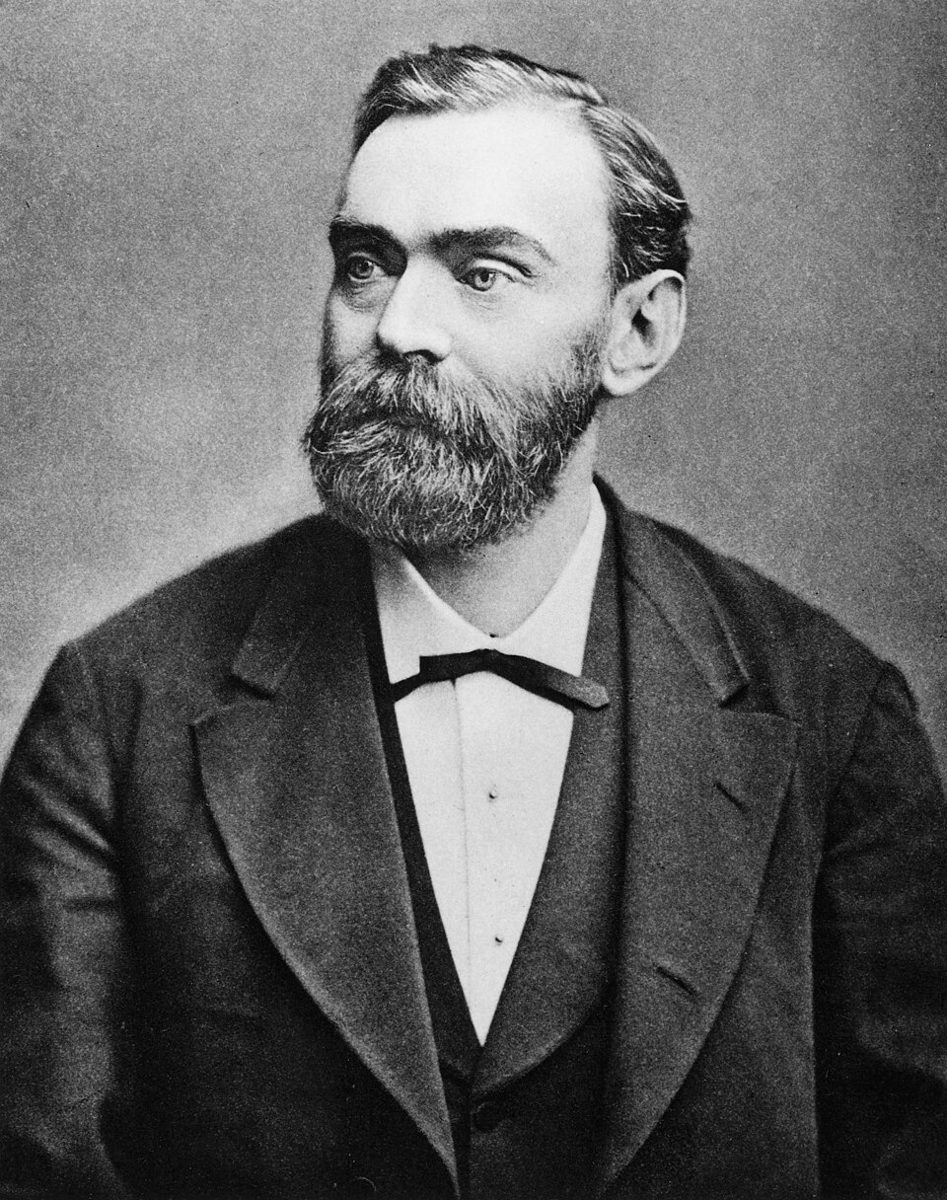 Wikimedia Commons
Alfred Nobel: Biography, Inventions, and the Nobel Prize Legacy
Biography
1. Introduction
Alfred Nobel was a Swedish chemist, engineer, inventor, and businessman whose inventions and scientific work made him one of the most influential industrialists of the nineteenth century.
He is best remembered for inventing dynamite and establishing the Nobel Prizes, which recognize outstanding contributions to science, literature, and peace.
Nobel's work in explosives technology transformed mining, construction, and engineering. However, his lasting historical importance is also connected to his decision to dedicate most of his fortune to awards that would recognize achievements benefiting humanity.
2. Early Life and Family Background
Alfred Bernhard Nobel was born on October 21, 1833, in Stockholm, Sweden.
His father, Immanuel Nobel, was an engineer and inventor who worked on mechanical equipment, construction projects, and explosives. His mother, Andriette Ahlsell, managed the family while supporting her husband's business activities.
The Nobel family experienced financial difficulties during Alfred's childhood. In 1837, Immanuel moved to Russia to pursue business opportunities, and the family later joined him in Saint Petersburg.
Growing up in a family involved in engineering and invention helped develop Alfred's interest in science and technology.
3. Education and Scientific Training
Alfred Nobel received much of his education through private tutors rather than attending a traditional university.
He studied several subjects, including chemistry, physics, literature, and languages. He became fluent in Swedish, Russian, English, French, and German.
As a young man, Nobel developed a particular interest in chemistry and explosives.
During his travels, he studied in Paris, where he became familiar with the work of chemist Théophile-Jules Pelouze. He also encountered the research of Italian chemist Ascanio Sobrero, who had invented nitroglycerin.
Nobel became interested in finding ways to make this powerful but highly unstable explosive safer to handle and use.
4. Early Career and Research on Explosives
After completing his education, Nobel returned to his family's business interests.
His father had established engineering and manufacturing operations in Russia, but financial difficulties eventually affected the business.
Nobel continued researching explosives and focused particularly on nitroglycerin.
Nitroglycerin was extremely powerful but dangerous because it could explode unexpectedly. Nobel worked to develop a more controlled method of handling and detonating it.
In 1863, he developed an improved detonator that made it possible to initiate explosions more reliably.
His research laid the foundation for later developments in commercial explosives.
5. Invention of Dynamite
One of Alfred Nobel's most important inventions was dynamite.
In 1866, he discovered that nitroglycerin could be absorbed into kieselguhr, a porous material made from the fossilized remains of microscopic aquatic organisms.
The resulting mixture was considerably easier to handle than liquid nitroglycerin.
Nobel patented dynamite in 1867. The invention made explosive materials more practical for controlled industrial applications.
Dynamite became widely used in mining, tunneling, railway construction, and major engineering projects.
It transformed the construction industry by making it easier to remove rock and carry out large excavation projects.
6. Other Inventions and Patents
Nobel continued developing new technologies throughout his career.
He held more than 350 patents across different countries. His inventions included improvements in explosives, detonators, and industrial chemical processes.
Some of his important inventions and developments included:
- Dynamite, patented in 1867.
- Improved blasting caps and detonators.
- Gelignite, a gelatinous explosive developed in the 1870s.
- Ballistite, a smokeless propellant developed in 1887.
His work helped establish a large industrial business involving explosives and related technologies.
7. Business Career and Industrial Expansion
Nobel became a successful industrialist through the development and commercialization of his inventions.
He established manufacturing facilities and businesses in several countries, including Sweden, Germany, France, and other parts of Europe.
His companies supplied explosives for mining, construction, engineering, and military applications.
Nobel also invested in oil-related businesses through his family's industrial activities in Russia.
Despite his considerable wealth, he spent much of his life traveling and working in laboratories, factories, and research facilities.
8. Personal Life and Interests
Alfred Nobel never married and had no children.
He was known for his interest in literature, philosophy, and languages, in addition to science and engineering.
He wrote poetry and literary works in his spare time and maintained correspondence with several intellectuals and public figures.
Nobel also developed an interest in peace and international cooperation. His friendship and correspondence with Austrian peace activist Bertha von Suttner influenced his thinking about the possibility of reducing conflict.
Although his inventions were used in both civilian and military contexts, he expressed interest in the advancement of peace.
9. The Decision to Establish the Nobel Prizes
The most enduring part of Alfred Nobel's legacy began with his final will, signed on November 27, 1895, in Paris.
In his will, he directed that most of his fortune be used to establish a fund. The income from this fund would be distributed annually as prizes to people who had made important contributions to humanity.
He specified five original prize categories:
- Physics
- Chemistry
- Physiology or Medicine
- Literature
- Peace
Nobel's will established the foundation for the Nobel Prizes, although the creation of the prize system required considerable legal and administrative work after his death.
The first Nobel Prizes were awarded in 1901.
10. Why Did Alfred Nobel Establish the Prizes?
Nobel's reasons for establishing the prizes have been discussed by historians.
One frequently repeated story concerns an incorrect newspaper obituary published after the death of his brother Ludvig Nobel in 1888. The obituary reportedly confused the brothers and described Alfred as a man who had become wealthy through destructive inventions.
Although the story is often presented as the moment that inspired his decision, historians cannot establish that it was the sole or definitive reason for his will.
His correspondence and long-standing interests suggest that he had broader concerns about science, literature, peace, and the use of his wealth.
His decision ultimately created one of the world's most recognized international award systems.
11. Death
Alfred Nobel died on December 10, 1896, at his home in San Remo, Italy, at the age of 63.
He died from a cerebral haemorrhage.
Following his death, the execution of his will required significant administrative and legal efforts. His relatives and other interested parties had to be addressed before the Nobel Foundation could be established.
The Nobel Foundation was created in 1900, and the first awards were presented in 1901.
12. The Nobel Prizes and Their Global Importance
The Nobel Prizes became internationally respected awards recognizing exceptional achievements.
The original five categories were established through Nobel's will. The Sveriges Riksbank Prize in Economic Sciences in Memory of Alfred Nobel was later established in 1968 and first awarded in 1969. It is not one of the original prizes specified in Nobel's will.
Today, the Nobel Prizes recognize achievements that have influenced science, medicine, literature, and international peace.
The awards have become an important part of global intellectual and cultural life.
13. Legacy and Historical Importance
Alfred Nobel's influence extends beyond his inventions.
His major contributions include:
- Inventing dynamite and improving the practical use of nitroglycerin.
- Developing blasting technologies used in mining and construction.
- Holding more than 350 patents.
- Building an international industrial business.
- Establishing the financial foundation for the Nobel Prizes.
- Supporting recognition of achievements in science, literature, medicine, and peace.
His legacy reflects the complex relationship between scientific invention, industrial development, and social responsibility.
The Nobel Prizes remain his most enduring contribution, bringing international recognition to people whose work has had a significant impact on humanity.
14. Conclusion
Alfred Nobel was a remarkable inventor and industrialist whose work transformed explosives technology and helped advance industrial engineering.
Although he became wealthy through inventions such as dynamite, his decision to establish the Nobel Prizes became the defining feature of his historical legacy.
Through his final will, he created a lasting institution that recognizes outstanding contributions to science, literature, medicine, and peace.
More than a century after his death, Alfred Nobel's name remains closely associated with achievement, discovery, and the advancement of human knowledge.
Did you know?
**Did You Know?** 1. Alfred Nobel held more than 350 patents during his lifetime. 2. He patented dynamite in 1867 after discovering a way to make nitroglycerin easier to handle. 3. Nobel spoke several languages, including Swedish, Russian, English, French, and German. 4. He never married and had no children. 5. His will, signed in 1895, established the foundation for five original Nobel Prize categories. 6. The first Nobel Prizes were awarded in 1901, five years after his death. 7. Nobel was also interested in literature and wrote poetry and dramatic works. 8. The Nobel Prizes were established using most of the fortune he accumulated through his inventions and businesses.