Monarch · German Empire
Wilhelm II
Wilhelm II (1859–1941) was the last German Emperor and King of Prussia, ruling from 1888 until his abdication in 1918. He pursued an ambitious foreign policy, supported the expansion of Germany’s navy, and sought to strengthen the country’s position as a global power. His reign was marked by growing tensions among European powers and the outbreak of World War I in 1914. After Germany’s defeat and the German Revolution of 1918, Wilhelm abdicated and lived in exile in the Netherlands until his death in 1941.
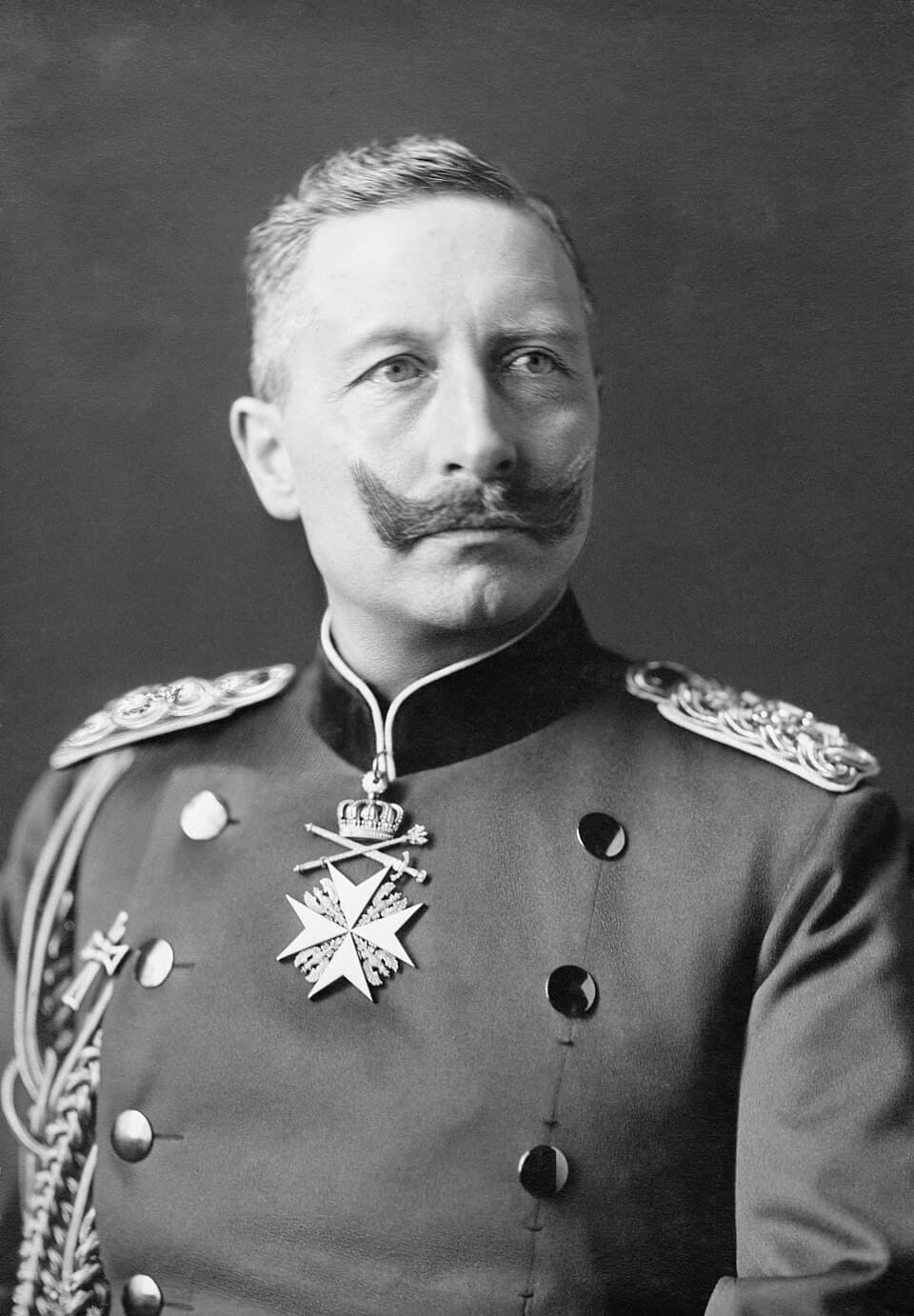 Wikimedia Commons
Wilhelm II: Full Biography
Biography
1. Introduction
Wilhelm II was the last German Emperor and King of Prussia. He ruled the German Empire from June 15, 1888, until November 9, 1918, when Germany's monarchy collapsed near the end of World War I.
His reign was characterized by rapid industrial development, military expansion, ambitious foreign policy, and increasing rivalry with other European powers. Wilhelm wanted Germany to become a leading global power, but his policies contributed to diplomatic tensions and helped shape the difficult international environment before World War I.
Following Germany's defeat, Wilhelm went into exile in the Netherlands, where he lived until his death in 1941.
2. Early Life and Birth
Wilhelm II was born Friedrich Wilhelm Viktor Albert on January 27, 1859, in Berlin, then the capital of the Kingdom of Prussia.
He was the eldest child of Crown Prince Frederick William of Prussia and Victoria, Princess Royal of the United Kingdom, the eldest daughter of Queen Victoria.
Wilhelm was born into one of Europe's most influential royal families. His birth connected the Prussian and British royal houses and placed him in the line of succession to the Prussian throne.
His upbringing was shaped by the traditions of the Prussian monarchy, which emphasized military discipline, duty, and loyalty to the state.
3. Family Background
Wilhelm's father later became Emperor Frederick III in 1888, while his mother, Victoria, maintained close connections with the British royal family.
His parents had different political outlooks. His mother was influenced by British constitutional traditions and supported aspects of political and social reform, while the Prussian royal establishment placed considerable emphasis on military authority and monarchical power.
These differences contributed to tensions within the family. Wilhelm's relationships with his parents remained complicated throughout his life.
His royal background gave him access to influential political and military figures from an early age.
4. Childhood and Physical Disability
Wilhelm experienced a difficult birth that resulted in permanent damage to his left arm. The arm remained shorter and less functional than his right arm.
The disability affected his childhood and became a source of personal sensitivity. His education included demanding physical and military activities, partly reflecting the expectations placed on a future Prussian king.
His upbringing emphasized discipline, obedience, and the public image of strength. These expectations shaped his understanding of royal leadership and his later interest in military ceremony.
5. Education and Training
Wilhelm received a formal education that included history, politics, languages, and military subjects. He attended the University of Bonn, where he studied from 1877 to 1879.
His education introduced him to academic life, but his training was also designed to prepare him for the responsibilities of a future monarch.
He became familiar with the institutions of the Prussian state and the German Empire, including the army and the royal court.
Although he acquired knowledge of government and international affairs, his later reign demonstrated the difficulty of balancing personal ambition with the constitutional and diplomatic responsibilities of the imperial office.
6. Marriage and Children
In 1881, Wilhelm married Princess Augusta Victoria of Schleswig-Holstein. Their marriage produced six sons and one daughter.
The eldest son, Crown Prince Wilhelm, was raised to inherit the imperial throne. Their children were brought up within the traditions of the German royal family.
Augusta Victoria generally maintained a private and religious public image. She supported charitable activities and accompanied Wilhelm in the formal duties associated with imperial life.
After Wilhelm's abdication, the family experienced the loss of its official royal position and moved into exile.
7. Becoming German Emperor
Wilhelm's grandfather, Wilhelm I, became the first German Emperor in 1871 after the unification of Germany under Prussian leadership.
When Wilhelm I died in March 1888, Wilhelm's father succeeded him as Emperor Frederick III. Frederick was already seriously ill and died in June of that year after a reign of approximately 99 days.
Wilhelm II then became German Emperor and King of Prussia at the age of 29. The year 1888 became known as the Year of the Three Emperors because Germany had three successive emperors within a single year.
His accession marked the beginning of a new phase in German politics and foreign policy.
8. Relationship with Otto von Bismarck
Otto von Bismarck was the dominant political figure behind German unification and served as chancellor when Wilhelm II became emperor.
Bismarck favored cautious diplomacy, a network of alliances, and policies intended to prevent Germany from facing a hostile coalition of major powers.
Wilhelm wanted a more personal role in government and disagreed with Bismarck over political direction and domestic issues. Their relationship deteriorated rapidly.
In March 1890, Wilhelm forced Bismarck to resign. The dismissal was a major turning point in German history because it ended the chancellor's long period of political dominance.
After Bismarck's departure, German foreign policy became increasingly associated with Wilhelm's ambitions and the decisions of his changing circle of advisers.
9. Domestic Politics and Government
The German Empire was a federal constitutional monarchy. It included multiple German states, while Prussia held a dominant position.
The emperor appointed the imperial chancellor and exercised considerable influence over the military and foreign affairs. However, the Reichstag, or imperial parliament, participated in legislation and budgetary decisions.
Wilhelm's relationship with elected representatives was often difficult. He supported the traditional authority of the monarchy and frequently expressed suspicion toward political movements that challenged the existing order.
During his reign, Germany experienced growing political participation, an expanding labor movement, and the increasing influence of the Social Democratic Party.
Industrialization also created new social problems, including difficult working conditions and disputes over workers' rights. These changes challenged the conservative political structure Wilhelm sought to preserve.
10. Weltpolitik: Germany's Global Ambitions
Wilhelm II supported a foreign policy commonly known as Weltpolitik, or world policy. It aimed to expand Germany's international influence through overseas possessions, commercial growth, diplomacy, and naval power.
Germany had unified later than several other European powers and sought greater access to overseas markets and imperial territories.
Under Wilhelm, Germany pursued colonial interests in Africa and the Pacific and tried to establish itself as a major global power.
These ambitions increased friction with Britain and other colonial powers. Rather than consistently improving Germany's international position, some of the policies contributed to suspicion and competition among European states.
11. Naval Expansion
Wilhelm believed that a powerful navy was essential to Germany's international standing. His government supported major naval construction programs, particularly under Admiral Alfred von Tirpitz.
The expansion of the German fleet challenged Britain's traditional naval superiority. Britain viewed its navy as essential to national security and the protection of its worldwide empire.
The resulting Anglo-German naval competition contributed to worsening relations between the two countries.
Although Germany's naval program reflected its desire for global influence, it also encouraged Britain to strengthen its own naval capabilities and seek closer diplomatic relationships with other powers.
12. Foreign Relations and European Rivalries
Wilhelm's reign coincided with a period of intense international competition. European powers were concerned about military strength, colonial possessions, trade, and the balance of power.
Germany maintained alliances with Austria-Hungary and Italy through the Triple Alliance, although Italy's relationship with the alliance later changed.
Meanwhile, France and Russia developed closer relations, and Britain gradually moved toward cooperation with France and Russia.
Wilhelm's diplomatic decisions, public statements, and support for an ambitious foreign policy sometimes complicated efforts to maintain stable relationships.
By the early twentieth century, Europe had become increasingly divided into rival diplomatic and military groupings.
13. The Moroccan Crises
Germany challenged French influence in Morocco during two major diplomatic crises in 1905–1906 and 1911.
During the First Moroccan Crisis, Wilhelm visited Tangier in 1905 and publicly supported Moroccan independence. The move was intended to challenge France's position and test the strength of its diplomatic relationships.
The resulting Algeciras Conference largely favored France and exposed Germany's limited diplomatic support.
During the Second Moroccan Crisis in 1911, Germany sent the gunboat Panther to Agadir. The incident further increased tensions with France and Britain.
These crises did not directly cause World War I, but they contributed to mistrust and reinforced the perception that Germany was willing to use diplomatic pressure to pursue its international ambitions.
14. The Outbreak of World War I
In June 1914, Archduke Franz Ferdinand of Austria-Hungary was assassinated in Sarajevo. The assassination triggered a major international crisis involving Austria-Hungary, Serbia, Russia, Germany, France, and Britain.
Wilhelm supported Austria-Hungary during the crisis, including assurances of German backing often referred to as the "blank cheque."
Austria-Hungary declared war on Serbia in July 1914. A chain of mobilizations, declarations of war, and strategic decisions then expanded the conflict into a European war.
Germany declared war on Russia on August 1, 1914, and on France on August 3. The German invasion of Belgium brought Britain into the conflict on August 4.
The outbreak of war resulted from multiple factors, including alliance commitments, military planning, nationalism, imperial rivalry, and the decisions of several governments. Wilhelm's support for Austria-Hungary was an important part of this sequence.
15. Wilhelm During World War I
At the beginning of the war, Wilhelm was presented as a symbol of national unity. However, practical military authority increasingly shifted toward the German General Staff and senior commanders.
As the war continued, generals Paul von Hindenburg and Erich Ludendorff acquired enormous influence over Germany's military and political decisions.
Wilhelm remained emperor and formally held supreme command, but his ability to direct the course of events became increasingly limited.
Germany faced severe challenges, including the British naval blockade, food shortages, mounting casualties, and the enormous economic cost of prolonged warfare.
The war placed tremendous pressure on German society and weakened confidence in the imperial government.
16. The German Revolution of 1918
By 1918, Germany was exhausted by war. Military defeats, shortages, and public dissatisfaction intensified opposition to the monarchy.
In late October and early November, a naval mutiny at Kiel developed into a broader revolutionary movement. Workers' and soldiers' councils emerged in several cities, and demands for political change spread across the country.
On November 9, 1918, political leaders announced the end of Wilhelm's rule amid the revolutionary crisis. Germany moved toward a republican system of government.
Wilhelm, who was at German military headquarters in Spa, Belgium, faced pressure to abdicate. His position had become untenable as military leaders and political figures withdrew their support for the continuation of his reign.
17. Abdication and Exile
Wilhelm's abdication marked the end of the German monarchy. He crossed into the Netherlands on November 10, 1918, seeking refuge in a neutral country.
His formal abdication was announced on November 28, 1918, after the monarchy had already collapsed.
The Dutch government allowed him to remain in exile. The Allies later sought to hold him responsible for the war, but the Netherlands refused to extradite him.
Wilhelm settled at Huis Doorn, a country house in the Netherlands. He spent the rest of his life there, separated from the political power he had once exercised.
18. Life at Huis Doorn
During his exile, Wilhelm lived a relatively secluded life. He maintained a household, received visitors, followed European political developments, and wrote memoirs defending his own interpretation of history.
He remained attached to the idea of monarchy and never fully accepted the legitimacy of the republican order that replaced the German Empire.
His views on World War I and his own responsibility for Germany's defeat remained controversial. His writings often placed considerable blame on other political and military figures.
Despite his political isolation, Wilhelm continued to attract attention because of his former position and the continuing debates over the causes of the war.
19. Relationship with Nazi Germany
After Adolf Hitler and the Nazi Party rose to power in Germany in 1933, Wilhelm's relationship with the new regime was complicated.
He initially expressed some hopes that Hitler's government might restore German national strength, but he was not given a role in the Nazi state. His expectations of a restoration of the monarchy were never fulfilled.
Wilhelm's views and statements changed over time, and his relationship with the regime was neither a straightforward alliance nor a consistent public opposition.
Following Germany's invasion of the Netherlands in 1940, Wilhelm remained at Huis Doorn under German occupation. He died the following year, without returning to the throne.
20. Death
Wilhelm II died on June 4, 1941, at Huis Doorn in the Netherlands, at the age of 82.
He was buried on the estate according to his wishes. His remains were not returned to Germany during his lifetime because he had requested that his burial take place only when the monarchy was restored.
His death occurred during World War II, when Nazi Germany occupied much of Europe. The monarchy he had ruled had disappeared more than two decades earlier.
21. Historical Legacy
Wilhelm II remains a controversial figure in German and European history. His reign coincided with major industrial growth, technological advances, and Germany's emergence as one of the world's leading economic and military powers.
At the same time, his pursuit of global influence, naval expansion, and often unpredictable diplomacy contributed to tensions with other major powers.
Historians continue to debate the extent of his personal responsibility for the outbreak of World War I. He was not the sole cause of the conflict, which involved decisions by several governments and long-standing structural tensions. Nevertheless, his support for Austria-Hungary in 1914 and his leadership of German foreign policy remain important subjects of historical analysis.
The collapse of the monarchy in 1918 ended the imperial political system established after German unification in 1871. Wilhelm's life illustrates the difficulties faced by traditional monarchies in an age of mass politics, industrial warfare, and revolutionary change.
22. Conclusion
Wilhelm II ruled Germany during a period of extraordinary transformation. He sought to strengthen the German Empire through military expansion, colonial ambition, and a more assertive international role.
His reign also coincided with worsening relations among European powers and the outbreak of World War I. Germany's defeat led to revolution, the abolition of the monarchy, and Wilhelm's exile in the Netherlands.
He died in 1941, having witnessed the destruction of the political order over which he had once presided. His legacy remains closely tied to imperial Germany, the origins and course of World War I, and the end of the German monarchy.
Did you know?
**Did you know?** Wilhelm II was the eldest grandson of Queen Victoria of the United Kingdom. He became German Emperor in 1888, the same year his father ruled for only about 99 days before dying. After World War I and the German Revolution, Wilhelm lived in exile at Huis Doorn in the Netherlands for more than two decades.