Monarch · United Kingdom of Great Britain and Ireland
Victoria
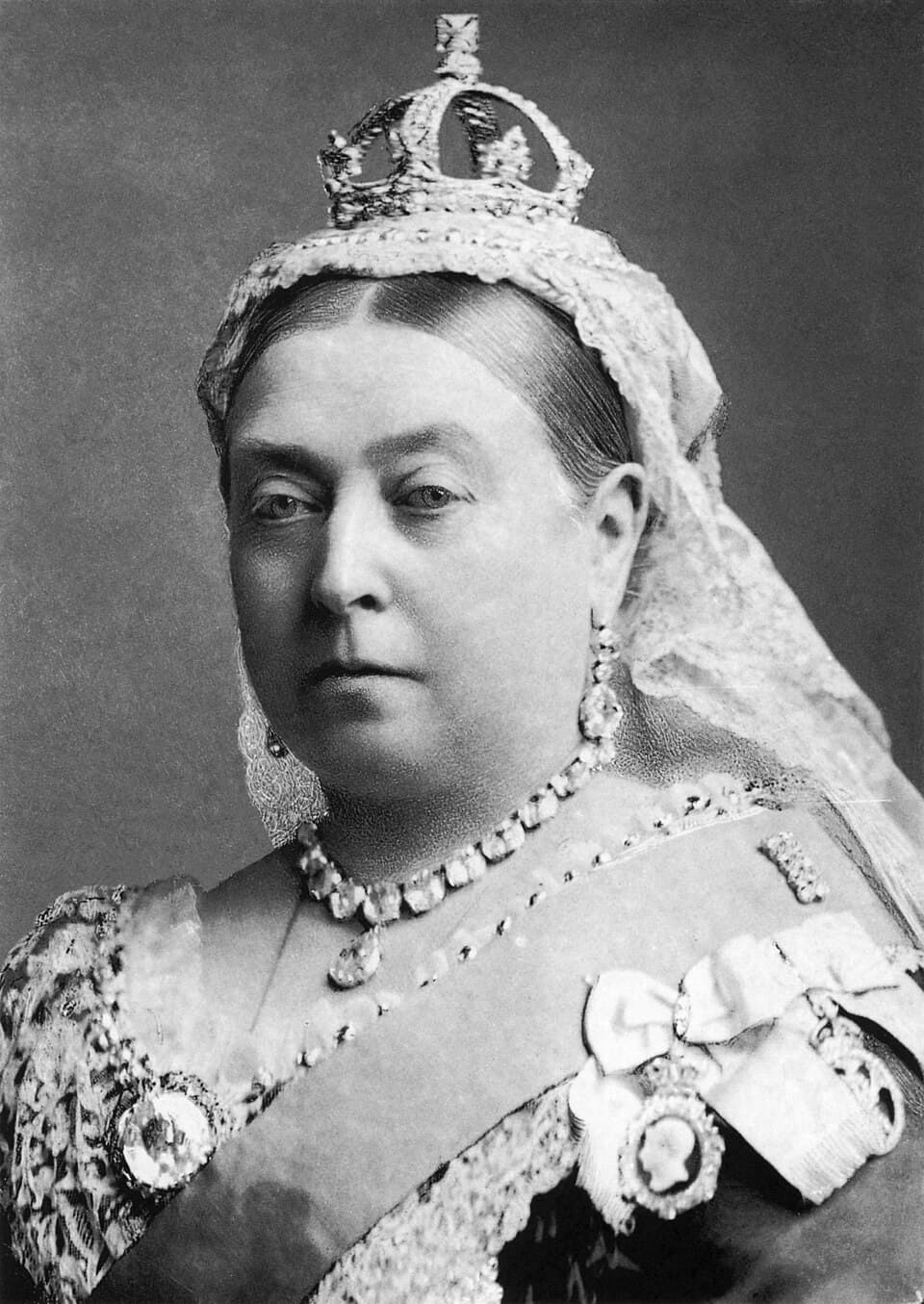
Queen Victoria (1819–1901) was Queen of the United Kingdom of Great Britain and Ireland from 1837 until her death in 1901. Her reign, known as the Victorian era, lasted more than 63 years and witnessed major industrial, scientific, social, and political changes. During her rule, the British Empire expanded significantly, becoming one of the world's most powerful imperial systems. Victoria also became Empress of India in 1876 and remains one of the most influential monarchs in British history.
 Wikimedia Commons
Queen Victoria: Full Biography
Biography
Early Life and Birth
Queen Victoria was born Alexandrina Victoria on May 24, 1819, at Kensington Palace in London, England. She was the only child of Prince Edward, Duke of Kent and Strathearn, the fourth son of King George III, and Princess Victoria of Saxe-Coburg-Saalfeld.
Victoria was born during a period of political and social change in Britain. Her birth initially seemed unlikely to lead to the throne because several older male members of the royal family stood ahead of her in the line of succession. However, the deaths of several royal heirs eventually made her the principal successor.
Family Background
Victoria belonged to the House of Hanover, a royal dynasty that had ruled Britain since 1714. Her grandfather was King George III, and her uncles included King George IV and King William IV.
Her father died when she was less than a year old. Her mother, Princess Victoria, played a major role in her upbringing and was supported by John Conroy, an adviser who became influential within the household.
Victoria's early family life was closely controlled, and her limited contact with the wider royal court helped shape her independent personality.
Childhood and Education
Victoria grew up at Kensington Palace under a strict set of rules later known as the Kensington System. Her mother and Conroy attempted to control her daily routine, education, and social relationships.
Her education included history, geography, languages, music, drawing, and constitutional matters. She learned English, French, and German, among other subjects, and received instruction about the responsibilities of monarchy.
Although her childhood was sheltered, Victoria developed a strong sense of duty. Her diaries also reveal that she was observant, emotionally expressive, and interested in the people and events around her.
Accession to the Throne
King William IV died on June 20, 1837, and Victoria became queen at the age of 18. Her accession ended the personal union of the British and Hanoverian crowns because Hanoverian succession law did not permit a woman to inherit the throne while a male heir was available.
Victoria moved away from the close supervision of her mother and established her own household at Buckingham Palace. Her early reign was influenced by the Whig prime minister Lord Melbourne, who became an important adviser and helped her understand the practical responsibilities of constitutional monarchy.
Coronation
Victoria's coronation took place at Westminster Abbey on June 28, 1838. The ceremony was an important public event and attracted widespread attention.
At the beginning of her reign, the young queen became a symbol of continuity during a period when Britain was undergoing political reform and rapid social change.
Although the monarch retained considerable symbolic importance, constitutional conventions increasingly required the sovereign to work through ministers and Parliament rather than govern through personal command.
Marriage to Prince Albert
Victoria married her first cousin, Prince Albert of Saxe-Coburg and Gotha, on February 10, 1840, at the Chapel Royal in St James's Palace, London.
Their marriage developed into a close personal and intellectual partnership. Albert became an important adviser to the queen and supported educational, scientific, artistic, and industrial initiatives.
The couple had nine children: Victoria, Albert Edward, Alice, Alfred, Helena, Louise, Arthur, Leopold, and Beatrice. Through their children's marriages into European royal families, Victoria became known as the “grandmother of Europe.”
Family Life and Children
Victoria was deeply involved in her children's upbringing, although her relationships with them varied over time. She expected high standards of conduct and often expressed strong opinions about their education and marriages.
Her eldest son, Albert Edward, later became King Edward VII. Several of her other children married into prominent European dynasties, strengthening Britain's connections with royal families across the continent.
Victoria's extensive family network became politically significant, especially because European monarchies were closely connected through marriage. These relationships also contributed to the popular image of Victoria as a central figure in European royal life.
The Victorian Era
The period of Victoria's reign, from 1837 to 1901, became known as the Victorian era. It was marked by industrial expansion, urban growth, advances in transportation, scientific discoveries, and major changes in social organization.
Railways expanded across Britain, steam-powered industry transformed manufacturing, and cities grew rapidly. The telegraph improved communication, while new technologies changed everyday life.
The era also witnessed significant poverty, overcrowding, difficult working conditions, and public-health problems. Reformers, politicians, labor organizations, and charitable groups campaigned for improvements in education, housing, sanitation, and workers' rights.
Constitutional Monarchy and Government
Victoria ruled during the development of modern parliamentary government. Britain was a constitutional monarchy in which elected representatives and ministers increasingly directed public policy.
The queen met regularly with prime ministers and reviewed government papers. Although she could express preferences and offer advice, she was expected to act within constitutional conventions.
Victoria worked with many prominent political leaders, including Lord Melbourne, Sir Robert Peel, Lord Palmerston, Benjamin Disraeli, William Ewart Gladstone, and Lord Salisbury.
Her relationships with these leaders varied. She sometimes strongly supported particular policies or individuals, but the growth of parliamentary government limited the monarch's direct political authority.
The Industrial Revolution
Industrialization was one of the defining developments of Victoria's reign. Britain became a major center of manufacturing, finance, engineering, and international trade.
Factories, coal mines, textile mills, railways, and ports expanded, creating employment and wealth while also exposing workers to dangerous conditions and long working hours.
Governments gradually introduced reforms concerning factories, mines, public health, and education. These changes were neither immediate nor complete, but they helped reshape British society during the nineteenth century.
Victoria became closely associated with an era in which Britain strengthened its position as a leading industrial and commercial power.
The Great Exhibition of 1851
One of the most famous events of Victoria's reign was the Great Exhibition of 1851, held in London's Crystal Palace. Organized with major support from Prince Albert, the exhibition displayed machinery, manufactured goods, inventions, and artistic achievements from Britain and other countries.
The event celebrated industrial innovation and international exchange. It attracted millions of visits and demonstrated Britain's confidence in its industrial capabilities.
The Great Exhibition also reflected Albert's interest in science, education, design, and the application of technology to economic and social development.
The Irish Potato Famine
The Great Irish Famine, which began in 1845, was one of the most devastating crises of Victoria's reign. A potato disease destroyed successive harvests, causing widespread hunger, disease, and displacement.
Approximately one million people in Ireland died, while many others emigrated. The crisis exposed the vulnerability of poor rural communities and the limitations of the relief policies pursued by the British government.
The famine's causes and consequences were complex, involving agricultural dependence, land ownership, poverty, government decisions, and the broader political relationship between Ireland and Britain. The monarchy was not the sole decision-maker in famine policy, but the tragedy remains a major part of the history of the Victorian period.
The Crimean War
The Crimean War, fought from 1853 to 1856, involved Russia against an alliance that included Britain, France, and the Ottoman Empire. The conflict arose from disputes over influence in the eastern Mediterranean and the declining Ottoman Empire.
British forces suffered from inadequate supplies, poor medical arrangements, and organizational problems. Reports of military suffering generated public criticism and encouraged reforms in military administration and medical care.
Queen Victoria supported the armed forces and took an active interest in the welfare of soldiers. After the war, she helped establish the Victoria Cross in 1856 to recognize acts of bravery by members of the armed forces.
The Indian Rebellion of 1857
The Indian Rebellion of 1857 began among Indian soldiers serving in the East India Company's army and expanded into a broader uprising across parts of northern and central India.
The rebellion involved multiple causes, including military grievances, political annexations, social tensions, and opposition to East India Company rule. It was suppressed by British forces and their allies, with severe violence and reprisals on both sides.
In 1858, the British government ended the East India Company's rule over India and transferred authority to the Crown. This marked a major transformation in British imperial administration and established the system commonly known as the British Raj.
Empress of India
In 1876, Parliament passed legislation enabling Victoria to use the title Empress of India, which she formally adopted in 1877.
The title symbolized the importance of India within the British Empire. Victoria herself did not govern India directly; colonial administration was conducted through the British government and its officials.
British rule in India brought changes to administration, transportation, communications, and economic structures, but it was also associated with colonial exploitation, racial hierarchy, political repression, and recurring famines.
Victoria's imperial role remains an important part of the broader historical debate over the consequences of British colonialism.
The Expansion of the British Empire
During Victoria's reign, Britain extended or consolidated control over territories in Africa, Asia, the Pacific, and other regions. The empire included colonies, protectorates, and territories governed under different arrangements.
Imperial expansion was driven by a combination of commercial interests, strategic competition, settler colonialism, missionary activity, and geopolitical rivalry.
Britain's global reach created extensive trade and political networks, but imperial rule also involved land dispossession, coercion, economic inequality, and resistance by colonized peoples.
Victoria became a symbol of imperial Britain, although imperial decisions were made through a wider political and administrative system rather than by the queen alone.
The Death of Prince Albert
Prince Albert died on December 14, 1861, at Windsor Castle, aged 42. His death devastated Victoria and profoundly changed the remainder of her life.
She withdrew from many public appearances for an extended period and wore mourning clothes for the rest of her life. Her grief became a defining feature of her public image.
Albert's death also meant that Victoria lost a trusted adviser who had influenced many aspects of her work. Her later relationship with ministers and royal advisers developed under the shadow of this loss.
Life After Albert's Death
After Albert's death, Victoria spent considerable time at Windsor Castle, Balmoral Castle in Scotland, and Osborne House on the Isle of Wight.
Her prolonged withdrawal from public ceremonies attracted criticism, particularly from those who believed the monarch should be more visibly present in national life. Over time, she gradually resumed a more public role.
Her relationships with John Brown, a Scottish servant who became a trusted companion, and later with Indian attendant Abdul Karim attracted public attention and generated speculation. These relationships also reflected her search for personal companionship after Albert's death.
Benjamin Disraeli and William Gladstone
Victoria worked with two of the most prominent British political leaders of the nineteenth century: Benjamin Disraeli and William Ewart Gladstone.
Disraeli cultivated a warm relationship with the queen and supported the use of the imperial title Empress of India. Gladstone, by contrast, often had a more difficult relationship with Victoria because of differences over policy and political style.
Their contrasting approaches reflected the political divisions of the era, including debates over reform, Ireland, imperial policy, and Britain's role in international affairs.
Victoria's preferences could influence her private discussions with ministers, but she remained constrained by the constitutional system and the need for governments to maintain parliamentary support.
Diamond Jubilee of 1897
Victoria celebrated her Diamond Jubilee in 1897, marking 60 years on the throne. The celebrations included processions, public ceremonies, and participation by representatives from across the British Empire.
The event emphasized the scale of her reign and Britain's global connections. Large crowds gathered to mark the occasion, and the queen became a symbol of continuity during a period of rapid technological and social change.
By this time, Victoria had become one of the most recognizable monarchs in the world.
Personal Interests and Character
Victoria enjoyed writing, drawing, music, and family correspondence. She kept extensive journals throughout much of her life, providing historians with valuable evidence about her thoughts, relationships, and experiences.
She was known for her strong opinions, emotional intensity, and sense of duty. Her personal preferences sometimes affected her relationships with ministers and members of the royal family.
Her public image evolved over time, from a young queen to a widowed monarch and eventually an elderly symbol of national continuity.
Later Years and Health
During her later years, Victoria's health declined, and she experienced increasing physical difficulties. Despite her age, she continued to carry out many official responsibilities.
Her long reign meant that she had witnessed extraordinary transformations in transport, communication, medicine, industry, and international politics.
By the end of the nineteenth century, the monarchy had become more closely associated with ceremonial duties and national identity, even as Parliament and ministers exercised the main responsibilities of government.
Death in 1901
Queen Victoria died on January 22, 1901, at Osborne House on the Isle of Wight, aged 81. Her reign had lasted 63 years, seven months, and two days.
She was succeeded by her eldest son, Edward VII. Her death marked the end of the Victorian era and the beginning of a new period in British history.
Victoria was buried beside Prince Albert in the Royal Mausoleum at Frogmore, Windsor.
Historical Legacy
Queen Victoria left a lasting mark on the British monarchy and the history of the nineteenth century. Her reign witnessed industrial development, political reform, imperial expansion, scientific progress, and profound social change.
She helped establish a recognizable model of constitutional monarchy in which the sovereign served as a national symbol while elected governments directed policy. Her family connections also linked many European royal houses.
However, her legacy is inseparable from the history of the British Empire, including colonial conquest, inequality, and resistance. A balanced understanding of Victoria requires examining both the transformations of Victorian Britain and the experiences of people living under British imperial rule.
Conclusion
Queen Victoria ruled the United Kingdom from 1837 until 1901 and became one of the most influential monarchs of the modern era. Her reign reshaped Britain's political, economic, cultural, and imperial history.
Remembered for her long rule, her marriage to Prince Albert, and her role as Empress of India, Victoria remains a defining figure in British history. The period bearing her name continues to be studied for its achievements, contradictions, and lasting global consequences.
Did you know?
- Victoria became queen in 1837 at just 18 years old. - Her reign lasted more than 63 years, making her Britain's longest-reigning monarch until Queen Elizabeth II surpassed her in 2015. - She married Prince Albert in 1840, and they had nine children. - Her descendants married into several European royal families, earning her the nickname “grandmother of Europe.” - Victoria became Empress of India in 1876, formally adopting the title in 1877. - The Victoria Cross, one of Britain's best-known military decorations, was established during her reign. - She celebrated her Diamond Jubilee in 1897, marking 60 years on the throne. - Victoria and Prince Albert are buried together at the Royal Mausoleum at Frogmore in Windsor.