Monarch · Macedonia
Alexander the Great
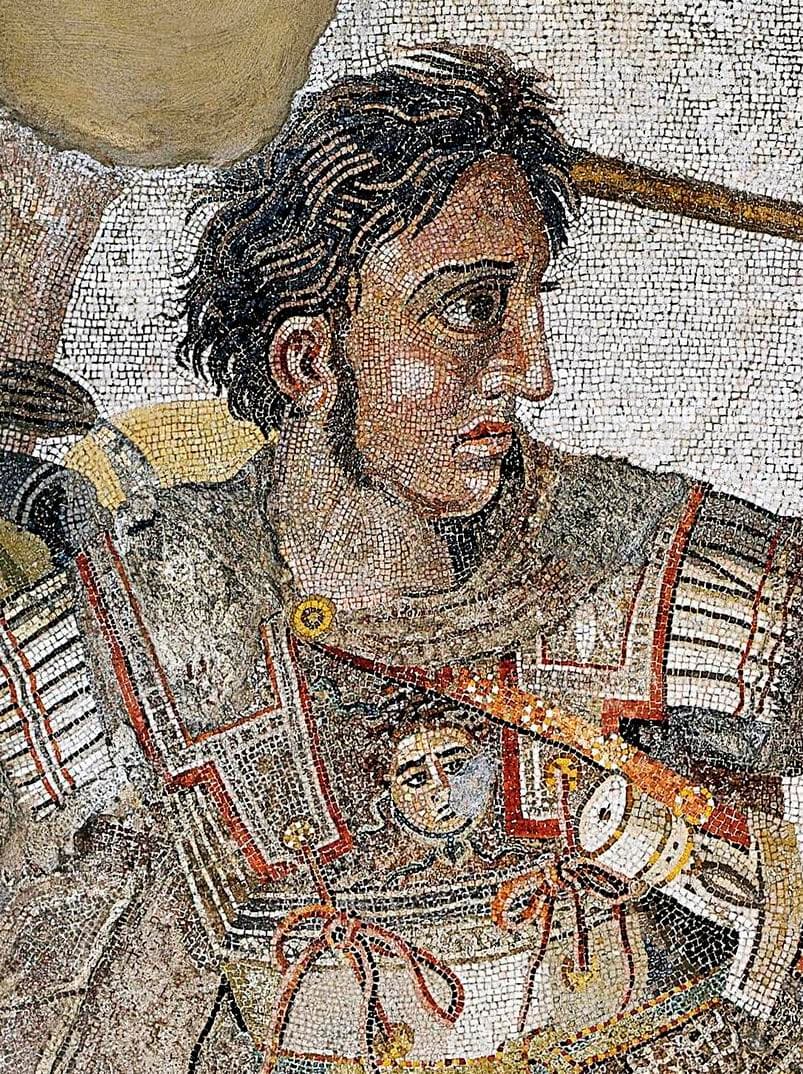
Alexander the Great (356–323 BCE) was the king of Macedon and one of the most successful military commanders in ancient history. He created a vast empire stretching from Greece and Egypt to parts of northwestern India. A student of the philosopher Aristotle, Alexander spread Greek culture across many regions and helped usher in the Hellenistic Age. His military achievements and political ambitions made him one of history's most influential rulers.
 Wikimedia Commons
Alexander the Great: Full Biography
Biography
Early Life and Birth
Alexander the Great was born in 356 BCE in Pella, the capital of the ancient kingdom of Macedon in northern Greece. He was the son of King Philip II of Macedon and Queen Olympias.
From childhood, Alexander was raised in a royal environment that emphasized military training, leadership, physical fitness, and education. Macedon was becoming a powerful kingdom under Philip II, who sought to extend his influence over the Greek city-states.
Family Background
Alexander's father, Philip II, transformed the Macedonian army into a highly effective military force. His mother, Olympias, was a member of the royal family of Epirus and played a significant role in his upbringing.
Alexander also had half-siblings and other relatives whose interests sometimes complicated Macedonian royal politics. His relationship with his father became strained at times because of disputes involving Philip's marriages and the question of royal succession.
Education and Aristotle
One of the most influential events of Alexander's childhood was his education under the philosopher Aristotle. Philip II arranged for Aristotle to tutor Alexander and several young Macedonian nobles.
Alexander studied subjects that included philosophy, literature, science, medicine, and politics. He admired Greek culture and was particularly inspired by Homer's Iliad, whose heroic figures influenced his understanding of leadership and glory.
His education helped shape his interest in Greek traditions, geography, and the lands beyond the Greek world.
Early Military Experience
Alexander gained military experience while still a teenager. In 338 BCE, he participated in the Battle of Chaeronea, where Philip II's forces defeated an alliance led by Athens and Thebes.
This victory established Macedonian dominance over much of Greece. Alexander's participation demonstrated that he could command troops and operate in major military campaigns before becoming king.
Becoming King of Macedon
In 336 BCE, Philip II was assassinated. Alexander, then about twenty years old, succeeded him as king of Macedon.
His position was initially uncertain because the kingdom faced internal political tensions and potential challenges from rival claimants. Alexander moved quickly to secure his authority and obtain recognition from key Macedonian leaders.
He also suppressed rebellions in Greece. The city of Thebes revolted in 335 BCE, and Alexander's forces destroyed much of the city. The event served as a severe warning to other Greek states against resisting Macedonian control.
The Campaign Against Persia
Alexander continued his father's plan to invade the Persian Empire, which was ruled by the Achaemenid dynasty. In 334 BCE, he crossed the Hellespont into Asia Minor with a Macedonian-led army.
His campaign was presented partly as a response to earlier Persian invasions of Greece, but it also reflected his ambition to conquer territory, gain wealth, and establish lasting personal glory.
The Persian Empire was enormous, wealthy, and politically complex. Alexander's victories against its armies would make him one of the most celebrated commanders in history.
Battle of the Granicus
In 334 BCE, Alexander fought Persian regional forces near the Granicus River in northwestern Asia Minor.
The Macedonian army won, allowing Alexander to advance into much of the region. Several Greek cities in Asia Minor came under his control, while others resisted.
The victory gave his campaign momentum and established a foothold in Persian territory.
Battle of Issus
In 333 BCE, Alexander confronted the Persian king Darius III at the Battle of Issus, near the eastern Mediterranean coast.
Despite facing a larger Persian force, Alexander achieved a decisive victory. Darius escaped, leaving his family and much of his royal camp in Macedonian hands.
Alexander treated Darius's captured family with respect according to ancient accounts. The victory weakened Persian royal authority and opened the way for further advances.
Conquest of Phoenicia and Tyre
Alexander moved south along the Mediterranean coast to secure Persian-controlled ports and prevent the Persian navy from using them effectively.
The city of Tyre resisted his forces. Its island position and strong defenses made the siege particularly difficult, and Alexander's army constructed a causeway to reach it.
Tyre fell in 332 BCE after a prolonged siege. The conquest demonstrated Alexander's determination and his ability to adapt engineering methods to difficult military challenges. It was also accompanied by severe violence against the city's population.
Conquest of Egypt
Later in 332 BCE, Alexander entered Egypt, where Persian authority had become unpopular among some groups. He was welcomed by many Egyptians as a liberator from Persian rule.
In 331 BCE, he founded the city of Alexandria on Egypt's Mediterranean coast. The city later developed into a major center of commerce, scholarship, and Hellenistic culture.
Alexander also visited the oracle of Amun at Siwa Oasis. Ancient accounts describe the visit as an important religious and symbolic moment in his life.
Battle of Gaugamela
In 331 BCE, Alexander faced Darius III again at the Battle of Gaugamela, near modern-day northern Iraq.
Alexander's army defeated the Persian forces despite the scale of Darius's preparations. Darius fled, and Alexander advanced toward the major Persian capitals.
Gaugamela is often regarded as one of the most decisive battles of the ancient world because it effectively destroyed the organized military power of the Achaemenid king.
Fall of the Persian Empire
After Gaugamela, Alexander occupied Babylon, Susa, and Persepolis, among other major centers of the Persian Empire.
Persepolis, one of the principal royal capitals, was burned in 330 BCE. Ancient sources disagree about the circumstances and motives behind the destruction, and historians continue to debate its significance.
Darius III was later killed by Bessus, one of his own senior officials. Alexander pursued Bessus and eventually captured him, presenting himself as the legitimate successor to the Persian monarchy.
Central Asian Campaigns
Alexander continued his campaigns into Bactria and Sogdiana, regions covering parts of modern Afghanistan, Uzbekistan, and neighboring areas.
Unlike some of his earlier victories, these campaigns involved prolonged resistance, difficult terrain, and guerrilla-style warfare. Alexander established settlements and military outposts to strengthen his control.
He also married Roxana, a noblewoman from the region of Bactria. The marriage has been interpreted as part of his personal life and his broader effort to build relationships with local elites.
Policy of Cultural Integration
Alexander increasingly sought to incorporate Persian officials and customs into his empire. He appointed some local elites to administrative positions and adopted elements of Persian royal ceremony.
He also encouraged marriages between Macedonians and women from Persian and other regional aristocratic families. In 324 BCE, a large group of Macedonian soldiers participated in marriage ceremonies with Persian women at Susa.
These policies aimed to integrate different peoples into the empire, but they caused resentment among some Macedonian soldiers and commanders who feared losing their privileged position.
Campaign in India
In 327 BCE, Alexander began his campaign into the Indian subcontinent, advancing through regions corresponding to parts of modern Pakistan and northwestern India.
His forces encountered local rulers and communities with unfamiliar military traditions, including armies that used war elephants.
Alexander sought to extend his conquests beyond the former Persian territories and reach the eastern limits of the known world as understood by many Greeks.
Battle of the Hydaspes
In 326 BCE, Alexander fought King Porus at the Battle of the Hydaspes River, generally identified with the Jhelum River in present-day Pakistan.
Porus used war elephants and fought from a strategically difficult position. Alexander ultimately won, but the battle was costly.
Ancient accounts portray Alexander as impressed by Porus's courage. Porus was allowed to continue ruling his territory as a subordinate ally, illustrating Alexander's willingness to retain some local rulers when doing so served his interests.
The Army Refuses to Advance
After the Hydaspes campaign, Alexander wanted to continue eastward. However, his soldiers were exhausted by years of campaigning, difficult weather, and the prospect of confronting additional powerful kingdoms.
At the Hyphasis River, usually identified with the Beas River in present-day India, the army refused to advance farther in 326 BCE.
Alexander eventually accepted the decision and began returning westward. The episode revealed the limits of his ambition and the importance of maintaining the loyalty of his troops.
Return Through the Gedrosian Desert
Alexander led part of his army through the Gedrosian Desert, in the region of modern southern Pakistan and southeastern Iran. The journey was exceptionally difficult, and many soldiers and followers died from thirst, exhaustion, and harsh conditions.
The exact reasons for choosing this route remain debated. The expedition illustrated the logistical risks involved in maintaining a huge army across unfamiliar territory.
Other parts of the army returned by different routes, while the fleet under Nearchus explored the coastline and attempted to connect maritime routes with the overland expedition.
Return to Babylon
By 324 BCE, Alexander had returned to the central regions of his empire. He faced challenges involving the behavior of officials, the administration of distant provinces, and dissatisfaction among Macedonian troops.
At Opis, he confronted a dispute with soldiers who objected to his policies of integrating Persians into the army and government. The conflict was eventually resolved, but it demonstrated the tension between his imperial ambitions and the expectations of his Macedonian followers.
Alexander continued planning new campaigns, including a proposed expedition toward Arabia.
Personal Life and Relationships
Alexander married Roxana, and ancient sources report that he also married Stateira, a daughter of Darius III, and Parysatis, a daughter of the Persian king Artaxerxes III, during the Susa marriage ceremonies.
His closest personal relationships, including those with companions such as Hephaestion, have been the subject of extensive historical discussion. Ancient accounts emphasize the emotional importance of Hephaestion's death in 324 BCE.
Alexander's personal life combined royal marriage politics, close friendships, and the pressures of maintaining an empire.
Death in Babylon
Alexander died in Babylon in June 323 BCE at approximately thirty-two years of age. The exact cause of his death remains uncertain.
Ancient accounts describe a period of fever and worsening illness. Proposed explanations have included infectious diseases, other natural illnesses, and poisoning, but the evidence does not establish a definitive cause.
His death occurred while he was preparing for further military and political projects, leaving his vast empire without a clearly established adult successor.
Division of the Empire
Alexander's death triggered a struggle among his generals and successors, commonly known as the Diadochi. His infant son, Alexander IV, and his half-brother Philip III were nominally associated with the succession, but powerful commanders competed for effective control.
Over time, the empire fragmented into several major Hellenistic kingdoms, including the Ptolemaic kingdom in Egypt and the Seleucid Empire across large parts of western Asia.
These successor states preserved and developed many of the administrative, cultural, and political changes associated with Alexander's conquests.
The Hellenistic Age
Alexander's campaigns helped create the conditions for the Hellenistic Age, a period during which Greek language, art, architecture, and political institutions spread widely across Egypt and Asia.
Greek culture did not simply replace local traditions. Instead, Greek and regional customs interacted in cities, courts, religious practices, and commercial networks.
Alexandria in Egypt became one of the most important intellectual centers of the ancient world, particularly under the Ptolemaic dynasty.
Military Legacy
Alexander is celebrated for his ability to combine infantry, cavalry, intelligence, logistics, and tactical maneuvering. His army's use of the Macedonian phalanx alongside highly mobile cavalry was especially important.
His victories inspired later commanders and military theorists. However, his success also depended on the professional army, administrative foundations, and military reforms developed under his father, Philip II.
His campaigns remain widely studied as examples of leadership, battlefield coordination, and the risks of overextension.
Historical Reputation
Alexander's reputation has changed across different cultures and historical periods. Ancient Greek and Roman writers often portrayed him as an extraordinary hero, while other traditions emphasized his violence, ambition, or destructive conquests.
Modern historians examine both his military achievements and the consequences of his expansion, including warfare, political upheaval, and the movement of peoples and cultures.
The title “the Great” reflects his extraordinary historical influence, but it does not remove the need to consider the human costs of his campaigns.
Conclusion
Alexander the Great transformed the ancient world through a series of remarkable military campaigns and ambitious political projects. From Macedon, he conquered the Persian Empire, entered Egypt and Central Asia, and advanced into the northwestern Indian subcontinent.
Although his empire fragmented soon after his death, the cultural and political changes associated with his conquests endured for centuries. His life remains a defining example of military ambition, imperial expansion, and the lasting influence of a ruler who died before reaching the age of thirty-three.
Did you know?
- Alexander became king of Macedon in **336 BCE**, when he was about twenty years old. - He was tutored by the philosopher **Aristotle** during his youth. - He founded **Alexandria in Egypt** in 331 BCE, a city that later became a major center of scholarship. - He never lost a major battle in the military campaigns recorded by surviving historical accounts. - His army refused to march farther east at the Hyphasis River in 326 BCE. - He died in Babylon at approximately **32 years old**, leaving an empire that his successors soon divided.