Statesman and playwright · Czechoslovakia
Václav Havel
Václav Havel (1936–2011) was a Czech playwright, essayist, dissident, and political leader who became a central figure in the peaceful political changes of 1989. He was one of the first spokespersons of Charter 77, the last president of Czechoslovakia, and the first president of the independent Czech Republic. His major plays include *The Garden Party*, *The Memorandum*, and *The Increased Difficulty of Concentration*.
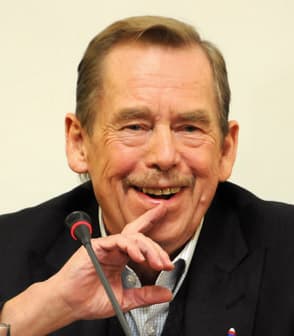 Wikimedia Commons
Biography
Václav Havel was born on October 5, 1936, in Prague, Czechoslovakia, into a prominent entrepreneurial and intellectual family. Because of his family background, the communist authorities restricted his educational opportunities. He completed an apprenticeship as a chemical laboratory assistant while attending evening secondary school and later studied at the Czech Technical University before leaving without completing a degree.
After compulsory military service, Havel worked in theater, first at the ABC Theatre and later at the Theatre on the Balustrade in Prague. From 1962 to 1966, he studied dramaturgy externally at the Academy of Performing Arts. His early plays included The Garden Party and The Memorandum, which established his reputation as an important Czech playwright.
Havel became increasingly involved in public and cultural affairs during the 1960s. Following the suppression of the Prague Spring in 1968, he openly criticized political repression and the communist government's policies. In 1975, he wrote an open letter to President Gustáv Husák addressing the condition of Czechoslovak society.
In January 1977, Havel became one of the founding figures and first three spokespersons of Charter 77, a civic initiative that criticized the Czechoslovak government for failing to respect human and civil rights. He later co-founded the Committee for the Defence of the Unjustly Prosecuted. His activities led to repeated imprisonment, and he spent nearly five years in prison in total.
The political changes of 1989 brought Havel into national leadership. After the November 17 student demonstration and the formation of the Civic Forum, he became its leading representative. On December 29, 1989, the Federal Assembly elected him president of Czechoslovakia. He was re-elected in 1990.
Havel resigned as president of Czechoslovakia on July 20, 1992, amid political disagreements over the future of the federation. After the creation of the independent Czech Republic, he was elected its first president on January 26, 1993. He was re-elected in 1998, and his presidential mandate ended on February 2, 2003.
Throughout his political career, Havel continued to write essays, plays, and works of political and philosophical thought. His presidency and public life were closely associated with themes such as democracy, civil society, human rights, and European cooperation. He died on December 18, 2011, at Hrádeček, Czech Republic.
Did you know?
Did you know that Václav Havel was both a successful playwright and a political prisoner? Before becoming president, he spent nearly five years in prison because of his opposition to the communist government and his involvement in civic initiatives such as Charter 77.