Politician · Kingdom of Great Britain
George Washington
George Washington (1732–1799) was an American military leader, statesman, Founding Father, and the first President of the United States. He commanded the Continental Army during the American Revolutionary War, presided over the Constitutional Convention of 1787, and became the nation's first president in 1789. Serving two terms, Washington helped establish the institutions and traditions of the new federal government before retiring to Mount Vernon in 1797.
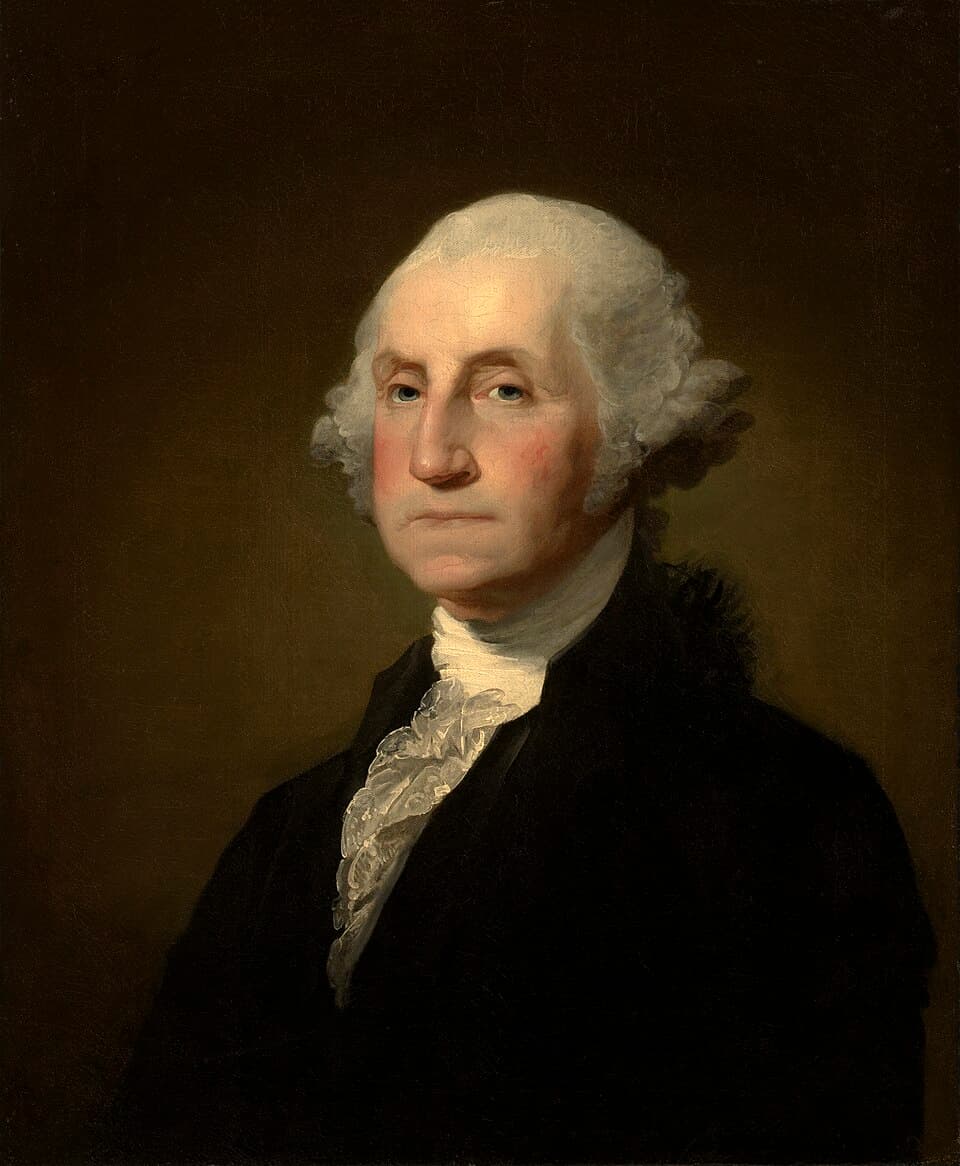 Wikimedia Commons
George Washington Biography
Biography
Early Life
George Washington was born on February 22, 1732, at Popes Creek in Westmoreland County, Virginia, then a British colony. He was the eldest child of Augustine Washington and Mary Ball Washington.
His father died when George was 11, which affected his educational opportunities. Unlike several other prominent Founding Fathers, Washington did not attend college or receive a formal education in England. He was educated through local schooling, private instruction, and extensive self-study.
Surveying Career
As a teenager and young man, Washington developed skills in mathematics, geometry, and surveying. In 1748, at the age of 16, he accompanied a surveying expedition through the Virginia frontier.
The following year, he became the surveyor of Culpeper County, Virginia. Surveying gave him practical knowledge of the land and helped establish his reputation and connections in Virginia.
Early Military Career
Washington entered military service during the French and Indian War. In 1754, he led Virginia troops into the Ohio River Valley, where his forces became involved in an early confrontation that contributed to the outbreak of the war.
He later served under British General Edward Braddock and gained valuable military experience. His service on the frontier helped establish him as a respected military officer.
Life at Mount Vernon
Washington inherited Mount Vernon from his half-brother Lawrence Washington and eventually developed the estate into a major plantation.
He became a successful landowner and planter and expanded his agricultural and business interests. Like many wealthy Virginia planters of his era, Washington enslaved people throughout much of his life. By the end of his life, he had owned, inherited, purchased, rented, or otherwise controlled hundreds of enslaved people.
In 1759, Washington married Martha Dandridge Custis, a wealthy widow with two children. They had no biological children together.
American Revolution
As tensions between the American colonies and Great Britain increased, Washington became increasingly involved in the colonial resistance.
In June 1775, the Continental Congress appointed Washington commander in chief of the Continental Army. He took command of the forces surrounding British troops in Boston.
Washington faced enormous challenges, including shortages of soldiers, supplies, training, and financial resources. Nevertheless, he remained commander of the Continental Army throughout the Revolutionary War.
Revolutionary War Leadership
Washington's army suffered serious setbacks, particularly during the early stages of the war. However, he helped maintain the Continental Army as a fighting force through difficult periods.
The crossing of the Delaware River and the victory at Trenton in December 1776 provided an important boost to American morale. Later campaigns included major operations in New York, Pennsylvania, and the southern colonies.
The decisive campaign came at Yorktown in 1781, where American and French forces surrounded British General Charles Cornwallis's army. Cornwallis surrendered, effectively ending major military operations in the Revolutionary War.
Constitutional Convention
After the Revolutionary War, Washington initially hoped to return to private life at Mount Vernon.
In 1787, however, he was chosen to preside over the Constitutional Convention in Philadelphia. The convention produced the United States Constitution.
Washington's presence and reputation helped lend authority to the proceedings and later to the effort to secure ratification of the Constitution.
First President of the United States
George Washington was unanimously elected as the nation's first president. He was inaugurated on April 30, 1789, in New York City.
As the first president, Washington had to establish many aspects of the new federal government from the beginning. He created a Cabinet and appointed prominent figures including Thomas Jefferson as Secretary of State and Alexander Hamilton as Secretary of the Treasury.
His administration also helped establish the federal judiciary, financial institutions, diplomatic practices, and other governmental precedents.
First Term
During his first term, Washington focused on organizing the new government and defining the responsibilities of the executive branch.
His administration supported the creation of the First Bank of the United States and worked to establish the financial stability of the new nation.
Washington also traveled through several states to strengthen connections between the federal government and the American people.
Second Term
Washington was reelected in 1792 and began his second term in 1793.
Foreign affairs became especially important during this period because the French Revolution and the resulting European conflicts created difficult diplomatic questions for the United States.
Washington's administration issued a proclamation of neutrality and sought to prevent the young nation from becoming involved in European wars.
Political disagreements between members of his administration, particularly Alexander Hamilton and Thomas Jefferson, also contributed to the emergence of organized political parties.
Farewell Address
Washington decided not to seek a third presidential term. He left office on March 4, 1797, after serving two terms.
His Farewell Address warned against excessive political factionalism and urged Americans to protect national unity. He also discussed foreign relations and cautioned against permanent political entanglements with other nations.
His voluntary retirement after two terms established an important tradition that lasted until the 20th century.
Return to Mount Vernon
After leaving the presidency, Washington returned to Mount Vernon and resumed his interests in farming, land management, and estate affairs.
Although he had retired from the presidency, he remained an important national figure and continued to receive visitors and correspond with political leaders.
Slavery and Washington's Legacy
Slavery was a major part of the economic and social system in which Washington lived. He enslaved people throughout his lifetime and depended on enslaved labor at Mount Vernon.
His views and practices regarding slavery changed in some respects over the course of his life, but he did not emancipate the people he enslaved during his lifetime.
In his will, Washington provided that the enslaved people he directly owned were to be freed after Martha Washington's death. This provision did not apply to the enslaved people belonging to the Custis estate.
This history remains an important and contested part of discussions of Washington's life and legacy.
Death
In December 1799, Washington became seriously ill after developing a severe throat infection.
He died at Mount Vernon on December 14, 1799, at the age of 67. He was buried at Mount Vernon in accordance with his wishes.
Legacy
George Washington played a central role in the founding of the United States. He was commander in chief of the Continental Army, president of the Constitutional Convention, and the country's first president.
His presidency established numerous precedents for the executive office, including the creation of a presidential Cabinet and the peaceful transfer of power after two terms.
Washington remains one of the most studied figures in American history. His military leadership, role in establishing the federal government, retirement from office, and complicated relationship with slavery all form important parts of his historical legacy.
Did you know?
George Washington was unanimously elected president in both the 1789 and 1792 elections. He remains the only U.S. president to have received a unanimous electoral vote in a presidential election.