Monarch · Qin
Qin Shi Huang
Qin Shi Huang (259–210 BCE) was the first emperor of a unified China and the founder of the Qin dynasty. Originally known as Ying Zheng, he became king of the Qin state in 246 BCE and unified the rival Chinese states in 221 BCE. He centralized government, standardized writing, currency, weights, and measures, and expanded infrastructure across his empire. His reign also involved harsh laws, forced labor, and suppression of intellectual opposition. Qin Shi Huang is closely associated with the early development of China's Great Wall defenses and the vast Terracotta Army buried near his mausoleum.
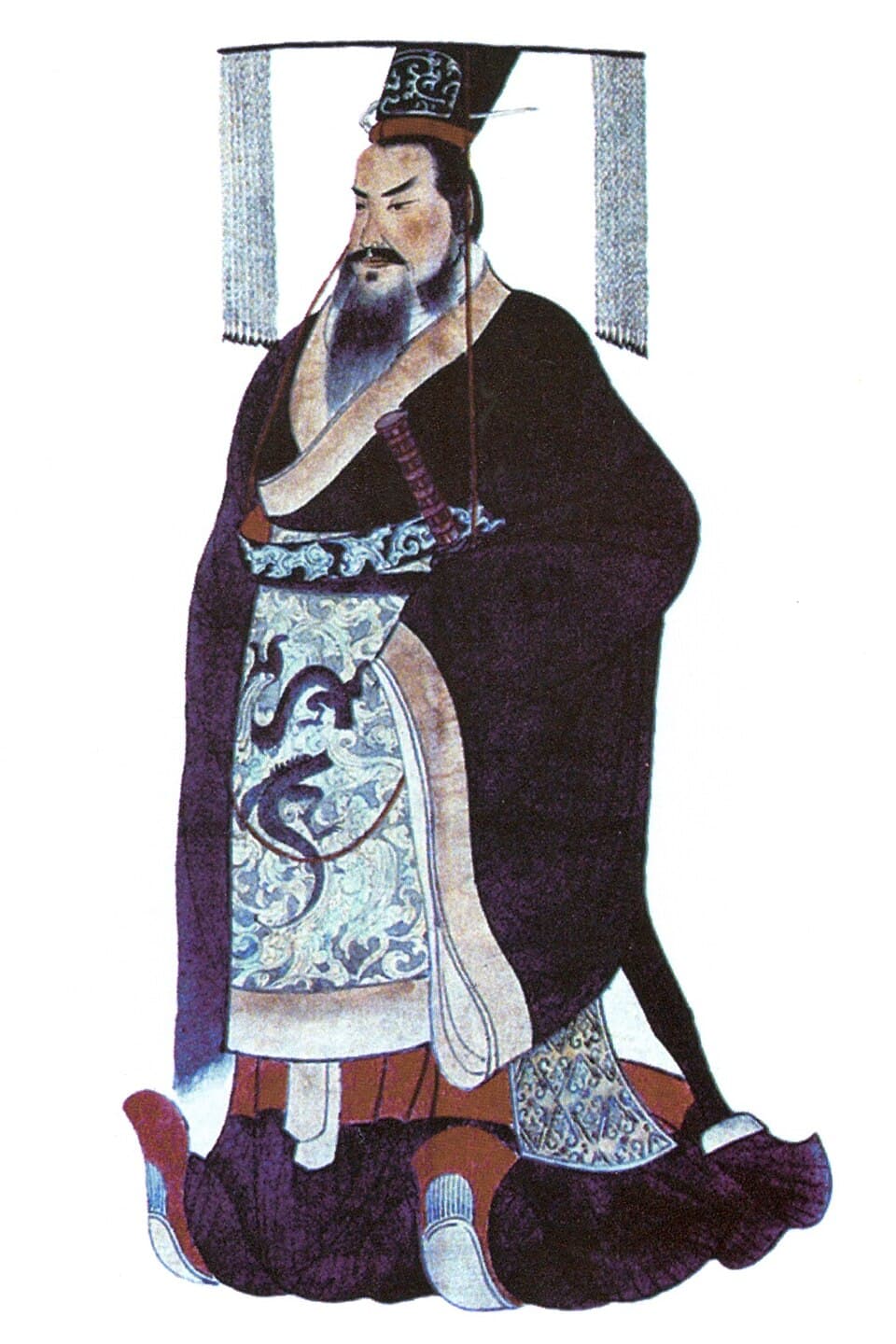 Wikimedia Commons
Qin Shi Huang: Full Biography
Biography
1. Introduction
Qin Shi Huang was the first emperor of a unified China and one of the most influential rulers in Chinese history. Before his reign, the region was divided among competing states that fought for political and territorial dominance during the Warring States period.
Born Ying Zheng, he became king of Qin and eventually defeated the other major states, establishing the Qin dynasty in 221 BCE. He adopted the title Qin Shi Huang, meaning “First Emperor of Qin,” to mark the beginning of a new imperial order.
His government transformed administration, law, infrastructure, and military organization. However, his methods were often coercive, and the Qin dynasty collapsed only a few years after his death.
2. Birth and Early Life
Qin Shi Huang was born in 259 BCE in Handan, the capital of the state of Zhao, during the Warring States period.
His father was Prince Yiren, later known as King Zhuangxiang of Qin. His mother is commonly identified as Lady Zhao, although some details of his family's early history remain debated in traditional accounts.
Because his father was connected to the Qin royal house but lived in Zhao as a political hostage, Ying Zheng's childhood unfolded amid diplomatic rivalry and uncertainty.
The circumstances of his birth and family relationships later became subjects of stories and political speculation, but the historical record does not resolve every detail.
3. Family Background
The Qin royal family ruled a powerful state in western China. Over several generations, Qin rulers expanded their territory, strengthened their armies, and introduced administrative reforms that helped them compete with neighboring states.
Ying Zheng inherited this political and military foundation. His father became king of Qin in 250 BCE but died in 247 BCE, leaving Ying Zheng to succeed him at a young age.
The new king inherited a state with considerable military strength and an ambitious political leadership. These advantages helped him pursue the goal of unifying the rival states.
4. Becoming King of Qin
Ying Zheng became king of Qin in 247 BCE, when he was approximately 13 years old. Because of his age, senior officials and regents initially exercised significant influence over the government.
As he grew older, Ying Zheng consolidated his authority and removed political rivals. By the early 230s BCE, he was directing an increasingly aggressive campaign against the other Chinese states.
His rule combined military expansion with a strong belief in centralized government. The Qin court sought to replace competing regional powers with a unified system controlled by the monarch.
5. The Warring States Period
Before unification, China was divided into several major states, including Qin, Zhao, Wei, Han, Chu, Yan, and Qi. These states competed through warfare, diplomacy, alliances, and administrative reform.
The period encouraged the development of new military technologies, larger armies, more systematic taxation, and stronger bureaucratic institutions.
Qin benefited from reforms that rewarded military achievement, organized society for state service, and strengthened the authority of central government.
By the time Ying Zheng began his major conquests, Qin possessed the resources and organizational capacity to defeat its rivals one by one.
6. Conquest of Han
The state of Han was the first major rival conquered by Qin during Ying Zheng's unification campaign. Qin forces captured Han in 230 BCE.
Han was relatively small and strategically vulnerable, and its defeat gave Qin greater control over important routes and territory in central China.
The conquest demonstrated that Ying Zheng's campaign was not merely an effort to expand Qin's borders. It was a coordinated attempt to eliminate the independent states and create a single political authority.
7. Conquest of Zhao and Yan
Qin continued its expansion against Zhao, a powerful state that had fought Qin repeatedly. Qin forces completed the conquest of Zhao in 228 BCE, although resistance and military operations continued afterward.
The state of Yan was then targeted. In 227 BCE, an attempted assassination of Ying Zheng was associated with the Yan court. The incident strengthened Qin's determination to defeat Yan.
Qin armies captured the Yan capital in 226 BCE, and the remaining Yan resistance was defeated later.
These victories reduced the number of independent states and brought Qin closer to achieving unification.
8. Conquest of Wei and Chu
Qin defeated Wei in 225 BCE. The conquest was aided by a strategy that involved flooding the capital's defenses, demonstrating the importance of engineering and logistics in Qin warfare.
The much larger state of Chu presented a more difficult challenge. Qin's first major campaign against Chu encountered serious resistance, but a subsequent campaign led by the
Did you know?
**Did you know?** Qin Shi Huang was buried in a vast mausoleum complex guarded by the famous Terracotta Army, discovered in 1974. He standardized writing, currency, weights, and measures across his empire. Although he unified China in 221 BCE, the Qin dynasty collapsed only a few years after his death in 210 BCE.