Poet · Seljuk Empire
Omar Khayyám
Omar Khayyám (1048–1131) was a Persian mathematician, astronomer, philosopher, and poet who made important contributions to mathematics and astronomy. Born in Nishapur, Persia, he became particularly known for his work on cubic equations, geometry, calendar reform, and astronomical calculations. In the Western world, he is especially famous for the *Rubáiyát*, a collection of Persian quatrains attributed to him and popularized internationally through Edward FitzGerald's 1859 English translation.
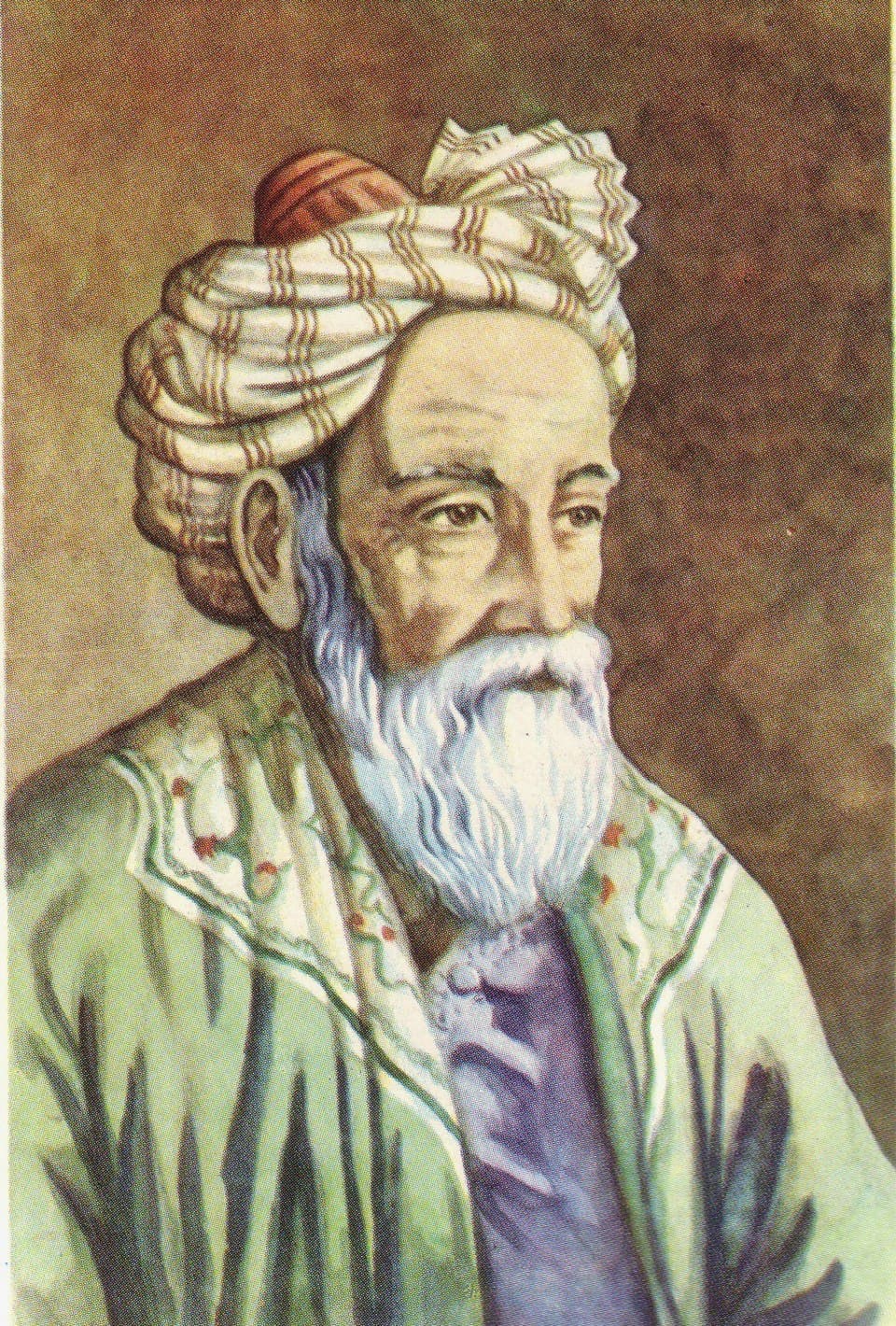 Wikimedia Commons
Biography
Omar Khayyám, whose full name was Ghiyāth al-Dīn Abū al-Fatḥ ʿUmar ibn Ibrāhīm al-Nīsābūrī al-Khayyāmī, was born on May 18, 1048, in Nishapur, Persia, in present-day Iran. His surname, al-Khayyām, is traditionally associated with the Persian word for "tentmaker," possibly reflecting his family's occupation. He became one of the major intellectual figures of the medieval Islamic world.
Khayyám was deeply involved in mathematics, astronomy, philosophy, and poetry. His mathematical work included a systematic treatment of cubic equations. He used geometric methods to study cubic equations and classified different types of equations according to their forms and solutions. His mathematical writings also included important discussions of geometry and Euclid's parallel postulate.
His work in astronomy was particularly significant. During the reign of the Seljuq ruler Malik Shah, Khayyám worked at the observatory in Isfahan and participated in the development of astronomical tables and a reform of the Persian calendar. His measurements of the length of the solar year were remarkably accurate for his time.
Khayyám also wrote philosophical works and was regarded as an Islamic scholar. His intellectual interests extended beyond mathematics and astronomy, reflecting the broad scholarly tradition of his period. His writings demonstrate the close relationship between mathematics, philosophy, astronomy, and other sciences in medieval Persian intellectual culture.
Today, however, Omar Khayyám is perhaps best known internationally as a poet. The Rubáiyát of Omar Khayyám consists of Persian quatrains, or rubāʿiyāt, traditionally associated with him. The number of poems attributed to Khayyám varies considerably among manuscripts and editions, and scholars have questioned whether all of the verses traditionally collected under his name were actually written by him.
His poetry became particularly influential in the English-speaking world after Edward FitzGerald published his celebrated English translation in 1859. Although FitzGerald's version was an adaptation rather than a literal translation, it played a major role in making Khayyám's name widely known in Western literature.
Omar Khayyám died on December 4, 1131, in Nishapur. His legacy spans several fields: mathematics, astronomy, philosophy, and literature. His work on cubic equations and astronomy remains an important part of the history of science, while the Rubáiyát has secured his enduring place in world literature.
Did you know?
Did you know? Omar Khayyám's mathematical work on cubic equations used geometric constructions involving the intersection of curves, centuries before general algebraic formulas for cubic equations were developed in Europe.