Playwright · German Empire
Bertolt Brecht
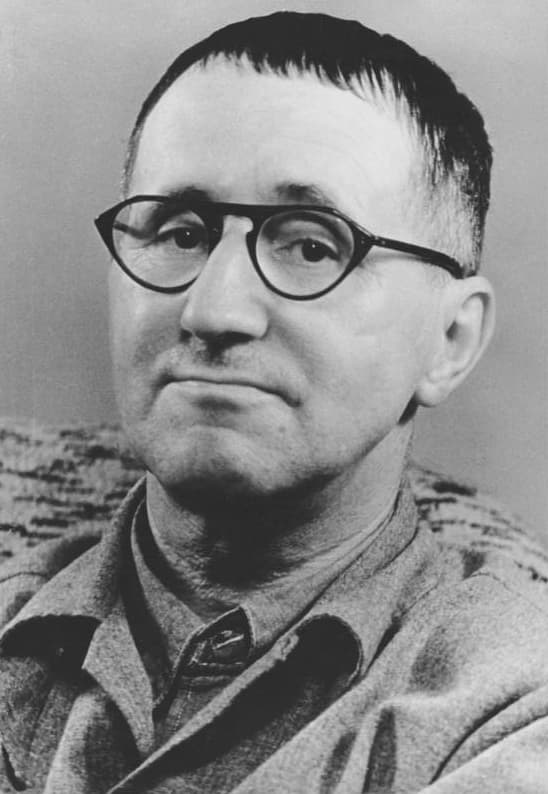
**Bertolt Brecht (1898–1956)** was a German playwright, poet, theatre director, and drama theorist who became one of the most influential figures in 20th-century theatre. He developed the concept of **Epic Theatre**, which encouraged audiences to think critically about social and political issues rather than simply becoming emotionally absorbed in a performance. His major works include *The Threepenny Opera*, *Mother Courage and Her Children*, *The Good Person of Szechwan*, and *The Caucasian Chalk Circle*.
 Wikimedia Commons
Biography
Bertolt Brecht, born Eugen Berthold Friedrich Brecht on February 10, 1898, in Augsburg, Germany, was a major German playwright, poet, theatre director, and theatrical theorist. He studied medicine and philosophy at the University of Munich but became increasingly interested in drama and theatre. During World War I, he served as a medical orderly at an Augsburg military hospital, an experience that strengthened his opposition to war.
Brecht began gaining recognition in the early 1920s. His plays Baal and Drums in the Night established his reputation as a provocative young dramatist. In 1922, Drums in the Night won the Kleist Prize for Drama. He moved to Berlin in 1924, where he became increasingly involved in the city's experimental theatre scene.
During the 1920s, Brecht developed ideas that became central to his Epic Theatre. Influenced by Marxist thought, he sought to create theatre that encouraged audiences to examine social conditions and question established assumptions. His use of techniques associated with the alienation effect was intended to prevent audiences from becoming completely absorbed in the fictional world and instead encourage critical reflection.
One of his most famous works was The Threepenny Opera (1928), created in collaboration with composer Kurt Weill. The work became highly successful and established Brecht as an internationally important dramatist. He also developed his theatrical ideas through works such as The Rise and Fall of the City of Mahagonny and The Measures Taken.
After Adolf Hitler came to power in 1933, Brecht left Germany and spent years in exile. He lived in Denmark, Sweden, Finland, the United States, and Switzerland. During this period, he continued to write plays, poetry, essays, and theoretical works. Important plays associated with his exile years include Mother Courage and Her Children, The Good Person of Szechwan, The Life of Galileo, and The Caucasian Chalk Circle.
Brecht lived in the United States from 1941 to 1947 and worked on theatre and film projects in Hollywood. In 1947, he appeared before the House Un-American Activities Committee. He subsequently left the United States and returned to Europe.
In 1948, Brecht returned to Germany and settled in East Berlin the following year. Together with his wife, actress Helene Weigel, he established the Berliner Ensemble in 1949. The company became a major center for Brecht's theatrical practice and helped spread his ideas about Epic Theatre internationally.
Brecht continued directing, writing, and adapting plays during his final years. His theatrical methods influenced generations of playwrights, directors, and actors around the world. He died on August 14, 1956, in East Berlin at the age of 58. His legacy remains closely associated with modern political theatre, Epic Theatre, and the use of theatrical techniques to encourage critical audience engagement.
Did you know?
**Did you know?** Bertolt Brecht and composer **Kurt Weill** collaborated on *The Threepenny Opera*, which premiered in Berlin in 1928 and became one of Brecht's best-known works.