Monarch · Russian Empire
Nicholas II of Russia
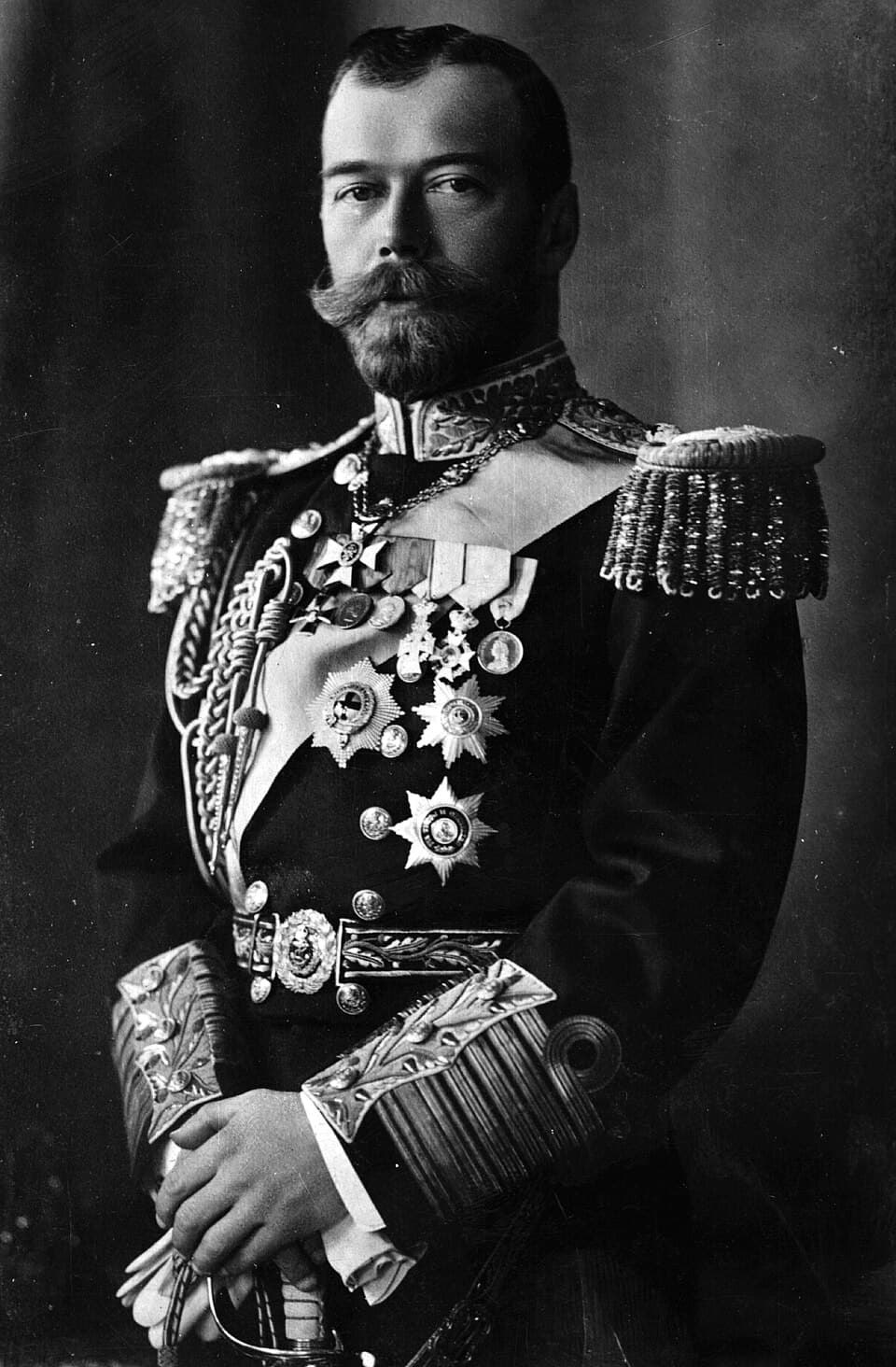
Nicholas II of Russia (1868–1918) was the last Emperor of Russia and the final ruler of the Romanov dynasty. He reigned from 1894 until his abdication in March 1917 during the Russian Revolution. His rule witnessed rapid industrialization, political unrest, the Russo-Japanese War, and Russia’s involvement in World War I. After the Bolsheviks seized power, Nicholas and his family were held captive and executed in July 1918.
 Wikimedia Commons
Nicholas II of Russia: Full Biography
Biography
Early Life and Birth
Nicholas II, born Nikolai Alexandrovich Romanov on May 18, 1868, was the eldest son of Emperor Alexander III and Empress Maria Feodorovna. He was born at the Alexander Palace in Tsarskoye Selo, near Saint Petersburg, Russia. He belonged to the Romanov dynasty, which had ruled Russia since 1613.
As the eldest son of the emperor, Nicholas was expected to inherit the throne. His childhood took place within the traditions of the Russian imperial court, where religion, military discipline, and loyalty to the monarchy played central roles.
Family Background
Nicholas's father, Alexander III, ruled Russia from 1881 to 1894 and strongly supported autocratic government. His mother, Maria Feodorovna, was born Princess Dagmar of Denmark and maintained close connections with European royal families.
Nicholas grew up with several siblings, including his younger brother Grand Duke Michael Alexandrovich, who later became central to the succession crisis of 1917.
Education and Training
Nicholas received private education in history, languages, military affairs, economics, and government. He was also trained in religious and court traditions and undertook military service.
Despite his education, his preparation for the responsibilities of ruling the Russian Empire was limited by the highly controlled environment in which he grew up. His father died in 1894, leaving Nicholas to assume power at the age of 26.
Accession to the Throne
Nicholas became emperor following the death of Alexander III in November 1894. His reign began during a period of significant social and economic change. Russia was expanding its industrial sector, while many peasants continued to live in poverty and industrial workers faced difficult conditions.
Nicholas believed strongly in the divine authority of the monarchy and sought to preserve the autocratic system inherited from his father. His determination to maintain imperial authority increasingly brought him into conflict with people demanding political representation and reform.
Marriage to Alexandra Feodorovna
In November 1894, Nicholas married Princess Alix of Hesse and by Rhine, who became Empress Alexandra Feodorovna after converting to Russian Orthodoxy. Their marriage was marked by a close personal relationship and a shared commitment to their family and religious faith.
The couple had five children: four daughters—Olga, Tatiana, Maria, and Anastasia—and one son, Alexei.
Coronation and the Khodynka Tragedy
Nicholas and Alexandra were crowned in Moscow in May 1896. During the public celebrations, a crowd gathered at Khodynka Field to receive food and commemorative gifts. A deadly stampede occurred, killing more than a thousand people.
The disaster damaged the public image of the new emperor. Although the tragedy was not a deliberate act by Nicholas, the handling of the celebrations and the court's response became a source of criticism.
Industrialization and Economic Change
During Nicholas's reign, Russia experienced substantial industrial growth, including the expansion of railways, factories, mining, and heavy industry. The Trans-Siberian Railway became one of the era's major infrastructure projects, connecting European Russia with Siberia and the Far East.
However, economic development did not eliminate deep social inequalities. Many peasants struggled with land shortages, while industrial workers experienced low wages, overcrowded housing, and demanding working conditions. These problems contributed to growing labor unrest and political opposition.
Foreign Policy and Expansion in Asia
Nicholas's government sought to expand Russian influence in East Asia, particularly in Manchuria and Korea. These ambitions brought Russia into conflict with Japan, which also sought regional influence.
Diplomatic tensions eventually escalated into the Russo-Japanese War of 1904–1905. Russia suffered major military defeats, including the destruction of much of its Baltic Fleet at the Battle of Tsushima in 1905. The war damaged the government's reputation and intensified domestic dissatisfaction.
Bloody Sunday and the Revolution of 1905
On January 22, 1905, according to the Gregorian calendar, workers and their families marched toward the Winter Palace in Saint Petersburg to present a petition calling for better working conditions and political reforms. Troops fired on demonstrators, killing and injuring many people. The event became known as Bloody Sunday.
The killings helped trigger strikes, protests, mutinies, and unrest throughout the empire. The Revolution of 1905 exposed the weaknesses of the existing political system and forced Nicholas to consider concessions.
The October Manifesto and the Duma
In October 1905, Nicholas issued the October Manifesto, promising civil liberties and the creation of an elected legislative assembly known as the State Duma.
The reforms marked an important change in imperial government, but they did not establish full parliamentary control. Nicholas retained substantial executive authority, and his government repeatedly clashed with the Duma. The emperor dissolved several early Dumas, while electoral rules were changed to strengthen the representation of more conservative groups.
Political opposition continued among liberals, socialists, revolutionary organizations, and national movements across the empire.
The Romanov Family and Alexei's Illness
Nicholas was deeply devoted to his wife and children. His only son, Alexei, suffered from hemophilia, a hereditary disorder that interferes with blood clotting. The illness created significant anxiety within the family because even relatively minor injuries could become dangerous.
Alexei's condition also contributed to the growing influence of Grigori Rasputin, a religious figure who appeared to help the boy during some medical crises. The imperial family's reliance on Rasputin became controversial, especially as rumors spread about his access to the empress and his alleged influence over government appointments.
Grigori Rasputin and Public Distrust
Rasputin became a controversial presence at court during the later years of Nicholas's reign. Many members of the aristocracy and political establishment distrusted him, and his relationship with Alexandra became the subject of widespread gossip.
During World War I, Alexandra remained in Russia while Nicholas spent extended periods away at military headquarters. Critics increasingly associated the imperial court with poor administration and political favoritism. Rasputin was murdered by members of the nobility in December 1916, but his death did not restore confidence in the monarchy.
Russia and World War I
Russia entered World War I in 1914 as part of the Allied Powers, fighting Germany, Austria-Hungary, and their allies. The conflict placed enormous pressure on the empire's military, economy, and transportation systems.
Russian forces suffered heavy casualties and serious defeats. Shortages of food, fuel, and other essential goods worsened, while inflation reduced the purchasing power of ordinary people. Military setbacks and administrative problems undermined public confidence in the government.
In 1915, Nicholas took personal command of the Russian armed forces. This decision linked the emperor more directly to military outcomes, so defeats increasingly damaged his personal reputation as well as that of his government.
The February Revolution of 1917
By early 1917, strikes, food shortages, and public demonstrations had intensified in Petrograd, the capital then known as Saint Petersburg. Protests expanded, and soldiers ordered to suppress them increasingly refused to obey or joined the demonstrators.
Nicholas was away from the capital when the crisis developed. As the political and military situation deteriorated, senior military commanders and political leaders urged him to step down. His government could no longer reliably maintain control over the capital.
Abdication of the Throne
On March 15, 1917, using the Gregorian calendar, Nicholas formally abdicated. He initially intended to transfer the throne to his brother, Grand Duke Michael, but Michael declined to accept imperial authority without the decision of a representative national assembly.
The abdication ended more than three centuries of Romanov rule. A Provisional Government assumed power, but it faced enormous challenges, including the continuation of World War I, economic disruption, and competing revolutionary movements.
Imprisonment After Abdication
After leaving the throne, Nicholas and his family were placed under guard. They initially remained at the Alexander Palace before being transferred to Tobolsk in Siberia in August 1917.
Following the Bolshevik Revolution in October 1917, the new authorities took control of the former imperial family. In April 1918, Nicholas, Alexandra, and their daughter Maria were moved to Yekaterinburg. The remaining children joined them later.
The family lived under increasingly restrictive conditions at the Ipatiev House, where their movements and communications were closely controlled.
Execution of Nicholas II and His Family
During the Russian Civil War, anti-Bolshevik forces advanced toward Yekaterinburg. On the night of July 16–17, 1918, Nicholas, Alexandra, their five children, and several attendants were executed by Bolshevik guards in the basement of the Ipatiev House.
The killings eliminated the immediate possibility of restoring Nicholas to the throne, although the precise chain of responsibility for the execution has been the subject of historical investigation and debate.
The bodies were secretly buried, and the fate of the imperial family remained uncertain for decades. Their remains were eventually identified through forensic and DNA analysis.
Burial and Canonization
Nicholas's remains, together with those of Alexandra and three of their children, were reburied in the Peter and Paul Cathedral in Saint Petersburg in 1998. The remains of the two other children were identified later.
In 2000, the Russian Orthodox Church canonized Nicholas, Alexandra, and their children as passion-bearers. This designation reflects the church's religious interpretation of their suffering and deaths rather than a claim that Nicholas's political decisions were beyond criticism.
Historical Assessment
Nicholas II's reign is closely associated with the decline and collapse of the Russian monarchy. His government faced industrial unrest, demands for political reform, national tensions, military defeats, and the enormous pressures of World War I.
His reign also saw industrial expansion, railway construction, and efforts to modernize parts of the Russian economy. Nevertheless, his commitment to preserving autocratic rule limited the scope of political reform and contributed to persistent conflict with representative institutions and opposition movements.
Historians continue to examine the relationship between Nicholas's decisions and the broader structural problems confronting the Russian Empire. His fall was not the result of one event alone, but of interacting political, economic, social, and military crises.
Legacy
Nicholas II remains a significant and contested figure in Russian history. To some Orthodox Christians and monarchists, he is remembered for his faith, family devotion, and death alongside his family. To others, his reign represents the failure of an autocratic system to adapt to the demands of a changing society.
His abdication and execution marked the end of the Romanov dynasty and helped shape the revolutionary transformation of Russia in the twentieth century.
Conclusion
Nicholas II ruled Russia from 1894 until his abdication in 1917. His reign encompassed industrial growth, war, revolution, and the collapse of imperial authority. His execution with his family in 1918 brought a tragic end to the last ruling generation of the Romanov dynasty, while the consequences of his reign continued to influence Russian political and cultural memory long after his death.
Did you know?
- Nicholas II was the last emperor of Russia and the final reigning member of the Romanov dynasty. - He and Alexandra Feodorovna had four daughters and one son, Alexei. - Alexei suffered from hemophilia, which helped explain the imperial family's reliance on Grigori Rasputin. - The Trans-Siberian Railway expanded significantly during Nicholas's reign. - Nicholas abdicated in March 1917 during the February Revolution. - He and his family were executed in Yekaterinburg in July 1918. - The Russian Orthodox Church canonized Nicholas and his immediate family in 2000.