Statesman · Ottoman Empire
Mustafa Kemal Atatürk
Mustafa Kemal Atatürk (1881–1938) was a Turkish military commander, revolutionary, statesman, and the founder and first President of the Republic of Türkiye. He led the Turkish national movement during the War of Independence, played a central role in the establishment of the Turkish Republic in 1923, and introduced wide-ranging reforms that transformed Turkey's political, legal, educational, and social institutions. The Turkish Grand National Assembly granted him the surname Atatürk in 1934.
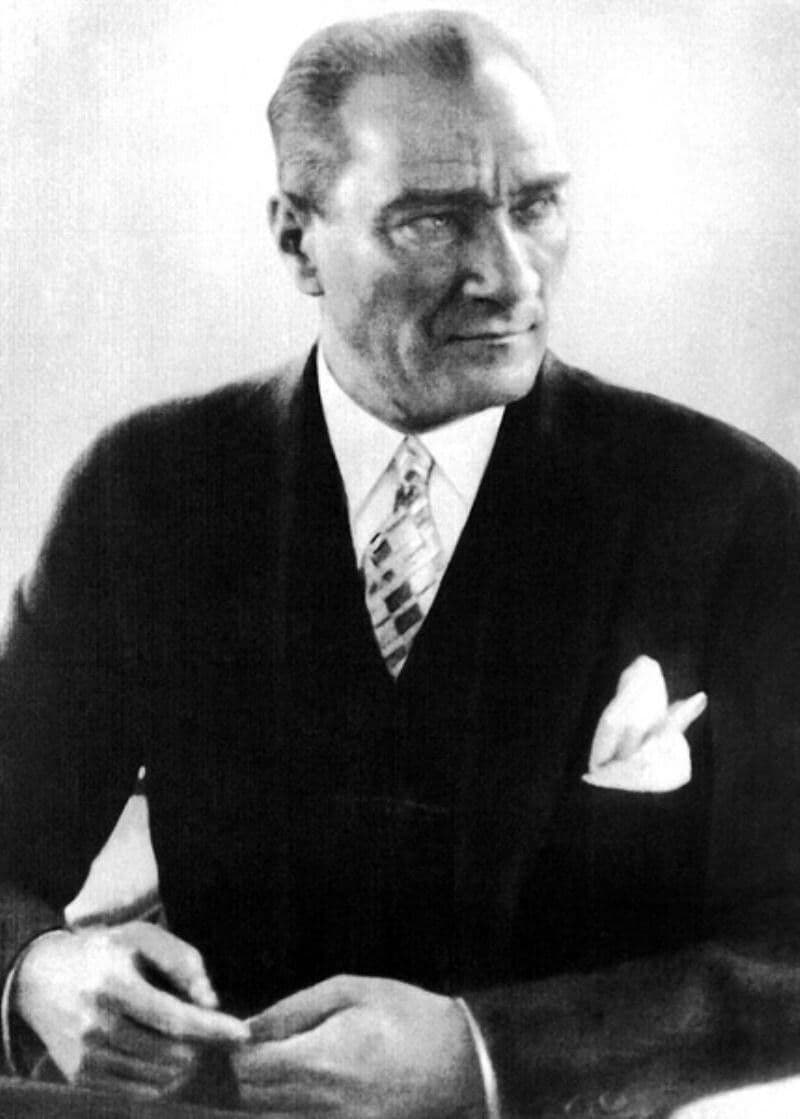 Wikimedia Commons
Mustafa Kemal Atatürk Biography
Biography
Early Life
Mustafa Kemal Atatürk was born in 1881 in Salonika, then part of the Ottoman Empire and now Thessaloniki, Greece. His parents were Ali Rıza Efendi and Zübeyde Hanım. He had several siblings, but only his sister Makbule survived into adulthood.
Atatürk began his education at a neighborhood school before transferring to Şemsi Efendi School. His father died when Mustafa was still young, after which he spent some time with relatives before continuing his education.
Military Education
Mustafa Kemal entered a military preparatory school in Salonika in 1893. It was during his studies there that his mathematics teacher gave him the additional name "Kemal," meaning perfection or maturity.
He later attended the Manastır Military High School and continued his military education in Istanbul. He graduated from the War Academy in 1905 with the rank of staff captain.
His early military assignments included service in Damascus and later positions within the Ottoman military establishment.
Early Military Career
Atatürk took part in several important military and political developments during the final years of the Ottoman Empire. He served in the Italo-Turkish War and the Balkan Wars and gained experience in military planning and command.
In 1913, he was appointed military attaché in Sofia. These experiences contributed to his development as a senior military officer.
World War I and the Gallipoli Campaign
Atatürk became internationally recognized for his role during the Gallipoli Campaign of World War I.
In 1915, he commanded Ottoman forces during important battles on the Gallipoli Peninsula. His leadership contributed to the Ottoman defense against the Allied landing forces.
His reputation as a military commander grew significantly during the campaign. He later served on several other fronts during World War I, including the Caucasus and Syria.
Turkish War of Independence
After the Ottoman Empire's defeat in World War I and the occupation of parts of Anatolia, Mustafa Kemal emerged as a leading figure in the Turkish national movement.
He arrived in Samsun on May 19, 1919, a date later commemorated in Turkey as the beginning of the national struggle. He subsequently helped organize national resistance through the Amasya Circular and the congresses of Erzurum and Sivas.
In April 1920, the Turkish Grand National Assembly was established in Ankara, and Mustafa Kemal became its first Speaker and head of the government.
Military Leadership
Under Mustafa Kemal's leadership, the national movement organized a regular army and fought against forces occupying Anatolian territory.
Important stages of the conflict included the battles of İnönü, the Battle of Sakarya in 1921, and the Great Offensive and Battle of Dumlupınar in 1922.
Following the victory at Sakarya, the Grand National Assembly awarded Mustafa Kemal the rank of Field Marshal and the title "Gazi," meaning veteran or victorious warrior.
The Turkish War of Independence concluded diplomatically with the Treaty of Lausanne in 1923.
Establishment of the Republic of Türkiye
The Ottoman Sultanate was abolished in 1922, ending the political authority of the Ottoman monarchy.
On October 29, 1923, the Republic of Türkiye was proclaimed, and Mustafa Kemal was unanimously elected its first President. He was subsequently reelected by the Grand National Assembly in 1927, 1931, and 1935.
As president, Atatürk pursued an extensive program of state modernization and institutional reform.
Political and Social Reforms
Atatürk's government introduced major changes to Turkey's political and social structure.
The Sultanate was abolished in 1922, the Republic was proclaimed in 1923, and the Caliphate was abolished in 1924.
Other reforms included changes to dress and headgear regulations, the closure of dervish lodges and shrines, adoption of the surname system, and changes to calendars, timekeeping, and measurements. Women also received expanded legal and political rights during the period of Atatürk's reforms.
Legal Reforms
Atatürk's government replaced major elements of the Ottoman legal system with new legislation based largely on European legal models.
The Turkish Civil Code and other laws were introduced as part of the effort to create a modern legal framework and establish a secular state structure.
These reforms significantly changed family law, civil rights, courts, and the relationship between religion and state institutions.
Educational and Cultural Reforms
Education was another major area of reform.
The government unified the country's educational institutions and introduced a new Turkish alphabet based on Latin script in 1928. The Turkish Historical Society and Turkish Language Association were established in the early 1930s, while university education was reorganized in 1933.
These changes were intended to increase literacy, strengthen national institutions, and reshape education and cultural life in the new republic.
Economic Development
Atatürk's government also pursued economic modernization. Agricultural production was encouraged, industrial development was promoted, and infrastructure projects were expanded.
Development plans during the 1930s supported industrialization and the construction of transportation infrastructure. These policies were part of a broader effort to establish an economically independent and modern Turkish state.
The Surname Atatürk
Turkey's Surname Law was introduced in 1934. On November 24, 1934, the Turkish Grand National Assembly granted Mustafa Kemal the surname "Atatürk."
The name is associated with the founding of the modern Turkish Republic and his central role in its establishment.
Personal Life and Interests
Mustafa Kemal Atatürk married Latife Hanım in 1923, and their marriage ended in 1925.
He had no biological children but adopted several children and took responsibility for their education and welfare.
Atatürk enjoyed reading, music, horse riding, swimming, dancing, and billiards. He also had a substantial personal library and was interested in language, history, culture, and science.
He spoke French and German and regularly met scholars, artists, and statesmen to discuss national and international issues.
Death
Mustafa Kemal Atatürk died on November 10, 1938, at 9:05 a.m. at Dolmabahçe Palace in Istanbul after suffering from cirrhosis of the liver.
He was initially buried at the Ankara Ethnography Museum. In 1953, his remains were transferred to Anıtkabir, the monumental mausoleum in Ankara that became his permanent resting place.
Legacy
Mustafa Kemal Atatürk remains the central founding figure of the Republic of Türkiye. His leadership during the Turkish War of Independence and his subsequent reforms fundamentally changed the country's political institutions, legal system, education, culture, and social structure.
His legacy is closely associated with the establishment of the Turkish Republic and the modernization program carried out during its early years. His life and political reforms continue to be studied in Turkish history and internationally.
Did you know?
Mustafa Kemal was given the surname “Atatürk” by the Turkish Grand National Assembly on November 24, 1934, after Turkey introduced its modern surname system.