Monarch · Ancient Rome
Marcus Aurelius
Marcus Aurelius (121–180 CE) was a Roman emperor, philosopher, and one of the most prominent representatives of Stoicism. He ruled the Roman Empire from 161 until his death in 180, sharing power initially with Lucius Verus. Known as the “Philosopher Emperor,” he is best remembered for his work *Meditations*, a collection of personal reflections on duty, self-discipline, virtue, and accepting life's challenges. His reign was marked by military conflicts, epidemics, and challenges along the Roman Empire's frontiers.
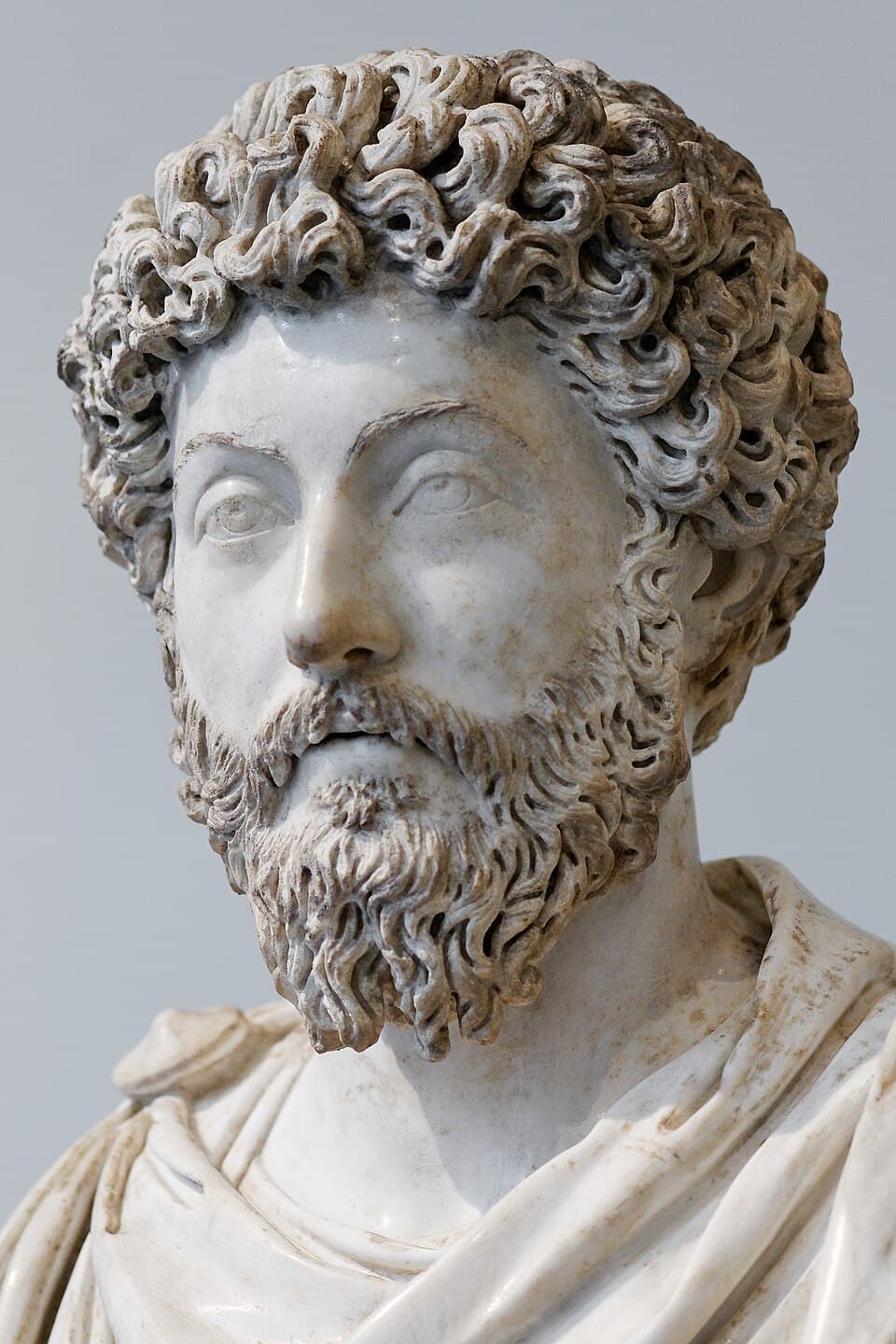 Wikimedia Commons
Marcus Aurelius: Full Biography
Biography
Early Life and Birth
Marcus Aurelius was born Marcus Annius Verus on April 26, 121 CE, in Rome, the capital of the Roman Empire. He came from a prominent family with strong connections to Roman political and social life.
His birth occurred during the reign of Emperor Hadrian, a period when the Roman Empire was relatively prosperous and enjoyed extensive territorial influence. Marcus received an education suited to an elite Roman child and was introduced to literature, philosophy, rhetoric, and public affairs from an early age.
He would eventually become one of Rome's most respected emperors and one of the most influential philosophical figures of the ancient world.
Family Background
Marcus was the son of Marcus Annius Verus, a Roman senator, and Domitia Lucilla, who came from a wealthy and influential family.
His father died when Marcus was young, and he was raised largely under the care of his mother and grandfather. His family connections helped bring him to the attention of Emperor Hadrian, who recognized his potential.
Marcus was later adopted by Antoninus Pius, who had been designated Hadrian's successor. This adoption placed Marcus directly in the line of imperial succession and shaped the course of his life.
Childhood and Education
Marcus received an extensive education in grammar, rhetoric, literature, and philosophy. He studied with respected teachers and developed a particularly strong interest in Stoicism, a philosophical tradition that emphasized reason, virtue, self-control, and living in accordance with nature.
Among his teachers was the Stoic philosopher Junius Rusticus, who introduced him to philosophical writings that deeply influenced his thinking.
Marcus gradually became less interested in luxury and public display and more committed to discipline, reflection, and moral responsibility. His education helped shape his approach to leadership and his understanding of the emperor's obligations.
Influence of Emperor Hadrian
Emperor Hadrian took an interest in Marcus and helped guide his future. Because Hadrian had no surviving biological son to inherit the throne, he arranged a succession plan that involved adopting Antoninus Pius and requiring Antoninus to adopt Marcus Aurelius and Lucius Verus.
This arrangement helped maintain continuity in imperial leadership. Marcus was still a young man when his future role as emperor became clear.
Hadrian's decision established the framework through which Marcus eventually rose to power, although Antoninus Pius would remain emperor for more than two decades before Marcus succeeded him.
Adoption by Antoninus Pius
In 138 CE, Marcus was adopted by Antoninus Pius, who became emperor following Hadrian's death. Marcus then took the name Marcus Aelius Aurelius Verus, later becoming known as Marcus Aurelius.
Antoninus Pius provided Marcus with practical experience in government and public administration. Marcus served in important political positions and learned about the responsibilities of managing the empire.
Their relationship was generally regarded as close and respectful. Marcus later praised Antoninus for his moderation, patience, simplicity, and sense of duty.
Marriage to Faustina the Younger
Marcus married Faustina the Younger, the daughter of Antoninus Pius, around 145 CE. The marriage strengthened his connection to the imperial family and was important to the succession arrangements.
The couple had numerous children, although several died during childhood. Their surviving children included Lucilla, who married Lucius Verus, and Commodus, who later succeeded Marcus as emperor.
Marcus's family life was an important part of his personal world, and his writings reveal that he thought deeply about his responsibilities as a husband, father, and ruler.
Becoming Emperor of Rome
Antoninus Pius died in March 161 CE, and Marcus Aurelius became emperor. In an unusual decision for the Roman Empire, Marcus insisted that Lucius Verus, his adoptive brother, be made co-emperor.
Lucius Verus shared imperial authority with Marcus until his death in 169 CE. Although Marcus held the senior position, the arrangement established a precedent for joint imperial rule.
Marcus inherited a vast empire with a complex administrative system, extensive trade networks, and powerful military forces. However, the empire soon faced major external threats and internal difficulties.
The Roman Empire Under Marcus Aurelius
Marcus ruled during a challenging period in Roman history. The empire faced invasions along its borders, military campaigns in the East, and a devastating epidemic that affected large areas of the population.
Despite these pressures, Roman institutions continued to function, and the emperor worked to maintain the army, administer justice, and oversee public finances.
His reign is often associated with the end of the period commonly called the Pax Romana, a long era of relative stability that had begun under Augustus. The difficulties of his rule exposed the vulnerabilities of even a powerful empire.
The Parthian War
Soon after Marcus became emperor, Rome faced conflict with the Parthian Empire in the East. Parthian forces challenged Roman influence in Armenia and other territories near the empire's eastern frontier.
Lucius Verus was sent east to oversee the campaign, while experienced Roman commanders led much of the military activity. Roman forces eventually achieved important victories and captured key enemy cities.
However, returning troops are thought to have contributed to the spread of a major epidemic, commonly called the Antonine Plague. The disease caused extensive loss of life and placed additional strain on Roman society.
The Antonine Plague
The Antonine Plague spread through the Roman Empire during Marcus Aurelius's reign, beginning in the 160s CE. Scholars have debated its exact cause, although smallpox is one leading possibility.
The epidemic killed large numbers of people, including soldiers and civilians. It disrupted trade, reduced the available workforce, and created difficulties for military recruitment and public administration.
The outbreak was one of the most serious crises of Marcus's reign. It demonstrated that the empire's strength could be undermined not only by warfare but also by disease and demographic decline.
The Marcomannic Wars
The northern frontiers of the Roman Empire came under increasing pressure from Germanic peoples, including the Marcomanni and Quadi, as well as other groups.
Beginning in the late 160s CE, Marcus led or directed a series of campaigns along the Danube frontier. These conflicts became known collectively as the Marcomannic Wars.
The wars demanded enormous military and financial resources. Roman forces fought to repel invasions, restore frontier security, and prevent further incursions into imperial territory.
Marcus spent much of his later life near military camps rather than in Rome. His experiences on campaign influenced the reflective tone of Meditations, in which he repeatedly considered duty, endurance, and the temporary nature of worldly success.
Leadership During Wartime
Marcus's approach to leadership emphasized personal responsibility and perseverance. He faced the practical problems of supplying armies, responding to emergencies, and maintaining the loyalty of military commanders.
Ancient sources portray him as a serious and conscientious ruler who sought to fulfill his obligations even under difficult conditions. His philosophical commitments encouraged him to distinguish between events beyond his control and actions for which he was personally responsible.
His military leadership did not mean that he rejected force. As emperor, he directed campaigns intended to protect Roman territory and preserve the empire's political order.
Marcus Aurelius as a Stoic Philosopher
Marcus Aurelius is one of the most famous figures associated with Stoicism. Stoic philosophy teaches that people should develop wisdom, justice, courage, and self-control while recognizing that many external events lie beyond their control.
For Marcus, philosophy was not simply an abstract intellectual pursuit. It was a practical discipline intended to shape everyday conduct, particularly when facing frustration, fear, anger, hardship, and responsibility.
His reflections repeatedly return to the importance of acting fairly, treating others with patience, and avoiding excessive attachment to wealth, reputation, or power.
Meditations
Marcus Aurelius's best-known work is Meditations, written in Greek and preserved as a collection of personal reflections. Scholars
Did you know?
- Marcus Aurelius was born in Rome on April 26, 121 CE. - He became emperor in 161 CE and initially ruled alongside Lucius Verus. - He wrote *Meditations* in Greek as a series of personal philosophical reflections. - His reign was marked by the Antonine Plague and prolonged military campaigns along the Danube frontier. - He was one of the emperors traditionally known as the “Five Good Emperors.” - His son Commodus succeeded him in 180 CE. - The Column of Marcus Aurelius in Rome depicts scenes from his military campaigns. - Marcus Aurelius is widely remembered as the “Philosopher Emperor” because of his commitment to Stoic philosophy.