Explorer · Republic of Venice
Marco Polo
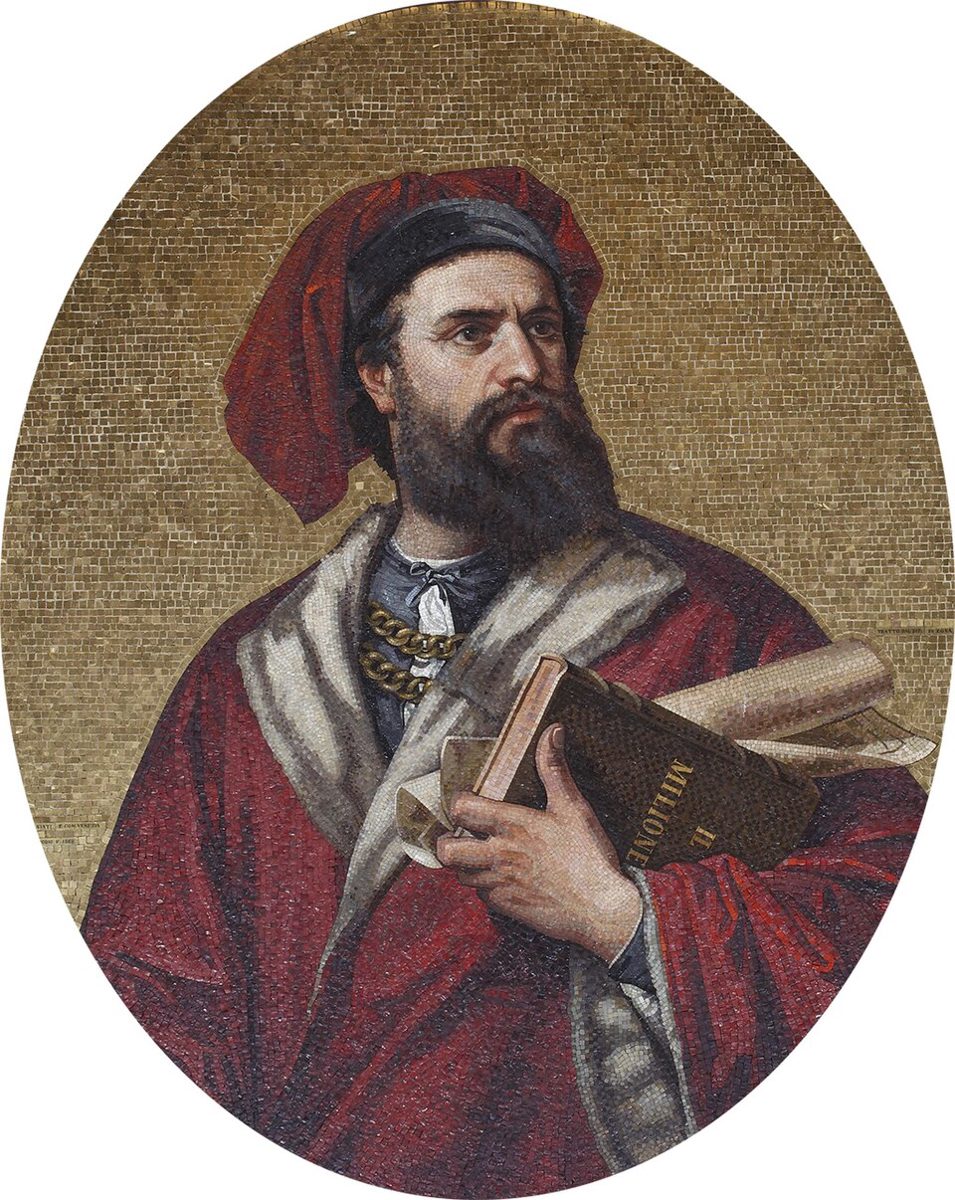
Marco Polo was a Venetian merchant, explorer, and travel writer who became famous for his journeys across Asia during the thirteenth century. Born around 1254 in the Republic of Venice, he traveled with his father, Niccolò Polo, and uncle, Maffeo Polo, on a long journey that brought him to the court of Kublai Khan, the Mongol ruler of China. After returning to Venice, Marco's experiences were recorded in *The Travels of Marco Polo*, a book that introduced many European readers to Asian societies, trade, geography, and customs. Although some details of his account remain debated by historians, his story became one of the most influential travel narratives of the medieval period.
 Wikimedia Commons
Biography
1. Introduction
Marco Polo was a Venetian merchant and travel writer whose accounts of Asia became among the most famous travel narratives of the medieval world. His journeys took place during the height of the Mongol Empire, when trade and communication connected Europe, the Middle East, Central Asia, and China.
Polo is best known for his reported experiences at the court of Kublai Khan, the Mongol ruler who established the Yuan dynasty in China. His descriptions of Asian cities, commercial networks, political institutions, and customs introduced many European readers to places and societies that were unfamiliar to them.
Although historians continue to debate certain details of his journeys, Marco Polo remains an important figure in the history of travel writing, cross-cultural exchange, and medieval geographical knowledge.
2. Early Life and Family Background
Marco Polo was born around 1254 in Venice, a prosperous maritime republic in what is now Italy. His family belonged to the merchant community, which played an important role in trade between Europe and the eastern Mediterranean.
His father, Niccolò Polo, and his uncle, Maffeo Polo, were merchants who traveled extensively in search of commercial opportunities. They undertook journeys through the Black Sea region and Central Asia and eventually reached the territories controlled by the Mongol Empire.
Because his father was away for much of his early childhood, Marco grew up largely under the care of relatives. His mother died when he was young, according to traditional accounts of his life.
His family's trading background exposed him to a world in which merchants crossed political and cultural boundaries to exchange goods, information, and ideas. This environment helped prepare him for the long journey that would later make him famous.
3. Education and Early Interests
Little is known about Marco Polo's formal education. Unlike many later explorers, he did not leave behind a detailed account of his childhood, school experiences, or early intellectual development.
Growing up in Venice would have exposed him to maritime commerce, merchant families, foreign goods, and travelers from different regions. Practical knowledge of trade, negotiation, and commercial relationships was especially valuable in this environment.
Polo's later travel narrative demonstrates familiarity with trading practices, geography, political organization, and cultural customs. However, historians cannot establish precisely how much of this knowledge came from direct experience, conversations with other travelers, or information gathered during his commercial activities.
His education was therefore closely associated with the practical world of medieval trade and travel rather than a documented university career.
4. The Journey Across Asia
In 1271, Marco Polo joined his father and uncle on a journey from Europe toward Asia. He was approximately 17 years old at the time.
The Polos traveled through the eastern Mediterranean and continued across regions of the Middle East and Central Asia. Their route passed through areas connected by commercial networks later commonly associated with the Silk Road.
The journey was demanding. Travelers faced difficult terrain, harsh climates, long distances, political uncertainty, and the practical challenges of obtaining food and shelter.
Rather than following one single road, merchants used a network of routes that connected trading cities, caravan stations, ports, and regional markets. These routes enabled the movement of silk, spices, precious stones, textiles, and other goods.
According to Marco Polo's account, the family eventually reached the court of Kublai Khan around 1275. Their journey gave Polo an opportunity to observe societies that differed substantially from those of medieval Europe.
5. Meeting Kublai Khan
Kublai Khan was one of the most powerful rulers of the thirteenth century. A grandson of Genghis Khan, he established the Yuan dynasty in China and governed an extensive empire that connected many regions of Asia.
Marco Polo's narrative describes the grandeur of Kublai's court, the administration of his territories, and the commercial activities supported under Mongol rule.
According to the account, Kublai welcomed the Venetian travelers and became interested in their knowledge of distant lands. Marco claimed that he gained the ruler's confidence and undertook assignments on his behalf.
These stories helped establish the central theme of Polo's book: the extraordinary scale, wealth, and diversity of the Mongol-ruled world.
The precise nature of Marco's official position remains uncertain. His account portrays him as a trusted emissary, but historians cannot independently verify every responsibility he described.
6. Life in Mongol China
Marco Polo's narrative describes many aspects of life in China during the Yuan dynasty. He wrote about large cities, busy markets, commercial activities, transportation networks, and the administration of the empire.
One subject that particularly impressed him was the use of paper money. While European economies relied heavily on metal coins, the monetary system he described demonstrated how paper currency could support commerce across a large territory.
Polo also discussed coal, postal and communication systems, bridges, canals, and the movement of goods between cities. His descriptions gave European readers a picture of an economically sophisticated society with extensive infrastructure.
He devoted considerable attention to the city of Khanbaliq, now known as Beijing, and to the summer residence associated with Kublai Khan at Shangdu, often identified with the legendary name Xanadu.
These accounts are valuable for understanding how a medieval European traveler perceived Asia. Nevertheless, some descriptions contain exaggerations, errors, or information that may have come from other people rather than firsthand observation.
7. Travels and Missions Across Asia
According to his book, Marco Polo traveled to different regions of the Mongol Empire on official assignments. These journeys allegedly took him through several parts of China and to other areas of Asia.
He described cities, local industries, religious traditions, trading practices, and the customs of communities he encountered. His narrative included information about regional products and the economic importance of ports and inland commercial centers.
Polo's descriptions of trade were particularly significant because merchants depended on reliable knowledge of markets, transportation routes, political conditions, and available goods.
Some accounts also describe journeys to regions corresponding to parts of present-day Myanmar and other areas of Asia. The exact routes and extent of his travels remain subjects of historical discussion.
Regardless of the uncertainty surrounding individual episodes, his book preserved a wide range of geographical and cultural observations that attracted generations of readers.
8. The Return Journey to Europe
After spending many years in Asia, the Polo family eventually sought permission to return to Venice. Their account describes how Kublai Khan agreed to let them leave on the condition that they accompany a Mongol princess traveling to Persia.
Around 1292, the Polos joined a maritime expedition carrying the princess, traditionally identified as Kököchin, toward her intended marriage.
The voyage involved travel through Southeast Asian waters and the Indian Ocean before reaching Persia. The journey was dangerous, and the narrative reports significant losses among those traveling with the expedition.
After reaching Persia, the Polos continued toward Europe through routes that included parts of the Middle East and the eastern Mediterranean.
They returned to Venice around 1295, completing an absence that had lasted more than two decades. Their return brought them back to a city whose commercial and political environment had continued to change during their travels.
9. Capture and Imprisonment in Genoa
After returning to Venice, Marco Polo resumed his involvement in the merchant world. In 1298, during a conflict between Venice and its rival maritime republic, Genoa, he was captured and imprisoned.
While in captivity, he encountered Rustichello of Pisa, a writer familiar with medieval romance literature. Polo recounted his experiences, and Rustichello helped put them into written form.
The resulting work became known through several titles, including The Description of the World and The Travels of Marco Polo. It circulated in different manuscript versions and languages, meaning that the surviving text does not represent one simple, universally fixed original.
The collaboration between a Venetian traveler and a writer experienced in storytelling helped turn Polo's experiences into a narrative that could reach readers far beyond his immediate circle.
The book's combination of geographical description, commercial information, courtly stories, and extraordinary accounts made it popular and influential.
10. The Travels of Marco Polo
The Travels of Marco Polo is the work most closely associated with his name. It describes the lands, peoples, rulers, and commercial systems that Polo claimed to have encountered during his journeys.
The narrative contains accounts of the Mongol court, Chinese cities, trade routes, regional industries, and unfamiliar customs. It also includes stories that modern readers may regard as exaggerated or difficult to verify.
The book was not written in the form of a modern travel diary. Rustichello's literary contribution, the manuscript tradition, and the conventions of medieval travel writing all influenced how the stories were presented.
Over time, the work became an important source for Europeans interested in Asia. It helped stimulate curiosity about distant societies and the commercial possibilities of eastern trade.
Its historical value must nevertheless be assessed carefully. Some descriptions correspond with other evidence, while other claims remain uncertain or disputed.
11. Family and Personal Life
After returning to Venice, Marco Polo married Donata Badoer around 1300. Historical accounts identify three daughters: Fantina, Bellela, and Moreta.
Polo continued participating in commercial and legal affairs after his return. Surviving records provide some information about his activities, although many details of his private life remain unknown.
Unlike modern celebrities or public figures, he left relatively little personal documentation outside the travel narrative and a limited number of historical records.
His book concentrates primarily on the places and societies he described rather than on his emotions, relationships, or daily routines. As a result, historians know much more about the image he presented of Asia than about many aspects of his personal character.
12. Historical Debates About His Travels
Marco Polo's travels have generated debate among historians. Most scholars accept that he was a real Venetian merchant who produced a significant account of Asia, but questions remain about particular episodes in the narrative.
Some researchers have examined the absence of his name from certain surviving Chinese records and his failure to mention practices or objects that modern readers might expect to find in an account of China.
Others emphasize the geographical detail, commercial observations, and historical information contained in his work. They argue that the narrative includes knowledge consistent with conditions in Mongol-ruled Asia during the period.
It is also possible that parts of the book drew on information obtained from other travelers and merchants. Medieval travel literature often combined personal experience with secondhand reports.
The historical debate therefore concerns the reliability and origins of specific details rather than simply whether Polo existed. His narrative remains an important source, but individual claims should be evaluated in their historical context.
13. Death and Final Years
Marco Polo died in Venice on January 8, 1324, at approximately 69 years of age. His final years were spent in the city where he had been born and where his family had established its commercial connections.
According to a well-known tradition, people urged him near the end of his life to admit that some of the extraordinary stories in his book were untrue. The story maintains that he refused because he had not described everything he had seen.
Although this episode has become part of his popular legend, it should be treated as a traditional account rather than an independently verified transcript of his final words.
After his death, his travel narrative continued circulating in manuscript form. Its reputation grew over the centuries as European readers became increasingly interested in geographical exploration and Asian trade.
14. Influence on Later Explorers
Marco Polo's narrative influenced later generations of travelers, merchants, and geographical thinkers. His descriptions helped stimulate European curiosity about Asian societies, commercial wealth, and long-distance routes.
Christopher Columbus is often associated with Polo's book. Columbus owned a copy of a version of the travel narrative and made annotations in it while considering geographical questions related to his own voyages.
Polo's account contributed to the wider body of geographical literature available to Europeans before the major voyages of the late fifteenth and sixteenth centuries.
However, it would be inaccurate to attribute the later age of exploration to Polo alone. European maritime expansion also resulted from commercial competition, advances in navigation, political developments, and the search for alternative trade routes.
His book was one important influence within a much larger historical process.
15. Major Achievements and Contributions
Marco Polo's historical significance rests primarily on his travel narrative and its influence on European knowledge of Asia.
His major contributions include:
- Producing one of the best-known medieval European accounts of travel across Asia.
- Describing aspects of Mongol imperial administration and the court of Kublai Khan.
- Recording observations about Asian cities, commerce, transportation, and regional customs.
- Introducing many European readers to accounts of paper currency and other unfamiliar economic practices.
- Helping stimulate European interest in Asian geography and long-distance trade.
- Contributing to the development of travel literature as a way of communicating geographical and cultural knowledge.
Although Polo was not the first European to travel to Asia, the popularity and breadth of his narrative helped distinguish his place in history.
16. Cultural Legacy and Popular Recognition
Marco Polo's name has become synonymous with exploration, long-distance travel, and curiosity about unfamiliar cultures. His story has inspired books, documentaries, television productions, and other forms of popular entertainment.
The traditional image of Polo as a traveler who crossed vast distances to visit an extraordinary imperial court has remained compelling for centuries.
His name has also been used in popular games and cultural references. The swimming-pool game called “Marco Polo,” for example, shares his name but is not a historical activity associated with the explorer.
Modern interpretations of his life sometimes simplify the complexity of medieval trade and travel. In reality, merchants and travelers from many regions helped connect Europe and Asia long before and during Polo's lifetime.
His lasting importance lies in the way his narrative preserved and transmitted knowledge about the interconnected world of the thirteenth century.
17. Conclusion
Marco Polo's journey from Venice across Asia and his reported experiences under Kublai Khan became the foundation of one of history's most famous travel narratives.
His book described unfamiliar cities, commercial systems, rulers, and cultures, encouraging European readers to imagine the scale and diversity of Asia. Although some details remain disputed, the work continues to provide insight into medieval travel writing and European perceptions of the Mongol world.
Marco Polo's legacy is not simply that of an individual traveler. It also reflects the wider networks of merchants, empires, and cultural exchange that connected distant regions during the medieval period. His story remains an enduring part of world history and the history of exploration.
Did you know?
- Marco Polo was approximately 17 years old when he began his famous journey toward Asia with his father and uncle in 1271. - His father, Niccolò Polo, and uncle, Maffeo Polo, had traveled to Mongol territories before Marco joined them. - According to his narrative, Marco spent many years at the court of Kublai Khan. - He described the use of paper money in China, a system that was unfamiliar to many European readers of his time. - His travel narrative was written down with the help of Rustichello of Pisa while the two men were imprisoned in Genoa. - Christopher Columbus owned and annotated a copy of a version of Marco Polo's travel account. - Marco Polo's book circulated under several titles, including *The Description of the World* and *The Travels of Marco Polo*. - He returned to Venice around 1295 after spending more than two decades away. - Historians continue to debate certain details of his account, including the precise extent of his travels. - Marco Polo died in Venice on January 8, 1324.