Writer · Russian Empire
Leo Tolstoy
Count Leo Tolstoy (1828–1910) was a Russian novelist, philosopher, and social thinker widely regarded as one of the greatest writers in world literature. Born into an aristocratic family, he wrote major works including *War and Peace* and *Anna Karenina*. His later life was strongly influenced by religious and moral ideas, including nonviolence, simplicity, and criticism of social inequality. His writings influenced literature, philosophy, and social movements around the world.
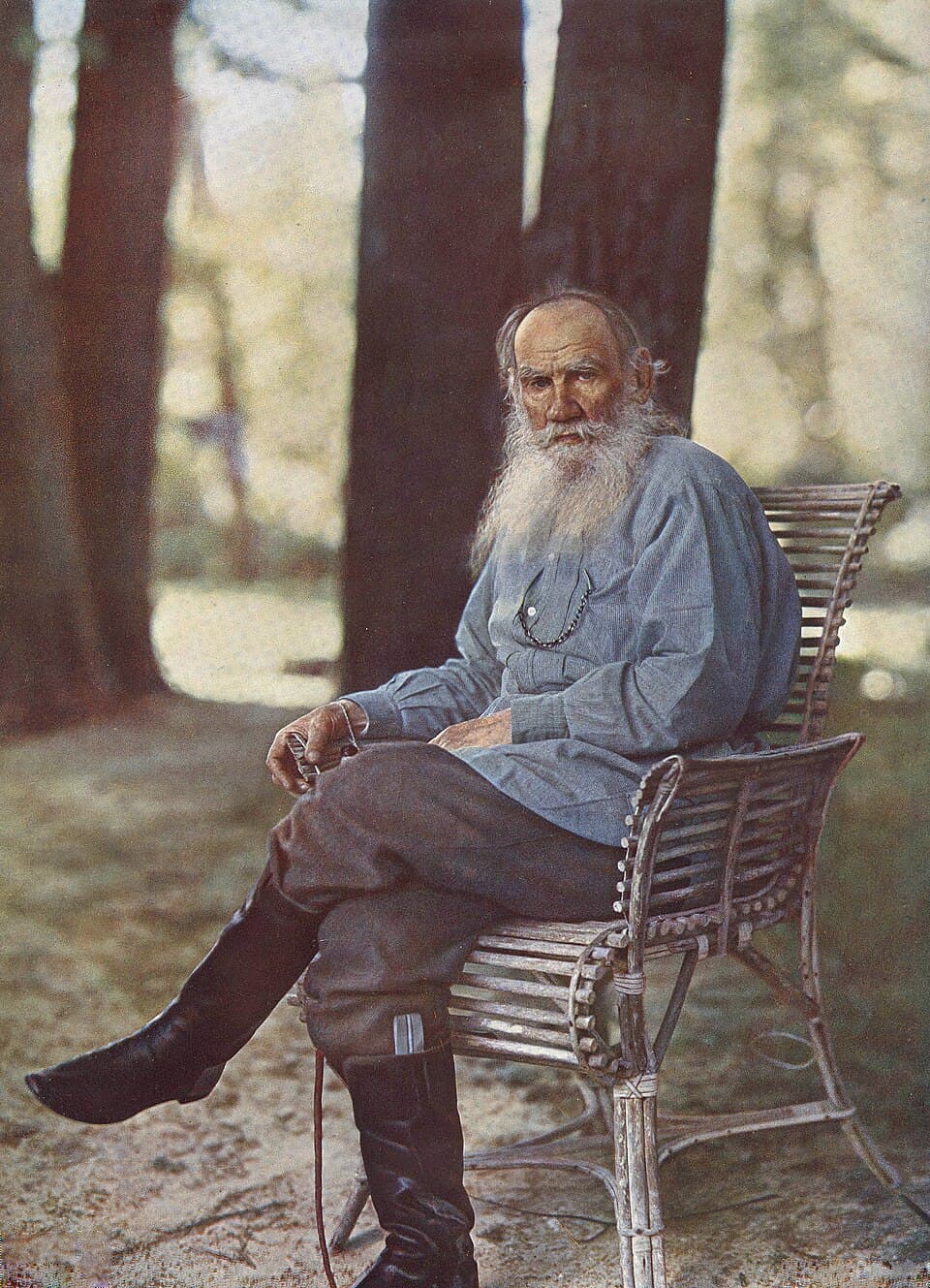 Wikimedia Commons
Leo Tolstoy Biography
Biography
Early Life
Lev Nikolayevich Tolstoy, widely known in English as Leo Tolstoy, was born on September 9, 1828, at Yasnaya Polyana, the family estate in the Russian Empire.
He was born into an aristocratic Russian family. Tolstoy lost both of his parents at a young age and was raised with the help of relatives.
His privileged upbringing exposed him to literature, education, and the traditions of the Russian aristocracy. However, his later writings frequently questioned the values and inequalities of the society into which he was born.
Education
Tolstoy studied at Kazan University beginning in 1844 but did not complete a degree. He returned to his family's estate and began exploring literature, philosophy, and questions about morality and human behavior.
During his youth, he struggled with gambling, social ambitions, and personal discipline. He later began keeping detailed diaries, which became an important part of his lifelong effort at self-examination.
Military Service
In the 1850s, Tolstoy joined the Russian army. He served in the Caucasus and later participated in the Crimean War.
His experiences as a soldier had a profound influence on his writing. They provided material for works such as The Cossacks and Sevastopol Sketches.
Tolstoy's observations of war eventually contributed to his increasingly critical view of violence and military glory.
Early Literary Career
Tolstoy's first major literary success came with Childhood, published in 1852. It was followed by Boyhood and Youth, forming a semi-autobiographical trilogy.
His Sevastopol Sketches, based on his experiences during the Crimean War, further established his reputation as an important Russian writer.
Tolstoy's early works demonstrated his interest in psychological realism and the inner lives of his characters.
War and Peace
Tolstoy began writing War and Peace in the 1860s. The novel was published in serial form between 1865 and 1869.
Set during the Napoleonic Wars and the invasion of Russia, the novel combines fictional characters with historical events and real historical figures.
War and Peace explores war, family, love, society, history, and the relationship between individuals and larger historical forces. It is widely regarded as one of the greatest novels ever written.
Anna Karenina
Tolstoy's second major masterpiece, Anna Karenina, was published between 1873 and 1877.
The novel follows Anna Karenina, a married aristocratic woman whose relationship with Count Vronsky leads to social conflict and personal tragedy.
Alongside Anna's story, the novel follows Konstantin Levin, whose struggles with family, work, faith, and meaning reflect many of Tolstoy's own concerns.
The novel is celebrated for its psychological depth, complex characters, and detailed portrayal of Russian society.
Spiritual and Moral Transformation
During the 1870s and 1880s, Tolstoy experienced a profound spiritual and philosophical crisis.
He became increasingly concerned with questions about the meaning of life, death, morality, religion, and human suffering. He rejected many aspects of the Russian Orthodox Church and developed his own interpretation of Christian teachings.
His later philosophy emphasized love, moral responsibility, simplicity, nonviolence, and resistance to injustice.
Religious and Philosophical Writings
Tolstoy wrote extensively about religion, ethics, government, poverty, and social inequality.
Among his important philosophical and religious works are A Confession, The Kingdom of God Is Within You, and What Is to Be Done?
He argued that people should live according to conscience and moral principles rather than relying on violence or coercion.
His interpretation of Christianity was highly critical of institutional religious and political authority.
Nonviolence and Social Influence
Tolstoy became an important advocate of nonviolence and peaceful resistance.
His writings influenced people around the world who were interested in pacifism, social reform, and moral resistance to oppression.
Mahatma Gandhi corresponded with Tolstoy and was strongly influenced by his ideas about nonviolence and moral resistance. Tolstoy's influence also extended to later thinkers and social activists.
Later Literary Works
Although Tolstoy is best known for War and Peace and Anna Karenina, he continued producing important works throughout his later life.
His shorter works include The Death of Ivan Ilyich, The Kreutzer Sonata, and Hadji Murat.
One of his best-known later novels, Resurrection, was published in 1899. The novel strongly criticized social injustice, institutional religion, and the Russian legal system.
Family Life
Tolstoy married Sofia Behrs in 1862. They had a large family and spent much of their married life at Yasnaya Polyana.
Sofia played an important role in managing the household and supporting Tolstoy's literary work. She also copied and edited many of his manuscripts.
Their relationship became increasingly complicated as Tolstoy's religious and social views changed and created conflicts over property, wealth, family responsibilities, and his desire for a simpler life.
Final Years
In his later years, Tolstoy became increasingly dissatisfied with aristocratic privilege and his own wealth.
He sought to live more simply and gave greater attention to poverty, morality, and social inequality. His views attracted a large international following, while also creating tensions within his family.
Tolstoy's writings were closely monitored by Russian authorities, and some of his works were censored or restricted.
Death
In 1910, at the age of 82, Tolstoy left his home in an attempt to live away from the conflicts surrounding his personal life.
He became ill during the journey and died on November 20, 1910, at the railway station of Astapovo in the Russian Empire.
He was buried at Yasnaya Polyana in accordance with his wishes.
Legacy
Leo Tolstoy is regarded as one of the greatest novelists in world literature. His works are admired for their realism, psychological depth, philosophical ideas, and detailed portrayal of human relationships.
War and Peace and Anna Karenina remain widely read and have been translated into numerous languages and adapted for film, television, and theater.
Beyond literature, Tolstoy's ideas about nonviolence, morality, religion, simplicity, and social justice influenced thinkers and reformers across the world.
His combination of literary achievement and moral philosophy made him one of the most influential intellectual figures of the nineteenth and early twentieth centuries.
Did you know?
Leo Tolstoy's novel *War and Peace* contains hundreds of characters and combines fictional stories with real historical events and figures from the Napoleonic era.