Writer · statelessness
Karl Marx
Karl Marx (1818–1883) was a German philosopher, economist, historian, journalist, and political thinker whose ideas profoundly influenced modern social and political thought. He developed a critical analysis of capitalism centered on class struggle, labor, and economic inequality. His major works include *The Communist Manifesto*, written with Friedrich Engels, and *Das Kapital*. Marx's ideas later became a major foundation of Marxism and influenced political movements around the world.
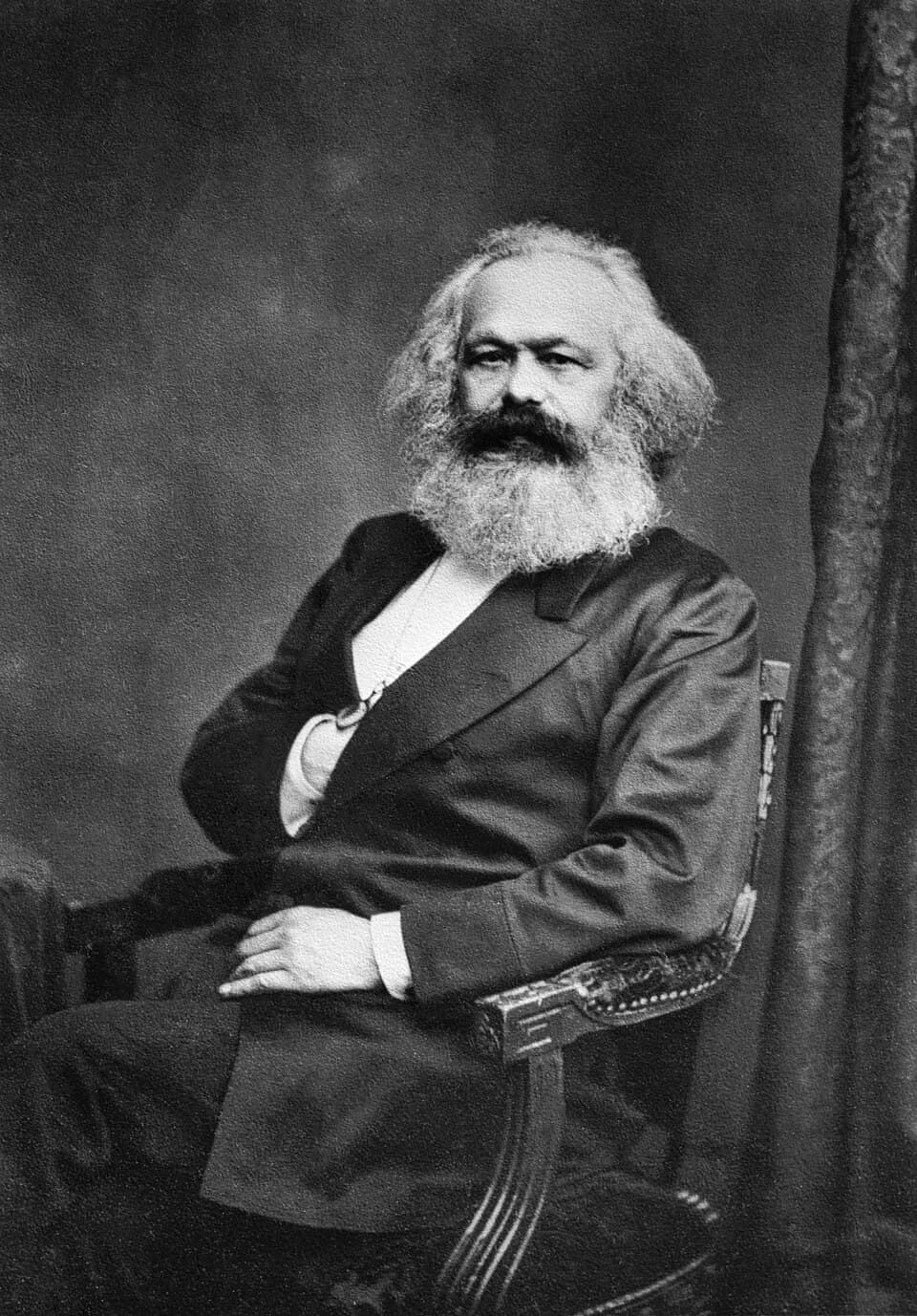 Wikimedia Commons
Karl Marx Biography
Biography
Early Life
Karl Marx was born on May 5, 1818, in Trier, in the Kingdom of Prussia. He came from a middle-class family. His father, Heinrich Marx, was a lawyer who converted from Judaism to Christianity before Karl's birth.
Marx grew up during a period of major political and economic change in Europe. The Industrial Revolution was transforming society, while debates about political freedom, economic inequality, and social reform were becoming increasingly important.
Education
Marx studied at the University of Bonn and later at the University of Berlin. He initially studied law but became increasingly interested in philosophy and history.
At Berlin, Marx became influenced by the philosophy of Georg Wilhelm Friedrich Hegel. He eventually joined intellectual circles known as the Young Hegelians, who critically examined religion, politics, and society.
He completed his doctoral dissertation in philosophy at the University of Jena in 1841.
Early Journalism and Political Thought
After completing his studies, Marx pursued journalism because an academic career was difficult amid the political restrictions of Prussia.
He became editor of the Rheinische Zeitung, a newspaper that criticized government policies and discussed social and economic problems.
The newspaper was eventually suppressed by the authorities, and Marx's political views became increasingly radical.
Move to Paris
In 1843, Marx moved to Paris, where he became involved with socialist and revolutionary thinkers.
Paris exposed him to a wide range of political and economic ideas. During this period, he developed a closer interest in the conditions of workers and the structure of capitalist society.
He also began his lifelong intellectual partnership with Friedrich Engels.
Friedrich Engels
Friedrich Engels became Marx's closest collaborator and friend.
Engels came from a wealthy industrial family but became deeply critical of the conditions experienced by industrial workers. His observations and writings strongly influenced Marx's understanding of capitalism.
Together, Marx and Engels developed many of the ideas that later became known as Marxism.
The Communist Manifesto
In 1848, Marx and Engels published The Communist Manifesto.
The work presented a theory of history based heavily on class conflict and argued that modern capitalist society was divided principally between the bourgeoisie, who controlled capital and the means of production, and the proletariat, who worked for wages.
The pamphlet called for political organization of the working class and became one of the most influential political texts in modern history.
Marx and the Revolutions of 1848
The year 1848 saw revolutionary movements across Europe.
Marx participated in political activities surrounding these upheavals and returned to Germany for a period. He became involved in revolutionary journalism and political organizing.
After the revolutionary movements failed, Marx faced increasing political pressure and eventually left Germany.
Life in London
In 1849, Marx settled in London, where he spent most of the rest of his life.
His early years in London were marked by poverty and financial difficulties. His family often struggled with limited income.
Marx continued researching economics, history, and politics while writing articles for newspapers and working on his major theoretical projects.
Das Kapital
Marx's most important economic work was Das Kapital.
The first volume was published in 1867. Marx examined the structure of capitalism, the production of commodities, labor, value, profit, and the accumulation of capital.
He argued that capitalist production created tensions between the owners of the means of production and wage workers.
The later volumes were published after Marx's death, with Friedrich Engels editing and organizing Marx's manuscripts.
Class Struggle
Class struggle is one of the central concepts associated with Marx's thought.
Marx argued that human history could be understood partly through conflicts between social classes with different economic interests.
In capitalist society, he focused particularly on the relationship between the bourgeoisie and the proletariat.
His analysis became a major influence on sociology, economics, political theory, and history.
Alienation and Labor
Marx also explored the relationship between workers and their labor.
He argued that under certain conditions of capitalist production, workers could become alienated from the products they create, the process of work, their own human potential, and other people.
These ideas were especially developed in his early writings and became influential in later social and philosophical theory.
Historical Materialism
Marx developed an approach to history often called historical materialism.
According to this perspective, the material conditions of production and the organization of economic life play a major role in shaping social institutions, politics, and historical change.
Marx believed that societies changed through tensions and conflicts arising from their economic structures.
Political Activism
Marx was not only a writer and philosopher but also an active political organizer.
In 1864, he became involved in the International Workingmen's Association, commonly known as the First International.
He played an important intellectual and organizational role in the international socialist movement.
The Paris Commune
The Paris Commune of 1871 became an important subject in Marx's political writings.
After the short-lived revolutionary government in Paris was defeated, Marx analyzed the event in The Civil War in France.
He regarded the Commune as an important historical experiment in working-class political organization.
Family Life
Marx married Jenny von Westphalen in 1843. They had several children, although the family experienced significant hardship and suffered the deaths of some children at young ages.
Jenny remained an important supporter of Marx throughout his difficult years of political exile and financial uncertainty.
Marx's close relationship with Friedrich Engels was also crucial to his ability to continue his intellectual work.
Later Years
During his later years, Marx continued researching economics and world history.
Although he became internationally known among socialist movements, he did not live to see the full political impact of his theories.
His health declined during the final years of his life, partly because of chronic illness and personal losses.
Death
Karl Marx died in London on March 14, 1883, at the age of 64.
He was buried at Highgate Cemetery in London.
Friedrich Engels delivered a memorial speech at his funeral and emphasize
Did you know?
Karl Marx's *Das Kapital* was published in 1867, but only the first volume was published during his lifetime; Friedrich Engels later edited Marx's manuscripts for the subsequent volumes.