Statesman · Ancient Rome
Julius Caesar
Gaius Julius Caesar (100–44 BCE) was a Roman general, statesman, and political leader. He conquered much of Gaul, played a major role in the Roman civil wars, and became dictator of Rome. His reforms included changes to the calendar and government. Caesar was assassinated on March 15, 44 BCE, an event that contributed to the final collapse of the Roman Republic and the rise of the Roman Empire.
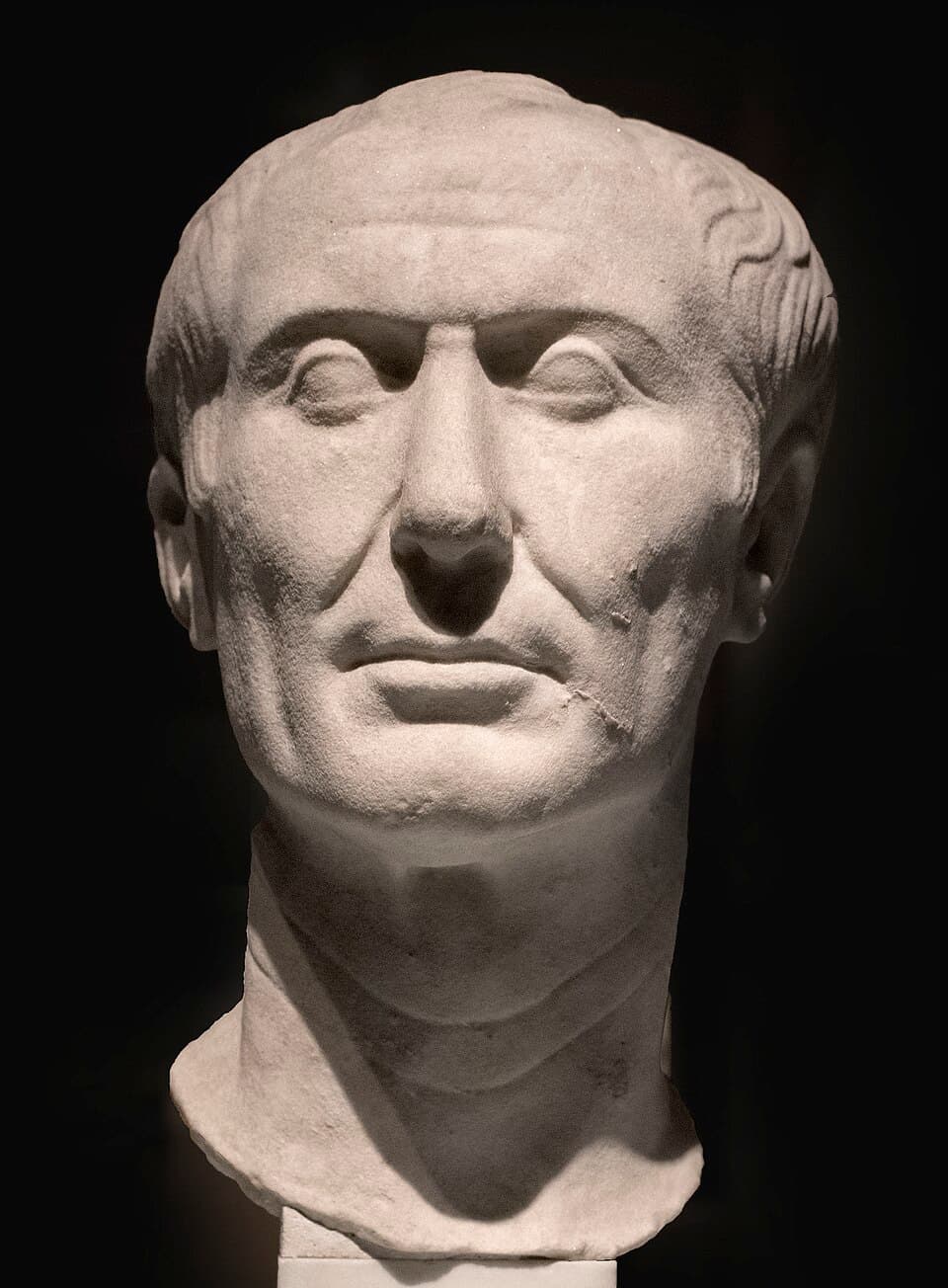 Wikimedia Commons
Julius Caesar Biography
Biography
Early Life
Gaius Julius Caesar was born in Rome in 100 BCE into the ancient patrician Julii family. His family claimed descent from Iulus, the legendary son of Aeneas, who was traditionally regarded as an ancestor of Rome's founders.
Caesar grew up during a period of intense political conflict within the Roman Republic. Rivalries between powerful political groups and military leaders shaped the political environment of his youth.
Early Political Career
Caesar began his public career through Rome's traditional political offices. He served as a military officer, quaestor, and later held other important positions.
He became increasingly popular among ordinary Romans through political alliances and public activities. His growing influence brought him into competition with powerful members of the Roman aristocracy.
The First Triumvirate
In 60 BCE, Caesar formed a powerful political alliance with Pompey the Great and Marcus Licinius Crassus. This informal alliance became known as the First Triumvirate.
The arrangement helped Caesar secure the consulship in 59 BCE. After serving as consul, he obtained command of several Roman provinces, giving him the opportunity to build a powerful military career.
Conquest of Gaul
From 58 to 50 BCE, Caesar conducted a series of military campaigns in Gaul, corresponding broadly to modern France, Belgium, and parts of neighboring regions.
His campaigns greatly expanded Roman control and made Caesar one of Rome's most successful military commanders.
He documented the campaigns in Commentarii de Bello Gallico (Commentaries on the Gallic War), which became an important example of Latin prose and one of the major surviving sources about the campaigns.
Crossing the Rubicon
Caesar's growing military power eventually brought him into direct conflict with the Roman Senate and his former ally Pompey.
In 49 BCE, Caesar crossed the Rubicon River with his army, entering Italy in violation of the political restrictions placed on his military command. The act effectively began another Roman civil war.
Caesar's famous association with the phrase “the die is cast” reflects the irreversible nature of his decision.
Civil War
Caesar fought against forces loyal to Pompey and the senatorial faction. He defeated Pompey's forces at the Battle of Pharsalus in 48 BCE.
Pompey fled to Egypt, where he was assassinated. Caesar then became involved in Egyptian politics and supported Cleopatra VII in her struggle for power.
Caesar and Cleopatra developed a close political and personal relationship, and they had a son known as Caesarion.
Dictatorship and Reforms
After defeating his major opponents, Caesar became the dominant political figure in Rome.
He was appointed dictator and introduced a series of administrative and political reforms. These included measures concerning citizenship, debt, taxation, public works, and the administration of Roman territories.
Caesar also reformed the Roman calendar. The resulting Julian calendar became the basis for the calendar system later developed into the modern Gregorian calendar.
Relationship with Cleopatra
Caesar's relationship with Cleopatra became one of the most famous political and personal relationships of the ancient world.
Cleopatra visited Rome and stayed there for a period while Caesar was consolidating his political position. Their son, Caesarion, was born in 47 BCE.
Although Caesar never officially recognized Caesarion as his principal political heir, Cleopatra's connection to Caesar later became important in the political struggles following his death.
Rise to Dictatorship for Life
Caesar accumulated increasingly extensive political authority. In 44 BCE, he was appointed dictator perpetuo, or dictator in perpetuity.
His concentration of power alarmed many senators, who feared that the Roman Republic was being replaced by personal rule.
A group of senators therefore organized a conspiracy against him.
Assassination
Julius Caesar was assassinated on March 15, 44 BCE, a date traditionally known as the Ides of March.
He was attacked by a group of senators in a meeting near the Theatre of Pompey. Among the conspirators were Marcus Junius Brutus and Gaius Cassius Longinus.
According to ancient accounts, Caesar received numerous stab wounds during the attack.
His assassination did not restore the Roman Republic. Instead, it triggered another series of civil wars.
Aftermath and Rise of Augustus
Following Caesar's death, his adopted heir Octavian, later known as Augustus, became involved in the struggle for political power.
Octavian eventually defeated Mark Antony and Cleopatra. He became the first Roman emperor, marking the beginning of the Roman Empire.
Caesar's death therefore became a major turning point between the Roman Republic and the imperial system that followed.
Literary Works
Caesar was also an accomplished writer. His Commentaries on the Gallic War describes his campaigns in Gaul, while Commentaries on the Civil War covers part of the conflict against Pompey and his supporters.
His writing style was known for its clear and relatively direct Latin prose. These works later became important texts for the study of Latin.
Legacy
Julius Caesar remains one of the most influential figures in world history. His military victories, political reforms, writings, and role in the collapse of the Roman Republic had a lasting impact on European and world history.
His name became associated with political power. Later rulers adopted titles derived from “Caesar,” including the German “Kaiser” and the Russian “Tsar.”
Caesar's life has also inspired countless books, plays, films, and works of art. William Shakespeare's Julius Caesar is among the best-known literary portrayals of his life.
His career continues to be studied as an example of military leadership, political ambition, and the transformation of republican government into centralized rule.
Did you know?
The month of July was named after Julius Caesar. It was originally called Quintilis, but it was renamed Julius in his honor after his death.