Writer · Saxe-Weimar-Eisenach
Johann Wolfgang von Goethe
Johann Wolfgang von Goethe (1749–1832) was a German writer, poet, philosopher, scientist, and statesman who became one of the most influential figures in European literature. His works explored love, nature, morality, individuality, and the human search for knowledge. Best known for *Faust*, *The Sorrows of Young Werther*, and *Wilhelm Meister's Apprenticeship*, Goethe also made important contributions to scientific thought and served for many years in the government of Weimar.
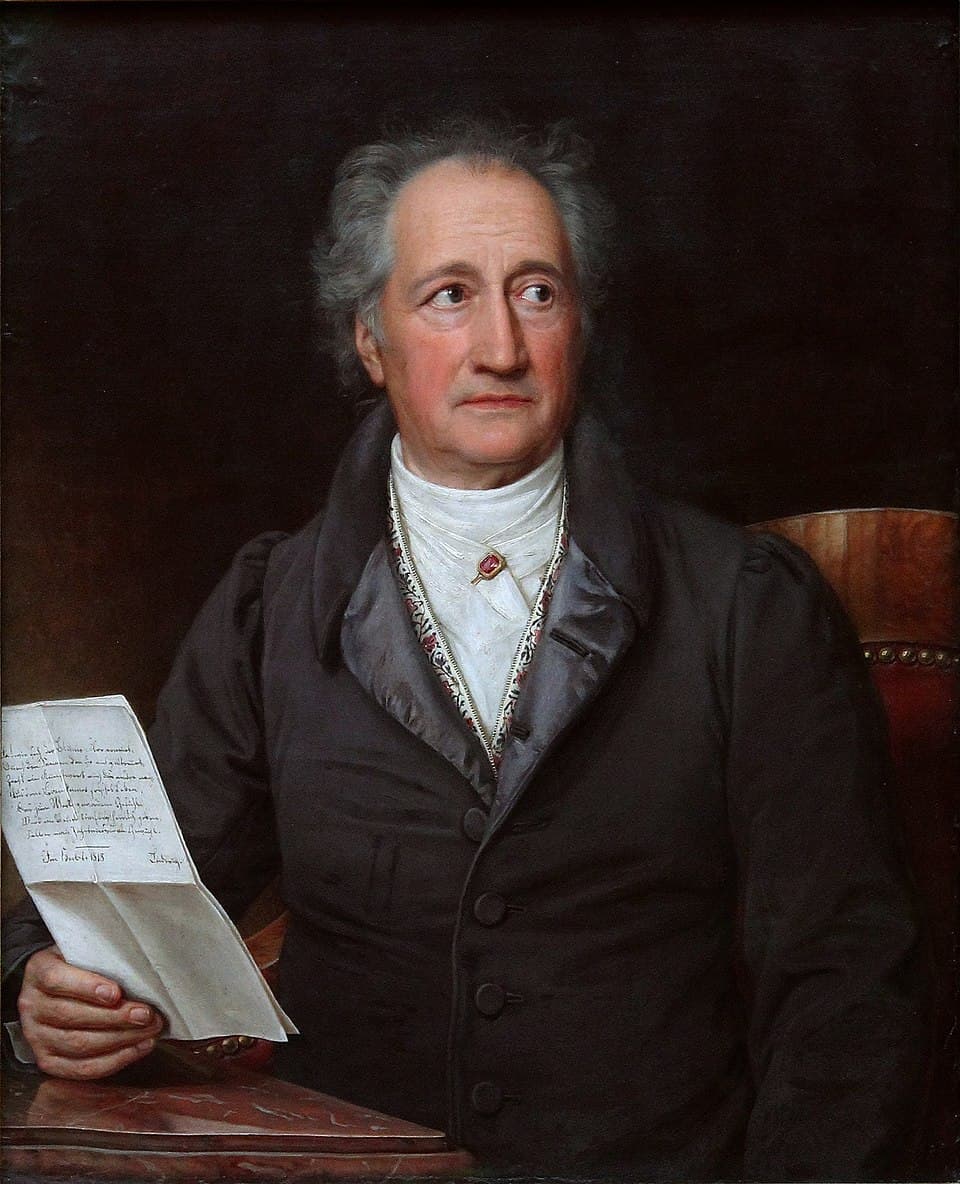 Wikimedia Commons
Johann Wolfgang von Goethe Biography
Biography
Early Life
Johann Wolfgang von Goethe was born on August 28, 1749, in Frankfurt am Main, in the Holy Roman Empire. He was born into a prosperous and educated family. His father, Johann Caspar Goethe, was a lawyer and imperial councillor, while his mother, Catharina Elisabeth Textor, came from a prominent Frankfurt family.
Goethe received a broad education at home. He studied languages, literature, history, religion, art, and science from an early age. His intellectual curiosity remained one of the defining characteristics of his life.
Education
In 1765, Goethe went to Leipzig to study law at the University of Leipzig. Although law was his formal field of study, he became increasingly interested in literature, poetry, art, and philosophy.
During his time in Leipzig, he wrote poetry and became familiar with contemporary European literary movements.
He later continued his legal studies in Strasbourg, where he completed his degree in 1771.
Early Literary Success
Goethe achieved early literary fame with The Sorrows of Young Werther, published in 1774.
The novel tells the story of a sensitive young man whose unrequited love leads to tragedy. Its emotional intensity and exploration of individual feeling resonated strongly with young readers throughout Europe.
The book made Goethe internationally famous while he was still in his twenties.
Sturm und Drang
Goethe became an important figure in the German literary movement known as Sturm und Drang, or "Storm and Stress."
The movement emphasized emotion, individual freedom, imagination, and resistance to rigid social and artistic conventions.
Goethe's early works reflected these ideas and helped establish him as one of the leading literary voices of his generation.
Life in Weimar
In 1775, Goethe moved to Weimar at the invitation of Duke Carl August. He became increasingly involved in the political and administrative affairs of the small state.
For many years, he held government responsibilities and worked on matters involving finance, mining, roads, agriculture, and education.
His service in Weimar gave him practical political experience while allowing him to continue his literary and intellectual activities.
Italian Journey
Between 1786 and 1788, Goethe traveled through Italy. The journey became one of the most important experiences of his life.
He visited cities including Rome, Naples, and Venice and studied classical art, architecture, literature, and culture.
His experiences in Italy influenced his artistic development and contributed to his movement away from the emotional style of his youth toward a more classical and balanced aesthetic.
His experiences were later described in Italian Journey.
Faust
Goethe's most famous work is Faust, a dramatic poem that occupied him for much of his life.
The work follows Faust, a scholar who seeks unlimited knowledge and experience and makes a pact with Mephistopheles.
Faust explores themes including ambition, knowledge, temptation, morality, love, redemption, and the limits of human understanding.
Part One was published in 1808, while Part Two appeared shortly before Goethe's death in 1832.
The work is regarded as one of the greatest achievements of German literature.
Wilhelm Meister
Another major contribution was the Wilhelm Meister series of novels.
Wilhelm Meister's Apprenticeship is considered an important example of the Bildungsroman, a literary form centered on the intellectual and personal development of an individual.
The work examines education, art, society, personal identity, and the process of growing into adulthood.
Relationship with Schiller
Goethe developed a close intellectual friendship with the German poet and dramatist Friedrich Schiller.
Their friendship began in the 1790s and became one of the most important literary partnerships in German history.
Together, Goethe and Schiller played major roles in the Weimar Classicism movement. They exchanged ideas about literature, philosophy, art, and aesthetics and supported each other's work.
Scientific Interests
Goethe was not only a literary figure. He also had extensive interests in science.
He studied botany, anatomy, geology, meteorology, and optics. His work Theory of Colours explored the nature of color and included arguments that differed significantly from the prevailing Newtonian approach.
His scientific writings were not always accepted by later scientists, but his interdisciplinary approach demonstrated his broad intellectual interests.
Political and Intellectual Life
Goethe remained involved in the administration of Weimar for many years, although his responsibilities changed over time.
He also maintained relationships with numerous writers, artists, scientists, and intellectuals throughout Europe.
His home in Weimar became an important meeting place for intellectual and cultural figures.
Later Life
During his later years, Goethe continued writing, revising his earlier works, and corresponding with intellectuals across Europe.
He witnessed major political and cultural changes, including the French Revolution and the rise of Napoleon.
Goethe's later writings became increasingly concerned with world literature, cultural exchange, nature, and the relationship between different civilizations.
Death
Johann Wolfgang von Goethe died on March 22, 1832, in Weimar at the age of 82.
His final years were spent completing and revising some of his most important works, including Faust.
He was buried in the Ducal Vault at Weimar.
Legacy
Goethe is widely regarded as one of the greatest figures in German and European literature.
His influence extends across poetry, drama, fiction, philosophy, science, aesthetics, and cultural criticism. Writers and thinkers throughout Europe and beyond studied his works and responded to his ideas.
His masterpiece Faust remains one of the most frequently studied works of world literature, while The Sorrows of Young Werther had a profound impact on European literary culture.
Goethe's ability to combine literature, science, philosophy, politics, and art made him an unusually broad intellectual figure. His concept of "world literature" also anticipated later ideas about the importance of cultural exchange between nations.
His legacy continues to shape German literature and the wider history of European intellectual thought.
Did you know?
Goethe's final major work, *Faust Part Two*, was published in 1832, the same year he died. He had worked on the Faust story for much of his adult life.