Monarch · Babylonia
Hammurabi
Hammurabi (c. 1810–1750 BCE) was the sixth king of the First Dynasty of Babylon and one of the most influential rulers of ancient Mesopotamia. He reigned from approximately 1792 to 1750 BCE and expanded Babylon into a powerful kingdom through military campaigns, diplomacy, and administrative reforms. He is best known for the Code of Hammurabi, a collection of laws inscribed on a stone stele that addressed subjects such as trade, property, family relationships, wages, and punishment. His reign helped establish Babylon as a major political and cultural center in the ancient Near East.
 Wikimedia Commons
Hammurabi: Full Biography
Biography
1. Introduction
Hammurabi was a prominent king of ancient Babylon who transformed his kingdom into one of the leading powers of Mesopotamia. He ruled during the early second millennium BCE, when numerous city-states and kingdoms competed for control of fertile land, trade routes, and valuable resources.
Through military campaigns, political alliances, and administrative organization, Hammurabi expanded Babylon's influence across much of southern and central Mesopotamia. His name is especially associated with the Code of Hammurabi, one of the best-known surviving collections of laws from the ancient world.
His reign contributed to Babylon's development as a major center of government, commerce, religion, and scholarship.
2. Birth and Early Life
Hammurabi was born around 1810 BCE, although his exact birth date and details of his childhood are not known with certainty.
He belonged to the Amorite ruling dynasty that governed Babylon. The Amorites were a West Semitic people whose dynasties became influential in several Mesopotamian cities during the early second millennium BCE.
Babylon was an established settlement on the Euphrates River, but it was not yet the dominant power it would become under Hammurabi. Its rulers had to navigate a complicated political landscape involving neighboring kingdoms and competing city-states.
Little reliable information survives about Hammurabi's childhood or personal education. Most knowledge of his career comes from royal inscriptions, administrative documents, diplomatic correspondence, and legal texts.
3. Family Background and Royal Heritage
Hammurabi was the son of Sin-Muballit, a king of Babylon who ruled before him. His family belonged to the First Dynasty of Babylon, which had established itself among the Amorite dynasties of Mesopotamia.
Sin-Muballit helped maintain Babylon's political position in a region dominated by several powerful states. Hammurabi inherited a functioning kingdom, but its authority remained limited compared with the larger powers around it.
The royal family relied on military strength, religious legitimacy, diplomacy, and control of agricultural resources to preserve its position.
4. Becoming King of Babylon
Hammurabi became king around 1792 BCE, following the reign of his father. Early in his rule, he concentrated on strengthening Babylon's administration and managing relations with neighboring rulers.
At the time, Mesopotamia was divided among competing powers, including Larsa in the south, Eshnunna to the east, and Mari and other kingdoms farther northwest. The kingdom of Elam also exercised considerable influence in the region.
Hammurabi initially pursued a combination of diplomacy and military preparation. Rather than conquering every neighboring territory immediately, he waited for opportunities to expand Babylon's influence while maintaining the security of his kingdom.
5. Political Landscape of Mesopotamia
Mesopotamia was one of the earliest centers of urban civilization. Its cities depended on irrigation agriculture, river transport, trade, and organized labor.
Political power was divided among kingdoms that controlled cities, agricultural districts, and trade routes. Alliances frequently changed as rulers sought to protect their interests or gain advantages over rivals.
Hammurabi's success depended partly on understanding these shifting relationships. He used treaties and military cooperation when they served Babylon's interests, but he also turned against former allies when circumstances changed.
His reign illustrates how diplomacy and warfare worked together in ancient Mesopotamian state-building.
6. Expansion of the Babylonian Kingdom
Hammurabi expanded Babylon's territory over several decades. In the earlier part of his reign, he strengthened defenses, improved administrative control, and pursued campaigns against selected rivals.
His major territorial gains came later, particularly during the final years of his rule. By defeating rival kingdoms and bringing their territories under Babylonian control, he established a much larger state.
The expansion gave Babylon access to additional agricultural land, population centers, trade routes, and economic resources.
Hammurabi's military achievements were important, but maintaining control over the newly conquered territories also required officials, taxation, irrigation management, and communication with local communities.
7. Rivalry with Larsa
Larsa, a powerful kingdom in southern Mesopotamia, was one of Babylon's most important rivals. It controlled fertile agricultural territory and had a long history of political influence.
Hammurabi eventually formed an alliance with other powers against common enemies, but political relationships shifted over time. After weakening rival states, he turned his attention toward Larsa, ruled by Rim-Sin II's predecessor Rim-Sin I.
Around 1763 BCE, Hammurabi defeated Larsa and incorporated its territories into the Babylonian kingdom.
The victory was a turning point because it gave Babylon control over a large portion of southern Mesopotamia and reduced the independence of one of its strongest competitors.
8. Conquests of Eshnunna and Mari
Hammurabi's campaigns extended beyond southern Mesopotamia. He also fought against Eshnunna, a kingdom east of the Tigris River, and brought its territory under Babylonian influence.
The kingdom of Mari, located along the Euphrates in what is now Syria, was another important political and commercial center. Mari had maintained diplomatic relations with Babylon, but the relationship eventually deteriorated.
Hammurabi captured and destroyed Mari's political center around 1761 BCE, according to conventional chronologies. The city had been an important hub for trade and communication between Mesopotamia and Syria.
These conquests expanded Babylon's reach and helped establish Hammurabi as the dominant ruler in much of the region.
9. Military Strategy and Leadership
Hammurabi combined military campaigns with diplomacy, strategic timing, and the integration of conquered territories.
He often benefited from rivalries among neighboring kingdoms, forming alliances when useful and shifting his position as the balance of power changed.
Military success also depended on the resources available to the Babylonian state, including soldiers, supplies, transport, and the ability to organize campaigns across river valleys and agricultural regions.
Ancient royal inscriptions present Hammurabi as a victorious ruler who restored order and defeated his enemies. These accounts also served to strengthen his political legitimacy, so they must be read as official royal representations rather than neutral descriptions of every campaign.
10. The Code of Hammurabi
Hammurabi is best known today for the legal collection associated with his name. The Code of Hammurabi contains nearly 300 surviving legal provisions, although some portions of the inscription are damaged or missing.
The laws address matters such as property ownership, commercial agreements, agricultural responsibilities, marriage, divorce, inheritance, debt, wages, injuries, and criminal penalties.
The text is written in Akkadian using cuneiform script and was inscribed on a large stone monument. The surviving stele was discovered at Susa, in present-day Iran, after being taken there in antiquity.
The code is one of the most famous examples of ancient Mesopotamian law, but it was not the world's first known law collection. Earlier Mesopotamian rulers had also issued legal texts.
11. Principles of Hammurabi's Laws
The laws associated with Hammurabi sought to define obligations, resolve disputes, and establish penalties for specific actions.
Some provisions imposed financial compensation, while others prescribed physical punishment or death. The severity of penalties often depended on the social status of the people involved.
The well-known principle of retaliation, commonly summarized as “an eye for an eye,” appears in some provisions. However, the code did not apply identical punishments to every person in every circumstance.
Its laws reflected a hierarchical society in which social class, gender, property, and legal status influenced people's rights and responsibilities.
12. Justice and Social Hierarchy
The Code of Hammurabi presents the king as a guardian of justice who was responsible for protecting vulnerable people from exploitation and maintaining order.
Yet the legal system it describes was unequal by modern standards. Penalties could differ depending on whether the individuals involved belonged to the elite, were free commoners, or were enslaved.
Women had certain legal rights concerning property, marriage, and inheritance, but their status remained shaped by the patriarchal structure of Babylonian society.
The code therefore provides valuable evidence about ancient legal thinking, social expectations, and the limits of royal justice.
13. Government and Administration
Hammurabi strengthened Babylon's administration as its territory expanded. Royal officials supervised taxation, agricultural production, irrigation, public works, and the enforcement of royal orders.
Written records were essential to this system. Scribes used cuneiform writing to record transactions, property transfers, court proceedings, and official correspondence.
The king's authority extended across the kingdom, but local officials and established institutions remained important to everyday governance.
Hammurabi's surviving letters reveal a ruler who closely monitored officials and sometimes intervened in specific administrative and legal matters.
14. Agriculture and Irrigation
Agriculture was the foundation of the Babylonian economy. Farmers cultivated crops such as barley and relied on irrigation systems to manage water from the region's rivers.
Maintaining canals, controlling water distribution, and repairing damaged infrastructure were essential tasks. Neglecting irrigation could harm harvests and create disputes between neighboring communities.
Hammurabi's royal correspondence shows that irrigation and agricultural management were matters of direct governmental concern.
The kingdom's economic strength depended on coordinating labor, protecting fields, regulating water, and collecting agricultural revenues.
15. Trade and the Babylonian Economy
Babylon benefited from its position near major river routes and regional trade networks. Merchants exchanged agricultural products, textiles, metals, timber, and other goods across Mesopotamia and neighboring regions.
Commercial activity relied on agreements, loans, partnerships, transport arrangements, and systems of measurement. Legal provisions in Hammurabi's code address many of these matters.
The government also depended on trade and agricultural production to support officials, temples, soldiers, and construction projects.
As Babylon expanded, its political influence connected a broader range of communities and commercial routes.
16. Religion and Royal Authority
Religion played a central role in Babylonian political life. People worshipped many gods, and temples served as important centers of worship, economic activity, and administration.
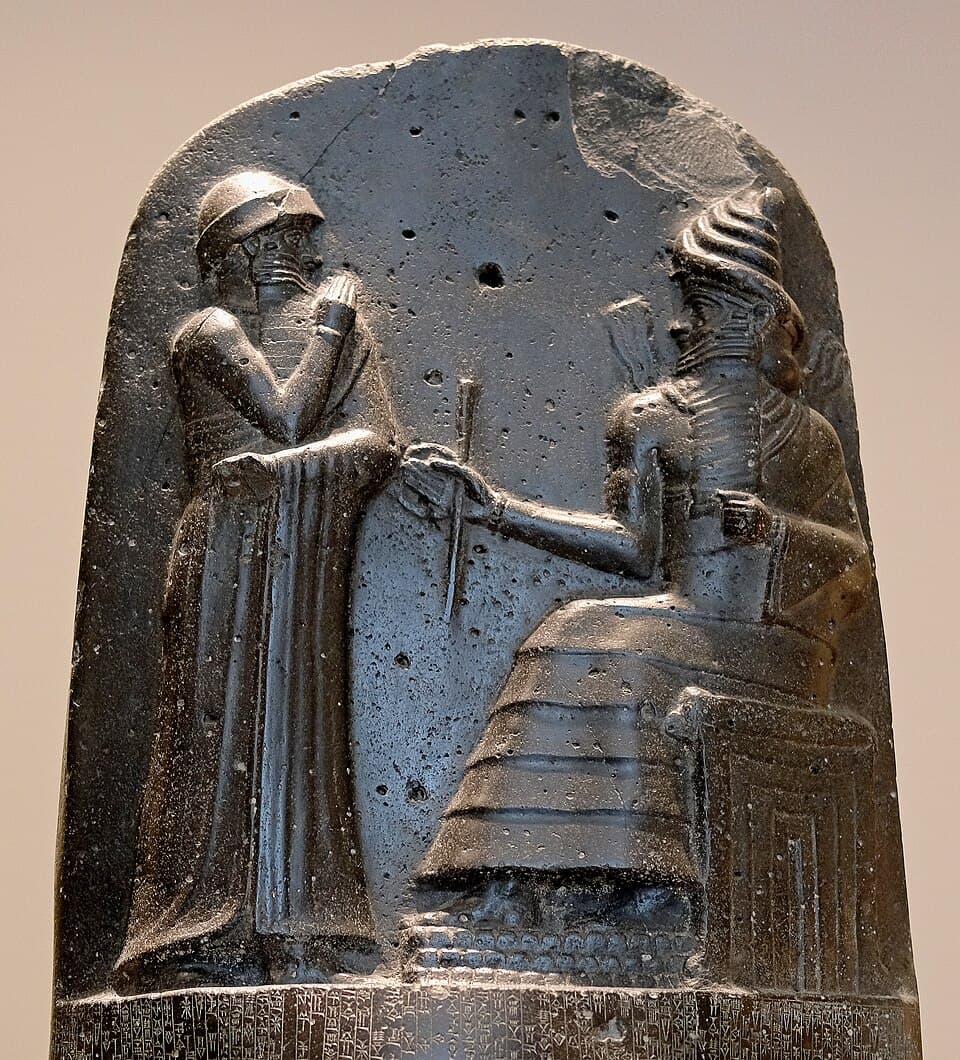
Hammurabi associated his authority with the divine order. In the famous law stele, the sun god Shamash, associated with justice, appears above the king and symbolizes the divine legitimacy of the laws.
Marduk, the principal god of Babylon, also became increasingly important as Babylon's political status grew.
Religious institutions helped support the king's authority, while royal patronage of temples reinforced the relationship between government and religious life.
17. The Stele and Its Discovery
The most famous surviving monument associated with Hammurabi is a tall black stone stele bearing the legal text and a relief showing Hammurabi standing before Shamash.
The monument was discovered at Susa in 1901–1902 by a French archaeological expedition. It is generally understood to have been transported there from Mesopotamia in antiquity, probably during a military campaign by an Elamite ruler.
Today, the stele is one of the most recognizable artifacts of ancient Mesopotamia and an important source for the study of law, writing, art, and royal ideology.
Its survival has made Hammurabi far more widely known to modern audiences than many other rulers of his era.
18. Final Years and Death
Hammurabi died around 1750 BCE, according to the commonly used middle chronology. His reign had lasted approximately 42 years.
By the end of his life, Babylon controlled a large territory that included many formerly independent kingdoms and cities.
However, the empire depended heavily on royal authority and the continued cooperation of regional officials. Maintaining such a large state presented challenges that would become increasingly difficult for later rulers.
His death marked the end of a significant period of Babylonian expansion.
19. Succession and the Later Babylonian Kingdom
Hammurabi was succeeded by his son Samsu-iluna. The new king faced revolts and territorial challenges, including the loss of control over some southern regions.
Although the dynasty continued for generations, the kingdom gradually lost some of the territory and influence acquired under Hammurabi.
Much later, Babylon experienced additional periods of power under different dynasties, including the Neo-Babylonian Empire of the first millennium BCE.
Hammurabi's reign nevertheless remained an important reference point in the political and cultural history of Babylon.
20. Historical Legacy
Hammurabi is remembered primarily for his legal collection and his transformation of Babylon into a major regional power.
The Code of Hammurabi provides evidence about property, commerce, family relations, labor, punishment, and the social hierarchy of ancient Mesopotamia. It also illustrates how rulers used law to present themselves as guardians of order and justice.
His reign demonstrates the close relationship between military conquest, administrative development, agriculture, trade, and religious legitimacy in the ancient Near East.
Although the code was neither a modern constitution nor a universal declaration of equal rights, it remains a landmark source for the study of ancient law.
21. Conclusion
Hammurabi helped transform Babylon from one kingdom among many into a dominant power in Mesopotamia. His military victories expanded its territory, while administrative measures supported the governance of a large and diverse population.
His most enduring legacy is the Code of Hammurabi, which preserves a detailed picture of legal principles and social relationships in the ancient world.
More than three thousand years later, Hammurabi remains a central figure in the history of law, government, and ancient civilization.
Did you know?
**Did you know?** The Code of Hammurabi was inscribed on a large stone stele written in Akkadian cuneiform. The monument was discovered at Susa in the early twentieth century, although it had originally been erected elsewhere. Its famous image shows Hammurabi before Shamash, the Mesopotamian sun god associated with justice. The code is one of the best-known ancient legal collections, but it was not the earliest one.