Writer · Russian Empire
Fyodor Dostoyevsky
Fyodor Dostoyevsky (1821–1881) was a Russian novelist, philosopher, and journalist regarded as one of the greatest writers in world literature. His major works, including *Crime and Punishment*, *The Idiot*, *Demons*, and *The Brothers Karamazov*, explore complex questions of morality, religion, free will, guilt, suffering, and human psychology. His experiences of imprisonment, exile, poverty, and personal hardship deeply influenced his writing and philosophy.
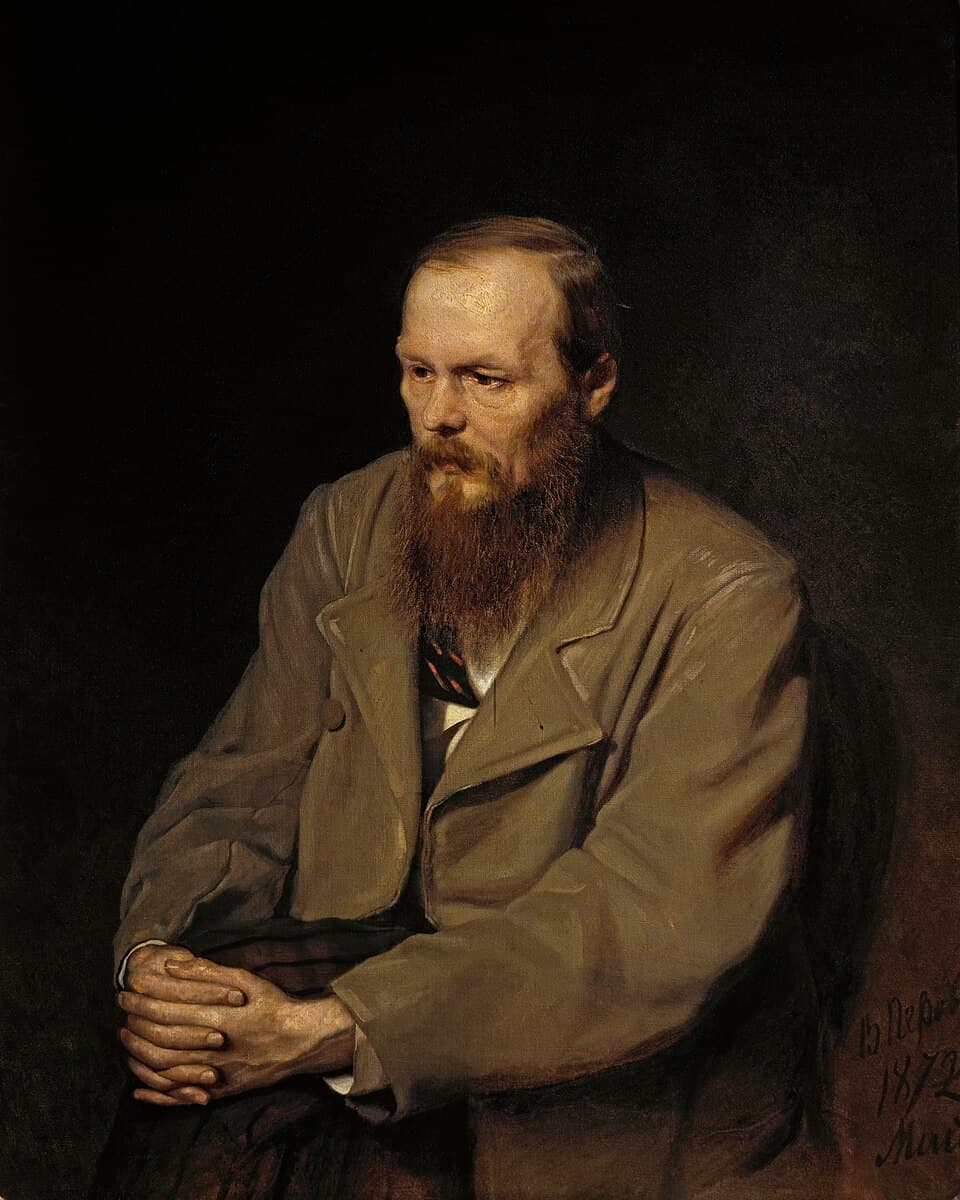 Wikimedia Commons
Fyodor Dostoyevsky Biography
Biography
Early Life
Fyodor Mikhailovich Dostoyevsky was born on October 30, 1821, in Moscow, Russian Empire. He grew up in a large family in a relatively strict household. His father was a physician at the Mariinsky Hospital for the Poor in Moscow.
From an early age, Dostoyevsky developed a strong interest in literature. He read works by Russian and European writers and became particularly interested in questions concerning human nature, morality, and society.
Education
Dostoyevsky studied at the Military Engineering Academy in Saint Petersburg. Although he was trained for a technical career, his interests increasingly turned toward literature.
After completing his education, he briefly worked as a military engineer before deciding to pursue writing.
Early Literary Career
Dostoyevsky's literary career began with the publication of Poor Folk in 1846. The novel attracted considerable attention and established him as a promising young writer.
He subsequently wrote works including The Double and White Nights. His early fiction often focused on poverty, isolation, social inequality, and the psychological lives of ordinary people.
Arrest and Imprisonment
Dostoyevsky became associated with the Petrashevsky Circle, a group of intellectuals who discussed literature, philosophy, and political and social ideas.
In 1849, he was arrested along with other members of the group and sentenced to death. He was taken to a place of execution, where the prisoners were informed at the last moment that their sentences had been commuted.
The experience profoundly affected Dostoyevsky.
Siberian Exile
Instead of execution, Dostoyevsky was sent to a Siberian prison camp, where he spent several years.
After his imprisonment, he served a period of compulsory military service in Siberia. These experiences exposed him to extreme hardship and to people from many different social backgrounds.
His time in prison strongly influenced his views on suffering, faith, morality, punishment, and human dignity.
Return to Literature
After returning to European Russia, Dostoyevsky resumed his literary career.
He published Notes from Underground in 1864, a short but highly influential work that challenged optimistic ideas about human rationality and social progress.
The work became an important precursor to existentialist and modern psychological literature.
Crime and Punishment
Dostoyevsky published Crime and Punishment in 1866.
The novel follows Rodion Raskolnikov, a poor former student who commits murder and struggles with guilt, morality, and the consequences of his actions.
The novel examines questions of justice, conscience, redemption, poverty, and whether an individual can place himself above ordinary moral laws.
It became one of Dostoyevsky's most famous works and remains one of the most widely studied novels in world literature.
The Idiot
The Idiot was published in 1869.
Its central character, Prince Myshkin, is portrayed as a deeply compassionate and innocent person whose behavior contrasts with the selfishness and social pressures surrounding him.
The novel explores innocence, compassion, love, jealousy, social status, and the difficulties faced by someone attempting to live according to moral ideals.
Demons
Dostoyevsky's Demons, also known as The Possessed, was published in the early 1870s.
The novel explores political radicalism, ideology, violence, and the consequences of abandoning traditional moral and social structures.
It reflected Dostoyevsky's concerns about revolutionary movements and political extremism in nineteenth-century Russia.
The Brothers Karamazov
The Brothers Karamazov was published in 1880 and became Dostoyevsky's final major novel.
The story centers on the Karamazov family and explores faith, doubt, morality, free will, responsibility, family conflict, and the existence of God.
The novel includes philosophical discussions that have had a lasting influence on literature, philosophy, theology, and psychology.
It is widely regarded as one of Dostoyevsky's greatest achievements.
Personal Life
Dostoyevsky married Maria Dmitriyevna Isayeva in 1857. She died in 1864.
He later married Anna Snitkina in 1867. Anna became an important partner in both his personal and professional life and helped manage his finances and publishing arrangements.
The couple had several children, although some died at a young age.
Financial Difficulties
Throughout much of his adult life, Dostoyevsky experienced serious financial difficulties.
He struggled with debts and gambling and was often required to write under demanding deadlines. His financial circumstances influenced the speed and circumstances under which some of his novels were produced.
His collaboration with stenographer Anna Snitkina helped him meet publishing deadlines and eventually contributed to greater financial stability.
Health and Epilepsy
Dostoyevsky experienced epileptic seizures throughout much of his life. His experiences with illness and the possibility of death influenced some of his literary characters and philosophical themes.
His writing frequently examines extreme psychological states, suffering, fear, guilt, and the possibility of spiritual transformation.
Religious and Philosophical Ideas
Religion became increasingly important to Dostoyevsky after his imprisonm
Did you know?
Dostoyevsky was once sentenced to death and taken to a place of execution in 1849, but his sentence was commuted at the last moment and replaced with imprisonment and exile in Siberia.