Monarch · Kingdom of Prussia
Frederick II of Prussia
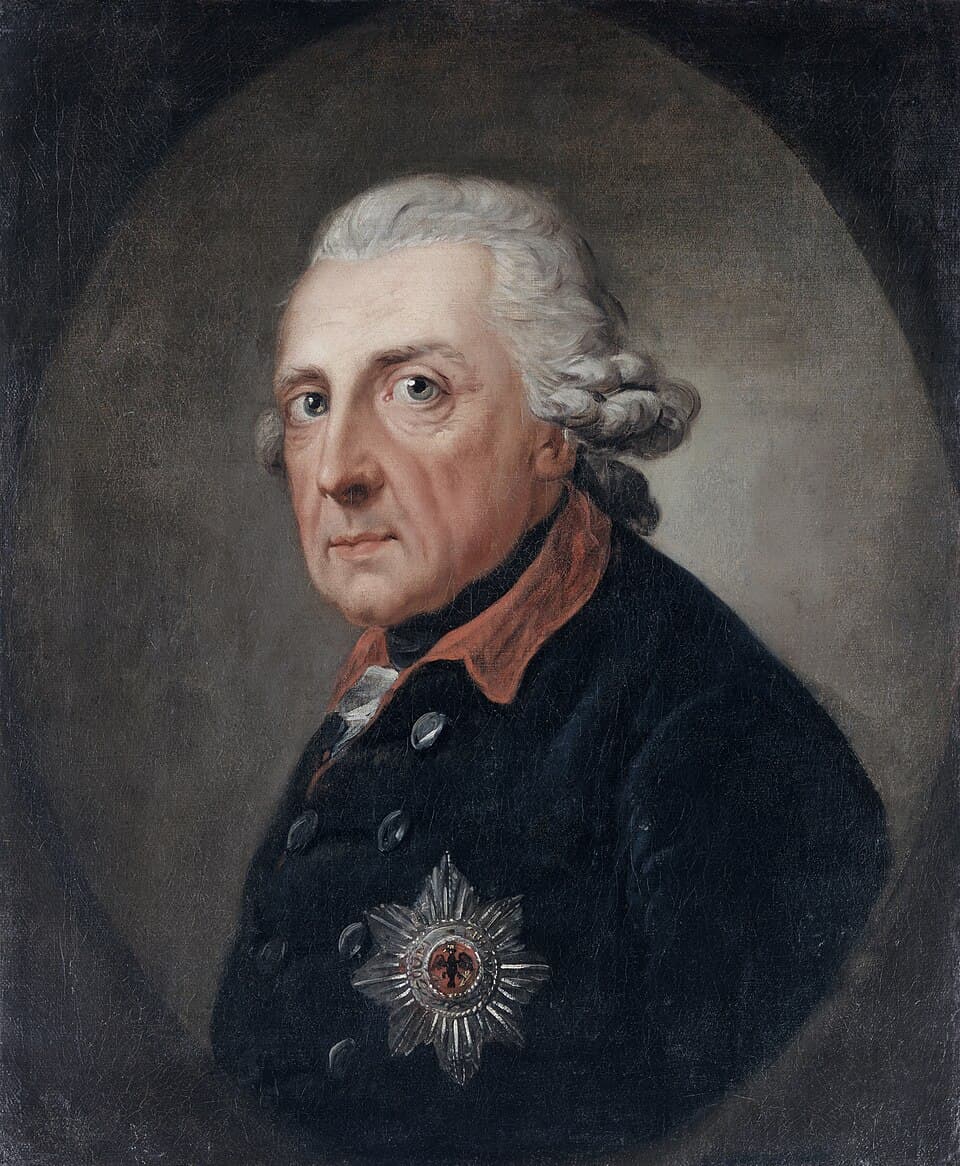
Frederick II of Prussia, widely known as Frederick the Great, was King of Prussia from 1740 until his death in 1786. Born on January 24, 1712, in Berlin, he became famous for his military leadership, administrative reforms, and support for the arts and philosophy. He expanded Prussian territory through major wars, strengthened the state's European influence, and helped establish Prussia as a leading military power.
 Wikimedia Commons
Frederick II of Prussia: Full Biography
Biography
Early Life
Frederick II was born on January 24, 1712, in Berlin, in the Kingdom of Prussia. He was the son of King Frederick William I and Sophia Dorothea of Hanover. His father ruled with strict discipline and emphasized military training, shaping the environment in which Frederick grew up.
Childhood and Education
Frederick developed an early interest in literature, music, philosophy, and French culture. These interests often brought him into conflict with his father, who preferred a more military-focused education. Despite these disagreements, Frederick received training in government and military affairs.
Conflict with His Father
Frederick's relationship with Frederick William I was difficult. In 1730, while still a young man, he attempted to escape Prussia with the help of his friend Hans Hermann von Katte. The attempt failed, and Frederick was imprisoned. Von Katte was executed, an event that deeply affected Frederick.
Marriage and Early Responsibilities
In 1733, Frederick married Elisabeth Christine of Brunswick-Wolfenbüttel-Bevern as part of a political arrangement. Their relationship remained largely distant, and they lived separately for much of their married life. Before becoming king, Frederick also gained experience in administration and military affairs.
Accession to the Throne
Frederick became King of Prussia on May 31, 1740, following the death of his father. He inherited a well-organized state with a strong army and efficient administration. His reign soon became defined by territorial expansion, military conflict, and efforts to strengthen Prussia's position in Europe.
The Silesian Wars
Shortly after becoming king, Frederick invaded the Habsburg province of Silesia in 1740. The resulting conflicts, known as the Silesian Wars, helped Prussia gain control of much of the region. The acquisition of Silesia increased Prussia's population, economic resources, and strategic importance.
War of the Austrian Succession
Frederick's invasion of Silesia formed part of the wider War of the Austrian Succession. Prussia fought against the Habsburg monarchy and its allies. The conflict ended with Prussia retaining Silesia, confirming its emergence as a major European power.
The Seven Years' War
From 1756 to 1763, Frederick led Prussia during the Seven Years' War. Prussia faced a coalition that included Austria, France, Russia, and other states. Despite severe military pressure and major losses, Frederick maintained resistance through a combination of battlefield leadership, strategic maneuvering, and diplomatic developments.
Military Leadership
Frederick became known for his tactical skill, strict discipline, and emphasis on rapid movement and coordinated infantry formations. His victories at battles such as Rossbach and Leuthen in 1757 strengthened his reputation as a military commander. However, the war also exposed Prussia to serious risks and heavy casualties.
Survival of Prussia
The Seven Years' War nearly exhausted Prussia's resources. In 1762, Russia's withdrawal from the coalition against Prussia significantly improved Frederick's position. The Treaty of Hubertusburg in 1763 confirmed Prussia's retention of Silesia and brought the war to an end.
Administrative Reforms
Frederick worked to improve state administration, strengthen the judiciary, and increase government efficiency. He promoted a more systematic approach to taxation and public administration while maintaining the monarchy's central authority.
Religious Toleration
Frederick generally supported a degree of religious toleration within his kingdom. He allowed different religious communities to practice their faiths, provided they did not threaten the state's political order. His policies were influenced partly by Enlightenment ideas and the practical needs of governing a diverse population.
Economic Development
Frederick promoted agriculture, manufacturing, and internal trade. His government encouraged the cultivation of unused land, supported infrastructure improvements, and sought to expand domestic production. These measures aimed to strengthen Prussia's economic resilience after repeated wars.
Legal and Judicial Changes
Frederick supported efforts to make the legal system more consistent and predictable. Judicial reforms continued during his reign, although the legal system remained hierarchical and royal authority was substantial. His administration helped lay groundwork for later Prussian legal reforms.
Patron of the Arts and Philosophy
Frederick was deeply interested in music, literature, and philosophy. He played the flute, composed music, and maintained correspondence with prominent intellectuals. His court at Sanssouci became a center of cultural activity and attracted writers, artists, and thinkers.
Relationship with Voltaire
Frederick maintained a famous relationship with the French philosopher Voltaire. The two corresponded for years, and Voltaire spent time at Frederick's court in the 1750s. Their relationship eventually deteriorated because of personal and intellectual disagreements, although their correspondence remains historically significant.
Sanssouci Palace
Frederick commissioned Sanssouci Palace in Potsdam as a summer residence and place for intellectual and artistic pursuits. The palace became one of the best-known examples of Prussian Rococo architecture and reflected his interest in culture and philosophy.
First Partition of Poland
In 1772, Frederick participated with Russia and Austria in the First Partition of Poland. Prussia acquired Royal Prussia, excluding several important areas, helping connect parts of its territory and strengthening its position around the Baltic Sea. The partition remains a major example of the territorial expansion of European powers at Poland's expense.
Later Years
During his later years, Frederick focused on administration, agriculture, military preparedness, and cultural interests. Although he continued to be influential in European affairs, he faced the long-term challenges of maintaining Prussia's power after decades of conflict.
Death
Frederick II died on August 17, 1786, at Sanssouci Palace in Potsdam. He was 74 years old. His nephew, Frederick William II, succeeded him as king.
Legacy
Frederick the Great transformed Prussia into one of Europe's major powers. His military achievements, administrative policies, and patronage of the arts shaped Prussian identity
Did you know?
- Frederick II is widely known as Frederick the Great. - He became king in 1740 and ruled for 46 years. - His victory at the Battle of Leuthen in 1757 became one of his best-known military achievements. - He was an accomplished flute player and composed music. - He commissioned Sanssouci Palace in Potsdam as a retreat for intellectual and artistic pursuits. - He corresponded with the French philosopher Voltaire and hosted him at his court. - His reign helped establish Prussia as a major European power.