Writer · Republic of Florence
Dante Alighieri
Dante Alighieri (c. 1265–1321) was an Italian poet, writer, philosopher, and political thinker from Florence. He is widely regarded as one of the greatest poets in Western literature. His masterpiece, *The Divine Comedy*, describes an imaginative journey through Hell, Purgatory, and Paradise and profoundly influenced European literature. Dante also played an important role in the development of the Italian language by writing major works in the Tuscan vernacular rather than exclusively in Latin.
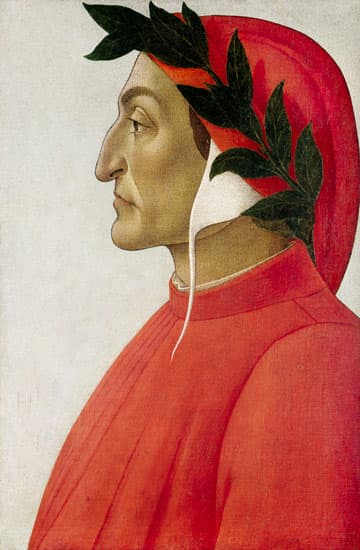 Wikimedia Commons
Dante Alighieri Biography
Biography
Early Life
Dante Alighieri was born in Florence around 1265 into a family connected to the city's political and social life. His exact birth date is unknown, although his writings suggest that he was born under the sign of Gemini.
He grew up during a period of intense political conflict in Florence. The city was divided by rival factions, and these struggles would later have a major impact on Dante's life and political career.
Education and Intellectual Development
Dante received an education in grammar, rhetoric, philosophy, theology, and classical literature. He was deeply influenced by the works of ancient Roman writers, particularly Virgil, as well as by medieval Christian philosophy.
His intellectual interests extended beyond poetry. He studied questions concerning morality, politics, philosophy, religion, and the nature of human existence.
Beatrice and Early Poetry
One of the most important figures in Dante's life was Beatrice, whom he identified in his writings as an idealized woman and source of spiritual inspiration.
Dante's love for Beatrice became central to his early poetry. His collection Vita Nuova (The New Life) combines poetry and prose to describe his love and spiritual devotion to her.
Although their relationship was not a conventional romantic partnership, Beatrice became an important symbolic figure in Dante's literary imagination.
Political Career
Dante became involved in Florentine politics and joined the Guild of Apothecaries, which allowed him to participate in political life.
He eventually held important political positions, including serving as one of the city's six priors in 1300.
Florentine politics were dominated by conflict between the Guelf factions, which later divided into the White Guelfs and Black Guelfs. Dante supported the White Guelfs.
Exile from Florence
Political conflict eventually transformed Dante's life. In 1302, after the Black Guelfs gained control of Florence, Dante was condemned to exile.
He never returned permanently to Florence.
His years of exile were difficult, but they also became one of the most productive periods of his literary career. During this time, he traveled between different Italian courts and cities while continuing his intellectual and literary work.
Major Literary Works
Dante wrote several important works during his lifetime.
His early masterpiece, Vita Nuova, explored love, spirituality, and his idealized relationship with Beatrice.
He later wrote De Monarchia, a political and philosophical work discussing the relationship between spiritual and temporal authority.
He also produced works on language, philosophy, and literary theory, including De vulgari eloquentia.
The Divine Comedy
Dante's greatest achievement was The Divine Comedy, written during the later part of his life.
The poem follows Dante himself as he travels through three realms of the afterlife:
- Inferno — Hell
- Purgatorio — Purgatory
- Paradiso — Paradise
The journey begins with the Roman poet Virgil guiding Dante through Hell and Purgatory. Beatrice later becomes Dante's guide through Paradise.
The poem combines Christian theology, classical mythology, philosophy, politics, history, and personal experiences.
Inferno
Inferno is the first part of The Divine Comedy. Dante travels through the circles of Hell and encounters sinners receiving punishments corresponding symbolically to their sins.
The work contains memorable figures from classical history, mythology, literature, and Dante's own era.
The opening of Inferno begins with Dante lost in a dark forest, establishing the poem's larger theme of spiritual confusion and the search for redemption.
Purgatorio
In Purgatorio, Dante climbs Mount Purgatory, where souls undergo purification before entering Paradise.
Unlike the punishments of Hell, the suffering in Purgatory has a hopeful purpose. The souls are preparing themselves for spiritual fulfillment.
The poem emphasizes repentance, moral transformation, and the possibility of salvation.
Paradiso
Paradiso describes Dante's journey through the heavens toward the presence of God.
Beatrice guides him through the celestial spheres and represents divine wisdom and spiritual illumination.
The final section is more philosophical and theological than the earlier parts of the poem and explores divine love, knowledge, faith, and the nature of the universe.
Language and Literary Importance
One of Dante's greatest contributions was his use of the Tuscan vernacular rather than writing his major literary work entirely in Latin.
At a time when Latin was the dominant language of scholarly writing, Dante demonstrated that a vernacular language could be used for sophisticated poetry, philosophy, and theology.
His writing helped establish the Tuscan variety of Italian as a major literary language and contributed to the later development of standard Italian.
Political and Philosophical Ideas
Dante believed that human beings possessed both spiritual and earthly responsibilities.
In De Monarchia, he argued for a form of universal political authority that could promote peace and human flourishing while maintaining a distinction between temporal and spiritual powers.
His political ideas were shaped by the conflicts he experienced in Florence and by his study of classical and Christian philosophy.
Final Years
Dante spent his later years in northern Italy, particularly under the protection of Guido Novello da Polenta in Ravenna.
He continued working on The Divine Comedy and other literary projects.
Dante died in Ravenna in September 1321, probably after becoming ill while returning from a diplomatic mission to Venice.
He was buried in Ravenna, where his tomb remains an important literary and cultural landmark.
Legacy
Dante Alighieri is considered one of the foundational figures of Western literature.
The Divine Comedy has influenced writers, artists, philosophers, theologians, and musicians for centuries. Its imagery of Hell, Purgatory, and Paradise has become deeply embedded in Western culture.
Dante's influence extends beyond literature. His treatment of politics, morality, religion, language, love, and human destiny continues to attract scholars and readers around the world.
He is often called the father of the Italian language because of the enormous influence of his vernacular writing.
Influence on World Literature
Dante's work influenced generations of writers and artists, including Geoffrey Chaucer, John Milton, William Blake, T. S. Eliot, and many others.
His imaginative vision of the afterlife remains one of the most influential literary representations of Heaven and Hell ever created.
More than seven centuries after his birth, Dante remains one of the central figures of Italian culture and world literature.
Did you know?
Dante's *Divine Comedy* was originally written in the Tuscan vernacular rather than Latin, helping establish the literary importance of the Italian language.