Monarch · Ptolemaic Kingdom
Cleopatra
Cleopatra VII Philopator (69–30 BCE) was the last active ruler of ancient Egypt's Ptolemaic dynasty. She became queen in 51 BCE and was known for her political intelligence, diplomatic skills, and relationships with Julius Caesar and Mark Antony. Cleopatra worked to preserve Egypt's independence amid the growing power of Rome. After her defeat by Octavian's forces, she died in 30 BCE, and Egypt became a Roman province.
 Wikimedia Commons
Cleopatra VII: Full Biography
Biography
Early Life and Birth
Cleopatra VII Philopator was born in 69 BCE in Alexandria, Egypt. She belonged to the Ptolemaic dynasty, a royal family of Macedonian Greek origin that had ruled Egypt since the death of Alexander the Great.
Her father was Ptolemy XII Auletes, and her family governed Egypt during a period when the Roman Republic was becoming increasingly powerful in the eastern Mediterranean. From an early age, Cleopatra lived in a world shaped by royal rivalries, political alliances, and the growing threat of Roman intervention.
Family Background
Cleopatra's family descended from Ptolemy I Soter, one of Alexander the Great's generals, who established the Ptolemaic dynasty after Alexander's death in 323 BCE.
The Ptolemies traditionally maintained their power through dynastic marriages and alliances. Cleopatra had several siblings, including her younger brother Ptolemy XIII and her younger brother Ptolemy XIV. Her sister Arsinoe IV also became involved in the struggle for the Egyptian throne.
These family relationships later developed into serious political conflicts as Cleopatra sought to preserve her authority.
Education and Languages
Cleopatra grew up in Alexandria, a major center of trade, scholarship, and cultural exchange. The city was home to the famous Library of Alexandria and the Mouseion, institutions associated with ancient learning.
She was educated in subjects appropriate to a royal ruler, including rhetoric, philosophy, diplomacy, and statecraft. Ancient accounts describe her as an engaging speaker and a highly educated monarch.
Greek was her first language, and she is particularly noted for learning the Egyptian language, something unusual among the Ptolemaic rulers. Ancient sources also associate her with knowledge of other languages, although the full extent of her linguistic abilities is difficult to establish with certainty.
Becoming Queen of Egypt
Cleopatra's father died in 51 BCE, leaving the throne to Cleopatra and her younger brother Ptolemy XIII. According to Ptolemaic custom, they were expected to rule jointly.
However, tensions soon developed between Cleopatra and the advisers surrounding her brother. A power struggle led to Cleopatra being driven from the royal court and forced to seek support outside Egypt.
She began organizing resistance in the hope of regaining her position. At the same time, Roman political conflict was moving directly into Egyptian affairs, creating an opportunity for Cleopatra to seek powerful allies.
Cleopatra and Julius Caesar
In 48 BCE, Roman general Julius Caesar arrived in Egypt during his pursuit of Pompey, his rival in the Roman civil war. Pompey had sought refuge in Egypt but was killed after arriving there.
Cleopatra recognized that Caesar's influence could help her regain the throne. Ancient accounts famously describe her arranging a secret meeting with Caesar, often portrayed as her being brought before him concealed in a rolled-up carpet or bedding. The exact details of this story remain uncertain.
Caesar supported Cleopatra in the ensuing conflict against Ptolemy XIII's forces. The fighting became known as the Alexandrian War, and Ptolemy XIII died in 47 BCE.
Cleopatra returned to power and ruled alongside her younger brother Ptolemy XIV, while maintaining a close political and personal relationship with Caesar.
Cleopatra and Caesarion
Cleopatra gave birth to a son, Ptolemy XV Philopator Philometor Caesar, commonly known as Caesarion, in 47 BCE. She presented him as the son of Julius Caesar.
Caesar never publicly established Caesarion as his legal heir in Rome. His political succession was instead shaped by his adoption of Octavian, who later became Augustus.
For Cleopatra, Caesarion was important to the future of the Ptolemaic dynasty. His existence offered the possibility of continuing her family's rule through a son associated with one of Rome's most powerful leaders.
Visit to Rome
Cleopatra visited Rome in 46 BCE and stayed there while Caesar held supreme political authority. Her presence attracted attention because she was a foreign monarch closely connected to the Roman leader.
She reportedly resided in a villa associated with Caesar. Her visit reflected the diplomatic relationship between Egypt and Rome, but it also became a source of political controversy.
Caesar was assassinated on March 15, 44 BCE. Cleopatra was in Rome at the time or had been visiting shortly before his death, and she subsequently returned to Egypt.
The assassination transformed the political situation and removed the powerful Roman ally on whom Cleopatra had relied.
Consolidating Her Rule
After returning to Egypt, Cleopatra ruled with Ptolemy XIV. He died in 44 BCE, and Cleopatra then made Caesarion her co-ruler.
She worked to strengthen royal authority and manage the economic needs of Egypt. The kingdom depended heavily on agriculture, especially grain production, and its wealth made it strategically important to Rome.
Cleopatra's government had to navigate internal dynastic tensions, economic pressures, and the competition among Roman leaders who sought influence over Egypt.
Cleopatra and Mark Antony
Following Caesar's assassination, Rome descended into further political conflict. Mark Antony, Octavian, and Marcus Aemilius Lepidus formed the Second Triumvirate in 43 BCE, dividing much of the Roman world among themselves.
In 41 BCE, Antony summoned Cleopatra to meet him at Tarsus in Cilicia to discuss Egypt's political position and its relationship with Rome. Cleopatra arrived with a carefully staged royal display that demonstrated her wealth and authority.
Their meeting developed into a political alliance and personal relationship. Antony needed resources and support for his eastern campaigns, while Cleopatra sought security for Egypt and the restoration of territories associated with the Ptolemaic kingdom.
The Alliance with Antony
Cleopatra and Antony's partnership strengthened Egypt's diplomatic position, but it also placed Cleopatra at the center of Roman political rivalries.
Antony spent considerable time in the eastern Mediterranean and relied on Egyptian financial and material resources. Cleopatra, meanwhile, sought to protect her kingdom and secure the future of her children.
Their relationship was not simply a romantic story; it involved military cooperation, territorial ambitions, dynastic succession, and the strategic interests of two political leaders.
Children of Cleopatra and Antony
Cleopatra and Mark Antony had three children together: twins Alexander Helios and Cleopatra Selene II, born around 40 BCE, and Ptolemy Philadelphus, born around 36 BCE.
Cleopatra also had Caesarion, whom she identified as Julius Caesar's son. Her children represented the future of the Ptolemaic dynasty and played a role in the political ambitions associated with the alliance between Egypt and Antony.
Cleopatra Selene II later became queen of Mauretania through her marriage to Juba II, allowing one branch of Cleopatra's family to remain politically significant after the fall of Egypt.
The Donations of Alexandria
In 34 BCE, Antony and Cleopatra held a ceremony in Alexandria commonly called the Donations of Alexandria. Antony announced territorial grants to Cleopatra and their children in the eastern Mediterranean.
These declarations were intended to organize political authority in the region and strengthen the family's position. However, they were used by Antony's rival Octavian to portray Antony as placing Roman interests under the influence of a foreign queen.
The episode intensified the struggle between Antony and Octavian and contributed to the propaganda campaign that preceded their final conflict.
The Conflict with Octavian
Octavian, Caesar's adopted heir, became Antony's principal rival. Political disagreements, competing claims to Roman leadership, and the relationship between Antony and Cleopatra helped bring their conflict to a head.
Octavian presented Cleopatra as a threat to Roman independence and used Antony's association with her to weaken his standing in Rome. His portrayal was political propaganda, and much of the surviving Roman narrative was shaped by the victors of the conflict.
By 32 BCE, the rivalry had escalated into open war. The outcome would determine not only Antony's future but also the survival of Cleopatra's kingdom.
The Battle of Actium
On September 2, 31 BCE, the forces of Antony and Cleopatra confronted Octavian's fleet at the Battle of Actium, off the western coast of Greece.
Octavian's fleet, commanded by Agrippa, achieved a decisive victory. Cleopatra and Antony escaped with part of their forces and returned to Egypt.
The defeat severely weakened their military position. Octavian's forces continued their campaign, and Egypt's ability to resist Rome diminished rapidly.
Actium became a turning point in Roman history as well as in Cleopatra's reign, marking the collapse of her effort to maintain Egypt's independence through an alliance with Antony.
The Fall of Alexandria
In 30 BCE, Octavian invaded Egypt and advanced toward Alexandria. Antony's remaining forces collapsed, and he faced the prospect of defeat and capture.
According to ancient accounts, Antony received false or mistaken information that Cleopatra had died. He then wounded himself with a sword and was brought to Cleopatra, where he died.
Cleopatra attempted to negotiate with Octavian, hoping to preserve her life, her children's future, or some part of the Ptolemaic dynasty's position. Octavian, however, intended to bring Egypt under Roman control.
Death of Cleopatra
Cleopatra died in August 30 BCE, at approximately 39 years of age. Ancient accounts generally describe her death as a suicide, but the precise method remains uncertain.
The familiar story that she died from the bite of an Egyptian cobra is famous, yet historians have not established it as fact. Other ancient accounts and modern interpretations suggest the possibility of poison or another method.
Octavian took control of Egypt, and Cleopatra's death ended the Ptolemaic dynasty's rule. Her burial place, traditionally associated with Antony, has not been conclusively identified.
Egypt Becomes a Roman Province
After Cleopatra's death, Egypt became a province under Roman control. Its agricultural wealth, especially its grain supply, made it an important possession for the new Roman regime.
Octavian later became Augustus, the first Roman emperor. Egypt was administered under special arrangements that gave the emperor direct control, reflecting its strategic and economic importance.
The end of Cleopatra's reign marked a major transition in the ancient Mediterranean world, bringing the long Hellenistic era of independent successor kingdoms closer to its conclusion.
Religion and Egyptian Identity
Although Cleopatra belonged to a Greek-speaking Macedonian dynasty, she presented herself as an Egyptian ruler and participated in Egyptian religious traditions.
She associated herself with Isis, an important Egyptian goddess, and used royal imagery that connected her authority with the religious and political traditions of Egypt.
Her ability to draw on both Greek and Egyptian traditions helped her communicate with different groups within her kingdom. This was particularly important in a multicultural state whose rulers had to maintain legitimacy among diverse populations.
Economic Policies and Governance
Cleopatra governed a kingdom whose wealth depended heavily on farming, trade, taxation, and control of the Nile's agricultural resources.
Egypt's grain production made it valuable to Rome, while its ports and commercial networks connected the Mediterranean with parts of Africa and Asia. Maintaining the kingdom's revenue and food supply was essential to royal authority.
Although surviving sources do not provide a complete picture of her domestic administration, Cleopatra's political decisions show a consistent concern with protecting Egypt's resources and preserving her dynasty.
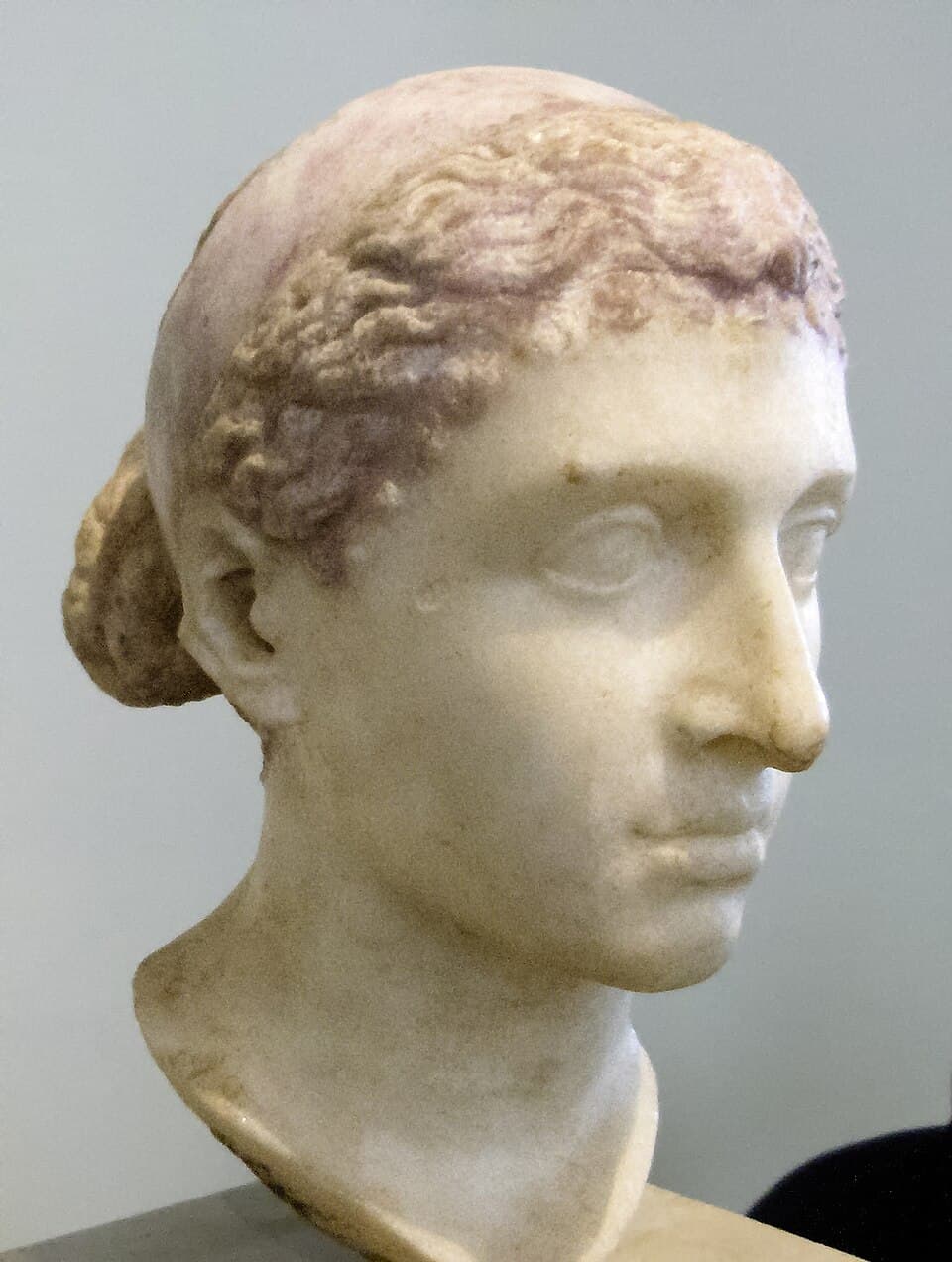
Cleopatra's Appearance and Public Image
Cleopatra has often been portrayed as a legendary beauty who used romantic attraction to control powerful men. Much of this image comes from later literature, art, and Roman accounts written by people connected to her political opponents.
The surviving evidence does not establish exactly what she looked like. Coins and ancient portraits offer some clues, but they do not provide a definitive modern likeness.
Ancient writers also emphasized her voice, intelligence, conversation, and personal presence. Her historical significance rests not only on her relationships but also on her political skills and efforts to defend Egypt's independence.
Cleopatra in Literature and Popular Culture
Cleopatra has inspired countless works of art, drama, poetry, and cinema. William Shakespeare's tragedy Antony and Cleopatra helped shape her image in English-language literature.
She has also appeared in numerous films and television productions, including the famous 1963 film Cleopatra, starring Elizabeth Taylor.
These portrayals often emphasize romance, luxury, and tragedy. Modern historians, however, increasingly examine her as a ruler who managed a kingdom under intense pressure from an expanding Roman power.
Historical Legacy
Cleopatra remains one of the most recognizable women in ancient history. Her reign illustrates the challenges faced by smaller kingdoms as Rome expanded its political and military influence.
She used diplomacy, royal symbolism, personal alliances, and military resources in an effort to preserve Egypt's independence. Although she ultimately failed, her decisions shaped the final years of the Ptolemaic kingdom and influenced the political transition from the Hellenistic kingdoms to the Roman imperial system.
Her reputation has been shaped by both historical evidence and centuries of artistic interpretation. Separating those portrayals from the surviving evidence remains an important task for historians.
Conclusion
Cleopatra VII ruled Egypt from 51 to 30 BCE and became its last active Ptolemaic monarch. Her alliance with Julius Caesar helped her regain the throne, while her partnership with Mark Antony shaped the final struggle between Egypt and Rome.
Following their defeat by Octavian, Cleopatra died in Alexandria, and Egypt became a Roman province. Her story continues to fascinate people because it combines political ambition, cultural identity, diplomacy, war, and the end of an ancient dynasty.
Did you know?
- Cleopatra was a member of the Ptolemaic dynasty, which descended from a general of Alexander the Great. - She was born in Alexandria, Egypt, in 69 BCE. - She is known for learning the Egyptian language, unlike many earlier Ptolemaic rulers. - Cleopatra had a son named Caesarion, whom she identified as Julius Caesar's child. - She had three children with Mark Antony: Alexander Helios, Cleopatra Selene II, and Ptolemy Philadelphus. - The Battle of Actium in 31 BCE was a decisive defeat for Cleopatra and Antony. - The exact method of Cleopatra's death remains uncertain, despite the famous story involving a snake. - After her death in 30 BCE, Egypt became a Roman province.