Monarch · Holy Roman Empire
Charles V
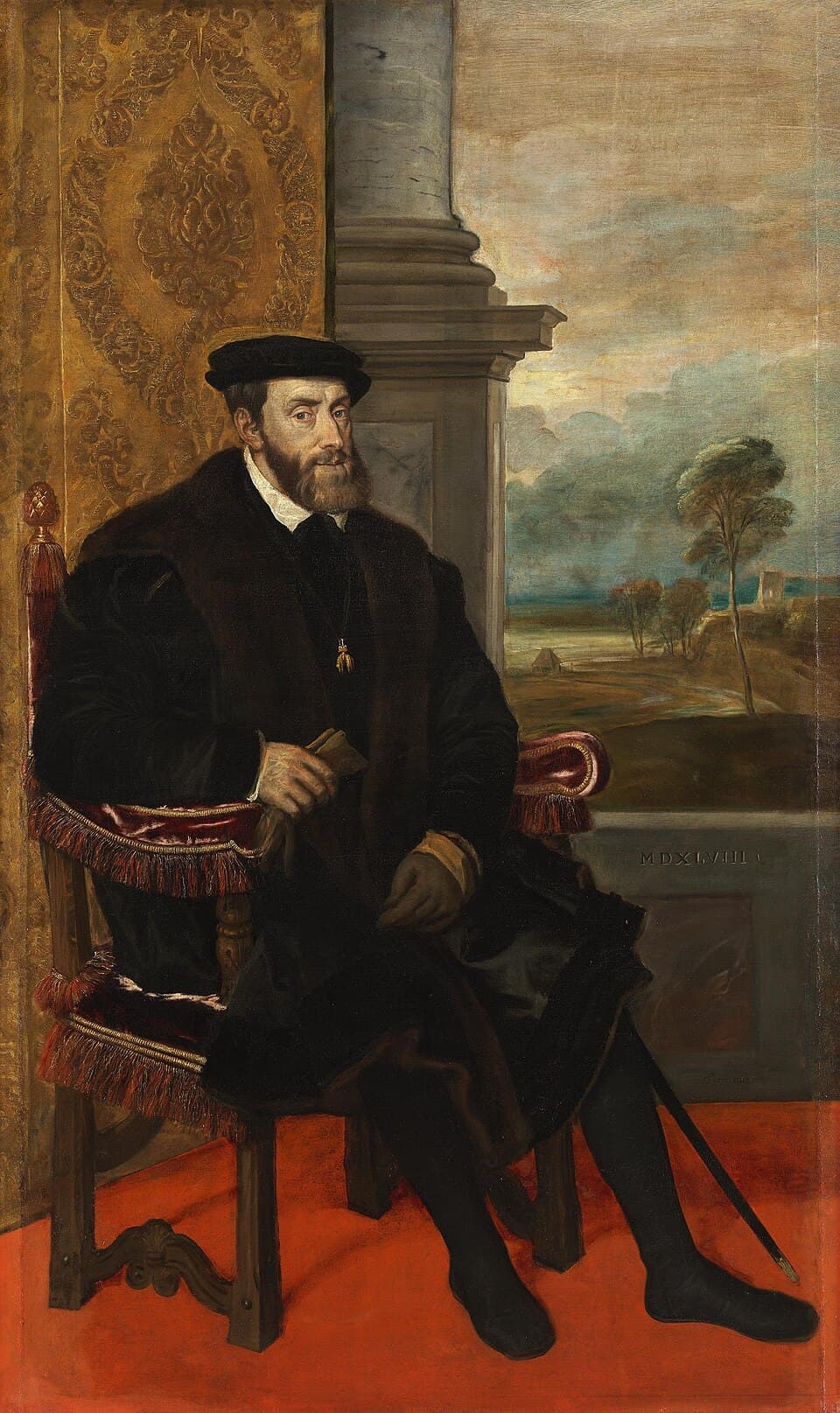
**Short Bio** Charles V (24 February 1500 – 21 September 1558) was Holy Roman Emperor from 1519 to 1556 and King of Spain as Charles I from 1516 to 1556. A member of the House of Habsburg, he ruled an extensive collection of European territories and Spain’s growing overseas empire in the Americas. His reign was marked by wars with France, conflicts with the Ottoman Empire, and the religious divisions caused by the Protestant Reformation. He abdicated his thrones in favor of his son Philip II and his brother Ferdinand I before retiring to the Monastery of Yuste in Spain, where he died in 1558.
 Wikimedia Commons
Charles V: Full Biography
Biography
1. Introduction
Charles V was one of the most influential monarchs of sixteenth-century Europe. As Holy Roman Emperor and King of Spain, he governed an extensive network of kingdoms, principalities, and overseas territories. His rule connected major political developments in Western Europe with the expansion of Spanish power in the Americas.
His reign coincided with the Protestant Reformation, the growth of Ottoman influence, and prolonged conflicts among European dynasties. Although he sought to preserve the unity of Christian Europe under imperial leadership, religious and political divisions repeatedly challenged his ambitions.
2. Early Life and Birth
Charles V was born on 24 February 1500 in Ghent, in the County of Flanders, now part of Belgium. His birth name was Charles of Habsburg.
He was the eldest son of Philip the Handsome, ruler of the Burgundian Netherlands and heir to the Habsburg dynasty, and Joanna of Castile, who later became known as Joanna the Mad.
Through his parents and grandparents, Charles inherited claims to territories belonging to several powerful European dynasties. These family connections eventually enabled him to rule lands across Spain, the Netherlands, Austria, Italy, and the Americas.
3. Family Background
Charles came from two of Europe's most important royal families. His paternal grandparents were Maximilian I, Holy Roman Emperor, and Mary of Burgundy. His maternal grandparents were Ferdinand II of Aragon and Isabella I of Castile, the Catholic Monarchs who had united much of Spain under their rule.
This ancestry gave Charles access to the Habsburg territories and the Spanish kingdoms. It also placed him at the center of European dynastic politics.
His younger brother Ferdinand later became Holy Roman Emperor, while his son Philip II inherited the Spanish monarchy and the associated overseas empire.
4. Education and Upbringing
Charles spent much of his childhood in the Netherlands, where he was raised under the supervision of his aunt Margaret of Austria and a group of court advisers.
His education included religion, history, languages, diplomacy, and the responsibilities of government. He grew up in a multilingual political environment and became familiar with the customs of different European territories.
Because his future inheritance included lands with distinct laws and political traditions, Charles had to learn how to govern through negotiation as well as royal authority.
5. Inheritance of the Burgundian Netherlands
Charles's father, Philip the Handsome, died in 1506. Charles inherited his father's Burgundian possessions, including the Netherlands.
During his minority, his aunt Margaret served as regent and helped manage the territories. In 1515, Charles assumed personal authority over the Burgundian lands.
These territories were commercially prosperous and strategically important. Their cities supported trade, manufacturing, and finance, providing resources that would later help sustain his wider European ambitions.
6. Becoming King of Spain
Charles's maternal grandfather, Ferdinand II of Aragon, died in 1516. Charles subsequently inherited the Spanish crowns of Castile and Aragon, although his mother, Joanna, remained queen in title.
Charles was formally recognized as king alongside his mother and gradually established his authority over the Spanish kingdoms.
His accession brought him control over territories in Europe, possessions in the Mediterranean, and Spanish colonies in the Americas. However, many Spanish subjects initially viewed him as a foreign-raised ruler who depended too heavily on advisers from the Netherlands.
7. Becoming Holy Roman Emperor
In 1519, Charles was elected Holy Roman Emperor following the death of his paternal grandfather, Maximilian I. He competed for the position against several candidates, including Francis I of France.
The imperial election strengthened Charles's position but also intensified his rivalry with France. His territories now surrounded or bordered important French interests, creating a major strategic conflict.
In 1520, he was crowned King of the Romans at Aachen. In 1530, Pope Clement VII crowned him emperor in Bologna, marking the culmination of his imperial ambitions.
8. The Revolt of the Comuneros
Charles faced resistance soon after becoming king of Spain. In Castile, many communities objected to taxation, the influence of foreign advisers, and the use of Spanish resources to support his wider European ambitions.
The Revolt of the Comuneros began in 1520 and developed into a major challenge to royal authority. The rebels demanded greater political influence and changes in government.
Royal forces defeated the principal rebel army at the Battle of Villalar in 1521. The revolt was suppressed, and Charles's authority in Castile gradually strengthened.
The uprising demonstrated the difficulties of governing territories whose inhabitants had different political expectations and local traditions.
9. Conflict with Francis I of France
One of the defining features of Charles's reign was his prolonged rivalry with Francis I of France. Both monarchs sought influence in Italy and competed for strategic territory and political prestige.
The conflict formed part of the Italian Wars, a series of struggles involving France, the Habsburgs, Italian states, and other European powers.
In 1525, Charles's forces defeated the French at the Battle of Pavia and captured Francis I. The French king was later released after agreeing to the Treaty of Madrid in 1526, although he subsequently repudiated important provisions.
The rivalry continued for years, consuming financial resources and preventing Charles from concentrating fully on other challenges.
10. The Sack of Rome
In 1527, troops serving Charles's imperial forces entered Rome and subjected the city to a devastating sack. Many soldiers were unpaid and poorly controlled, and the attack became one of the most notorious events of the Italian Wars.
Pope Clement VII was forced into a difficult position, and the event severely damaged the relationship between the papacy and the imperial cause.
Although Charles did not personally direct every action of the troops, the sack occurred under his imperial authority and had major political and religious consequences.
The episode illustrated the destructive effects of the wars that dominated sixteenth-century Italy.
11. The Protestant Reformation
Charles V ruled during the Protestant Reformation, which began in 1517 when Martin Luther challenged aspects of Catholic teaching and church practice.
At the Diet of Worms in 1521, Charles confronted the religious controversy surrounding Luther. The emperor defended the authority of the Catholic Church and rejected Luther's refusal to recant his teachings.
However, Protestant ideas continued to spread throughout the German territories. Several princes and cities adopted Lutheran beliefs, creating a religious division that became increasingly difficult to resolve.
Charles attempted negotiations and religious settlements but ultimately struggled to restore the unity he desired.
12. Wars Against the Ottoman Empire
The Ottoman Empire was another major challenge to Charles's rule. Under Sultan Suleiman the Magnificent, Ottoman power expanded into southeastern Europe and the Mediterranean.
In 1529, Ottoman forces besieged Vienna, the Habsburg capital in Austria. The siege ended without the city being captured, but the Ottoman advance remained a serious concern.
Charles also supported campaigns against Ottoman influence in North Africa. In 1535, he led a successful expedition that captured Tunis, although later efforts to establish lasting control over the region proved difficult.
The Ottoman conflicts required substantial military spending and cooperation among European rulers whose interests frequently differed.
13. The Conquest and Expansion of Spanish America
During Charles's reign, Spanish expeditions greatly expanded the empire in the Americas.
Hernán Cortés led the Spanish conquest of the Aztec Empire in Mexico, while Francisco Pizarro and his associates conquered the Inca Empire in South America.
These conquests brought vast territories under Spanish control and increased the flow of precious metals, particularly silver, into the Spanish imperial system.
However, Spanish expansion also involved warfare, forced labor, disease, displacement, and the destruction of Indigenous political and cultural institutions. The consequences for Indigenous populations were profound.
The growing American empire became a central component of Spain's global influence, although governing and defending these distant territories required considerable resources.
14. Economic Challenges
Despite controlling extensive territories, Charles frequently experienced financial difficulties. His wars against France, the Ottomans, and Protestant princes required enormous expenditures.
The monarchy relied on taxation, loans from major banking houses, and revenues from overseas possessions. American silver became increasingly important during the period, but it did not eliminate the financial pressures caused by prolonged warfare.
Borrowing and debt placed continuing burdens on royal finances. The wealth of his territories did not automatically translate into a stable or unified economic system because each territory had its own laws, institutions, and obligations.
15. Marriage and Family Life
In 1526, Charles married Isabella of Portugal, the daughter of King Manuel I of Portugal and Maria of Aragon. Their marriage strengthened diplomatic ties between the Spanish and Portuguese royal families.
Isabella became an important political partner during Charles's absences from Spain and served as regent on several occasions.
The couple had several children, including Philip II, who succeeded Charles as King of Spain. Their daughters included Maria of Austria and Joanna of Austria.
Isabella died in 1539, and Charles did not remarry. Her death deeply affected him, and he increasingly turned toward religious reflection in later life.
16. The German Princes and the Schmalkaldic War
The religious division within the Holy Roman Empire continued to threaten Charles's authority. Protestant rulers formed the Schmalkaldic League to defend their political and religious interests.
After years of failed negotiations, Charles launched a military campaign against the league. His forces won a major victory at the Battle of Mühlberg in 1547, capturing John Frederick I, Elector of Saxony, and strengthening imperial authority temporarily.
However, military success did not resolve the underlying religious dispute. Resistance continued, and Charles found it increasingly difficult to impose a lasting settlement on the German territories.
17. The Peace of Augsburg
Charles's efforts to preserve religious unity ultimately failed. In 1555, the Peace of Augsburg was concluded under the authority of his brother Ferdinand, who negotiated on behalf of the imperial government.
The agreement recognized Lutheranism alongside Catholicism within the Holy Roman Empire and allowed many territorial rulers to determine the official religion of their lands.
It did not establish universal religious freedom, and several groups remained excluded from its protections. Nevertheless, the agreement acknowledged the political reality of religious division.
The settlement marked an important turning point in the religious and constitutional history of the Holy Roman Empire.
18. Abdication and Division of the Habsburg Territories
By the 1550s, Charles faced declining health, mounting financial difficulties, military setbacks, and frustration over religious conflict.
Between 1554 and 1556, he gradually relinquished his possessions and titles. In October 1555, he surrendered the government of the Netherlands to his son Philip. In January 1556, he transferred the Spanish kingdoms and their overseas empire to Philip as well.
Charles subsequently gave up his imperial position in favor of his brother Ferdinand, whose succession was formally recognized later.
These transfers divided the Habsburg inheritance into two major branches: a Spanish branch led by Philip II and an Austrian branch associated with Ferdinand and his descendants.
19. Retirement at the Monastery of Yuste
After abdicating, Charles retired to the Monastery of Yuste in Extremadura, Spain, arriving in 1557.
His retirement did not mean that he completely withdrew from public affairs. He continued to receive correspondence, follow political developments, and maintain contact with members of his family and former advisers.
He also spent time in religious reflection, gardening, and his interest in mechanical devices and clocks. His final years were quieter than his earlier life, which had been dominated by military campaigns and government responsibilities.
20. Death
Charles V died on 21 September 1558 at the age of 58, following a period of declining health. He was buried initially at Yuste, and his remains were later transferred to the Royal Monastery of San Lorenzo de El Escorial.
His death ended the life of a ruler whose political responsibilities had stretched across much of Europe and the Spanish overseas empire.
21. Legacy and Historical Significance
Charles V left a complicated legacy. He presided over a period of major Spanish expansion, sustained the Habsburg dynasty's influence, and played a central role in the political struggles of sixteenth-century Europe.
His reign also demonstrated the limitations of dynastic power. Despite controlling extensive territories, he could not permanently defeat France, eliminate Ottoman influence, or restore religious unity within the Holy Roman Empire.
His abdication was particularly significant because it divided the Habsburg inheritance between his son and brother, shaping European politics for generations.
22. Conclusion
Charles V was a central figure in the transformation of Europe during the Reformation era. His rule connected the political histories of Spain, the Netherlands, the German lands, Italy, and the Americas.
His military campaigns and religious policies were marked by both achievements and setbacks. Ultimately, his decision to abdicate reflected the immense difficulty of governing a diverse collection of territories amid constant warfare and religious division.
His reign remains an important chapter in the history of European monarchy, the Habsburg dynasty, and the rise of Spain as a global power.
Did you know?
**Did You Know?** - Charles V was born in Ghent, in present-day Belgium, in 1500. - He became King of Spain in 1516 and was elected Holy Roman Emperor in 1519. - His territories included lands in Europe as well as Spain's expanding empire in the Americas. - He was a major opponent of Martin Luther during the early Protestant Reformation. - His forces captured Francis I of France after the Battle of Pavia in 1525. - In 1555–1556, he gave up his territories and titles, dividing the Habsburg inheritance between his son Philip II and his brother Ferdinand I. - After leaving the throne, he retired to the Monastery of Yuste in Spain, where he died in 1558.