Monarch · Russian Empire
Catherine II of Russia
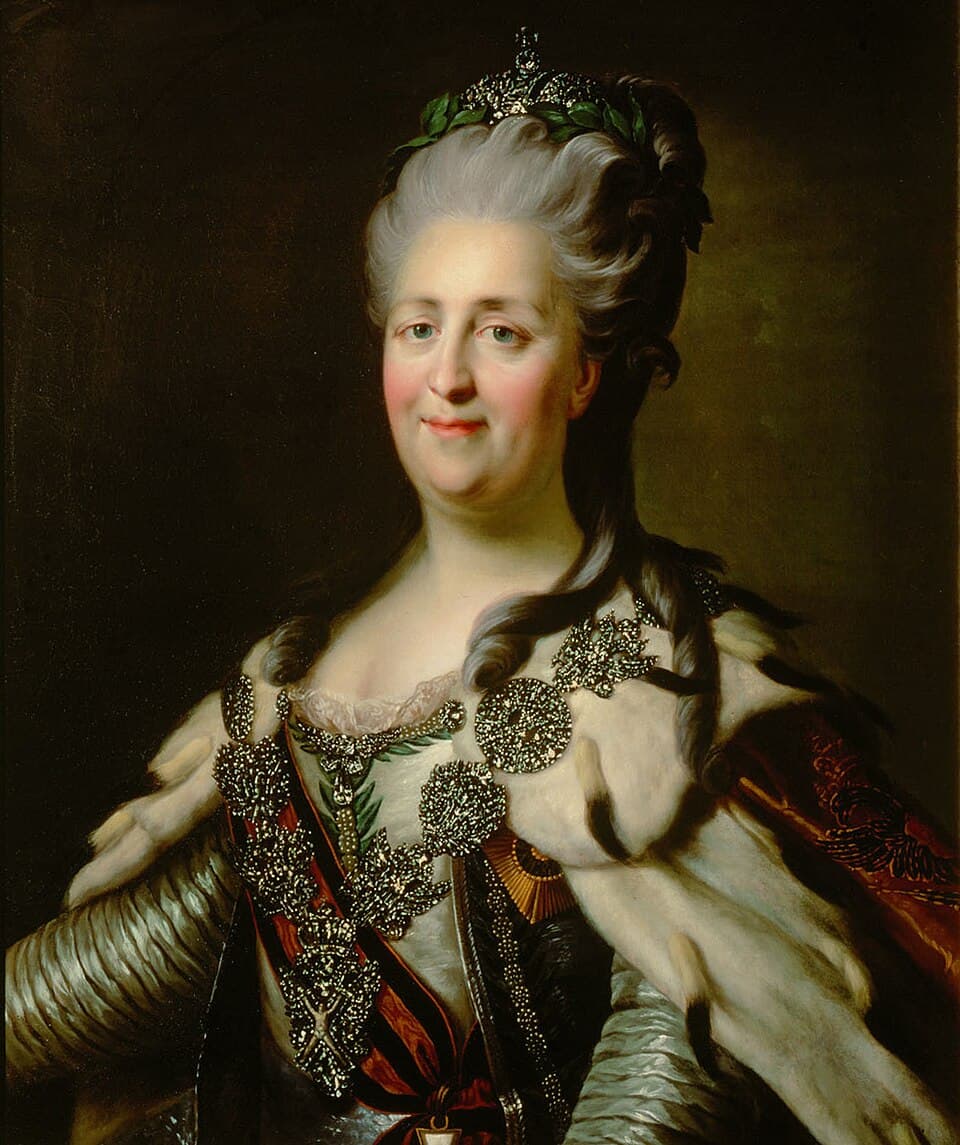
Catherine II of Russia, widely known as Catherine the Great, was Empress of Russia from 1762 to 1796. Born Sophie Friederike Auguste von Anhalt-Zerbst in Prussia, she came to Russia as a young woman and married the future Emperor Peter III. She seized power following a coup in 1762 and became one of the most influential rulers in Russian history. Her reign expanded Russia's territory, promoted education and the arts, and advanced administrative reforms, while also strengthening autocratic rule and expanding serfdom in parts of the empire.
 Wikimedia Commons
Catherine II of Russia: Full Biography
Biography
Early Life and Birth
Catherine II was born on May 2, 1729, in Stettin, then part of the Kingdom of Prussia and now Szczecin, Poland. Her birth name was Sophie Friederike Auguste von Anhalt-Zerbst. She came from a minor German princely family and was not originally expected to become the ruler of Russia.
Her father, Christian August, served as a Prussian military officer and governed the small principality of Anhalt-Zerbst. Her mother, Johanna Elisabeth of Holstein-Gottorp, belonged to a family connected to several European royal houses.
Family Background and Education
Catherine received an education that included languages, history, literature, religion, and French culture. French was widely used among European aristocrats, and she became familiar with the intellectual traditions of the Enlightenment.
Her education helped prepare her for life at a foreign royal court. She developed an interest in politics, philosophy, and literature that would later influence her public image as an enlightened ruler.
Arrival in Russia
In 1744, Catherine traveled to Russia after being selected as a potential bride for Grand Duke Peter, the heir to the Russian throne. Her marriage was intended to strengthen dynastic relationships between European ruling families.
After arriving in Russia, she studied the Russian language and became familiar with the country's customs and Orthodox Christian traditions. She converted from Lutheranism to Russian Orthodoxy and adopted the name Yekaterina Alekseyevna.
Her ability to adapt to Russian court life helped establish her position within the imperial household.
Marriage to Peter III
Catherine married Grand Duke Peter on August 21, 1745. Peter later became Emperor Peter III after the death of Empress Elizabeth in January 1762.
The marriage was troubled, and the couple developed separate political and personal interests. Catherine cultivated relationships with influential nobles and military officers, while Peter's policies alienated important sections of the Russian elite.
Their relationship and the political tensions surrounding Peter's short reign contributed to the events that brought Catherine to power.
Becoming Empress of Russia
Peter III became emperor in January 1762 but ruled for only about six months. On July 9, 1762, Catherine took power with the support of members of the Imperial Guard and influential political figures.
Peter was forced to abdicate and died shortly afterward while in custody. The circumstances of his death remain historically controversial, although he is generally believed to have been killed by people connected with the coup.
Catherine became empress in her own right, despite having no direct hereditary claim to the Russian throne.
Coronation and Consolidation of Power
Catherine was crowned Empress of Russia in Moscow on September 22, 1762. She faced the immediate challenge of securing the loyalty of the military, nobility, and government officials.
She worked to strengthen her position through appointments, patronage, diplomatic relationships, and administrative decisions. Her ability to maintain support among influential groups helped her remain in power for more than three decades.
The Enlightenment and Political Philosophy
Catherine presented herself as an admirer of Enlightenment thought. She read European philosophers and corresponded with intellectuals such as Voltaire and Denis Diderot.
She expressed interest in legal reform, education, and the rational organization of government. However, she maintained autocratic authority and did not establish a representative political system.
Her reign illustrates the tension between Enlightenment ideals and the realities of ruling a vast empire structured around aristocratic privilege and serfdom.
The Nakaz and Legal Reform
In 1767, Catherine issued the Nakaz, or Instruction, to guide a legislative commission tasked with considering a new legal code.
The document drew on Enlightenment ideas about justice, law, and government. It criticized torture and expressed opposition to arbitrary punishment, although it also defended centralized autocratic rule.
The commission failed to produce a comprehensive new legal code. Nevertheless, the Nakaz became an important example of Catherine's attempt to present her government as reform-minded.
Administrative Reforms
Catherine reorganized Russia's provincial administration, particularly after the Pugachev Rebellion. The Provincial Reform of 1775 divided the empire into more manageable administrative units and expanded local government institutions.
These changes strengthened the state's ability to collect taxes, administer justice, and maintain order. They also increased the responsibilities and influence of local nobles, reinforcing the social hierarchy on which the monarchy depended.
The Charter to the Nobility
In 1785, Catherine issued the Charter to the Nobility, confirming important privileges for the Russian aristocracy. It recognized noble corporate rights and reinforced their position within provincial society.
The charter helped secure aristocratic support for the monarchy. However, the privileges granted to nobles contrasted sharply with the restricted freedoms of peasants, many of whom remained bound by serfdom.
Serfdom and the Peasantry
Serfdom remained one of the defining features of Russian society during Catherine's reign. Serfs were peasants subject to the authority of landowners or, in some cases, the state.
Although Catherine expressed interest in Enlightenment ideas, she did not abolish serfdom. In several regions, landlords' control over peasants remained severe, and the expansion of noble privileges reinforced the existing social order.
This contradiction is central to assessments of her reign: cultural and administrative reforms coexisted with the continued subordination of much of the rural population.
The Pugachev Rebellion
From 1773 to 1775, Russia experienced a major uprising led by Yemelyan Pugachev, a Cossack who claimed to be the supposedly dead Emperor Peter III.
The rebellion drew support from Cossacks, peasants, and other groups dissatisfied with government authority and social conditions. It spread across parts of the Volga and Ural regions before government forces defeated it.
The uprising exposed the instability created by harsh social conditions and contributed to Catherine's decision to reorganize provincial administration and strengthen local control.
Expansion of the Russian Empire
Catherine pursued an expansive foreign policy that increased Russia's territory and influence. Her government fought wars against the Ottoman Empire and intervened in the affairs of the Polish-Lithuanian Commonwealth.
These campaigns brought Russia access to strategically important regions and strengthened its position as a major European power. They also involved prolonged warfare, territorial conquest, and the subordination of neighboring peoples.
Wars Against the Ottoman Empire
Russia fought two major wars against the Ottoman Empire during Catherine's reign: the first from 1768 to 1774 and the second from 1787 to 1792.
Russian victories expanded the empire's influence around the Black Sea and weakened Ottoman control in the region. The Treaty of Küçük Kaynarca in 1774 gave Russia important advantages, including greater influence in relation to the Crimean Khanate and the right to protect certain Orthodox Christian interests within the Ottoman Empire.
The later Treaty of Jassy in 1792 confirmed further Russian territorial gains and strengthened its position along the northern Black Sea coast.
Annexation of Crimea
In 1783, Catherine's government annexed Crimea, ending the independence of the Crimean Khanate. The region had long been strategically important because of its location on the Black Sea.
The annexation strengthened Russia's naval and commercial position in the region. It also marked a major change for the Crimean Tatar population and formed part of Russia's broader expansion into territories previously influenced by the Ottoman Empire.
The Partitions of Poland
Catherine played a major role in the partitions of the Polish-Lithuanian Commonwealth, carried out jointly by Russia, Prussia, and Austria.
The first partition occurred in 1772, followed by the second in 1793 and the third in 1795. These agreements progressively divided Polish-Lithuanian territory among the neighboring powers and ultimately removed the Commonwealth as an independent state.
Russia gained extensive lands, including territories with large populations of Belarusians, Ukrainians, Lithuanians, Poles, and other peoples. The partitions remain a major and controversial part of Catherine's foreign-policy legacy.
Relations with European Intellectuals
Catherine corresponded with prominent Enlightenment figures, including Voltaire and Denis Diderot. She also invited Diderot to visit Russia and purchased his library, supporting his intellectual work.
These relationships helped promote her reputation as a cultured and philosophically engaged monarch. However, her political system remained autocratic, and her government became more restrictive toward dissenting ideas as revolutionary movements spread across Europe.
Education and Women's Institutions
Catherine supported the development of educational institutions and expanded opportunities for some groups within Russian society. In 1764, she established the Smolny Institute in St. Petersburg, an important institution for the education of girls from noble families.
Her government also supported schools, cultural organizations, and projects intended to improve the training of officials. Educational opportunities remained unequal, however, and access to formal education was limited for much of the population.
Arts, Literature, and Architecture
Catherine was a major patron of the arts. She collected paintings, books, sculptures, and other works that helped build the foundations of Russia's imperial art collections.
Her court supported architects, writers, musicians, and artists. The Hermitage collection, which later became part of the State Hermitage Museum, grew significantly through her purchases and patronage.
Her interest in European artistic traditions contributed to the development of St. Petersburg as a major cultural center.
The Hermitage
Catherine began assembling an extensive art collection during her reign. The collection was initially housed in buildings associated with the Winter Palace and became known as the Hermitage.
She purchased significant collections from European collectors and supported the acquisition of paintings and other cultural objects. Over time, the collection developed into one of the most important art collections in the world.
Personal Life and Relationships
Catherine's personal relationships attracted considerable attention during and after her reign. She had several prominent favorites, some of whom played influential roles in court politics.
Among the best known was Grigory Potemkin, a military and political figure who became a close adviser and partner. He played a major role in Russia's southern expansion and the administration of newly acquired territories.
The political importance of Catherine's favorites varied, and their influence reflected the personal networks that shaped decision-making at the imperial court.
Children and Family
Catherine had a son, Paul, born in 1754, who later became Emperor Paul I. The official account recognized Paul as the son of Peter III, although speculation about his paternity circulated during Catherine's lifetime and afterward.
She also had a son, Alexei Bobrinsky, from her relationship with Grigory Orlov. Catherine's relationship with Paul was politically difficult, and she reportedly had reservations about his future role as ruler.
Paul succeeded her after her death in 1796.
Foreign Relations and Diplomacy
Catherine's government sought to make Russia a leading power in European diplomacy. Russia participated in alliances, negotiated treaties, and intervened in the politics of neighboring states.
Her foreign policy combined military expansion with diplomatic bargaining. While Russia gained territory and influence, its growing power also generated concern among other European governments.
The French Revolution
The French Revolution began in 1789 and challenged the hereditary monarchies of Europe. Catherine, who had earlier expressed interest in Enlightenment philosophy, became increasingly hostile toward revolutionary politics.
Her government restricted the circulation of some French writings and took a more conservative position toward ideas that threatened established authority. This shift demonstrated the limits of her earlier enthusiasm for reform.
Health and Later Years
During the final years of her reign, Catherine continued to direct government policy and oversee Russia's international affairs. She remained active in cultural patronage and administrative matters while facing the difficulties of managing an increasingly large empire.
Her later policies reflected a stronger emphasis on maintaining political stability and protecting the privileges of the monarchy and nobility.
Death
Catherine II suffered a stroke and died on November 17, 1796, at Tsarskoye Selo near St. Petersburg. She was 67 years old.
Her son Paul I succeeded her as emperor. His reign introduced changes to court practices and succession policy, while Catherine's long period in power remained a defining era in Russian history.
Historical Significance
Catherine the Great transformed Russia's international position. Her military campaigns expanded the empire, her administrative reforms strengthened central government, and her cultural patronage helped make Russia a major participant in European intellectual and artistic life.
At the same time, her reign maintained autocratic rule and preserved serfdom. The partitions of Poland and the annexation of Crimea also had lasting consequences for the peoples and territories affected by Russian expansion.
Legacy
Catherine II is remembered both for expanding Russia's power and for her engagement with Enlightenment culture. Her court became a center of art and scholarship, and her government introduced important administrative changes.
Her legacy remains complex because these developments occurred alongside social inequality, restrictions on political freedom, and territorial conquest. Her reign is a major case study in the possibilities and contradictions of enlightened absolutism.
Conclusion
Catherine II ruled Russia from 1762 to 1796 and became known as Catherine the Great. Through military campaigns, administrative reforms, and cultural patronage, she expanded Russia's influence across Europe. Yet her reign also preserved autocratic power, reinforced noble privilege, and left serfdom intact. These achievements and contradictions continue to shape historical interpretations of her rule.
Did you know?
- Catherine the Great was born in Prussia and was not originally Russian. - She learned Russian and converted to Russian Orthodoxy before marrying the future Peter III. - She came to power through a coup in 1762. - Catherine corresponded with Enlightenment thinkers such as Voltaire and Denis Diderot. - Her government annexed Crimea in 1783. - She supported the establishment of the Smolny Institute, an influential school for girls from noble families. - Her reign included all three partitions of the Polish-Lithuanian Commonwealth. - She collected thousands of works of art that helped establish the foundations of the Hermitage collection.