Politician · United States
Abraham Lincoln
Abraham Lincoln (1809–1865) was the 16th President of the United States and one of the most prominent figures in American history. Born into a poor frontier family in Kentucky, he became a lawyer and politician through largely self-directed education. He led the Union during the American Civil War, issued the Emancipation Proclamation in 1863, and delivered the Gettysburg Address. Lincoln was reelected in 1864 but was assassinated by John Wilkes Booth on April 14, 1865, shortly after the Confederate surrender.
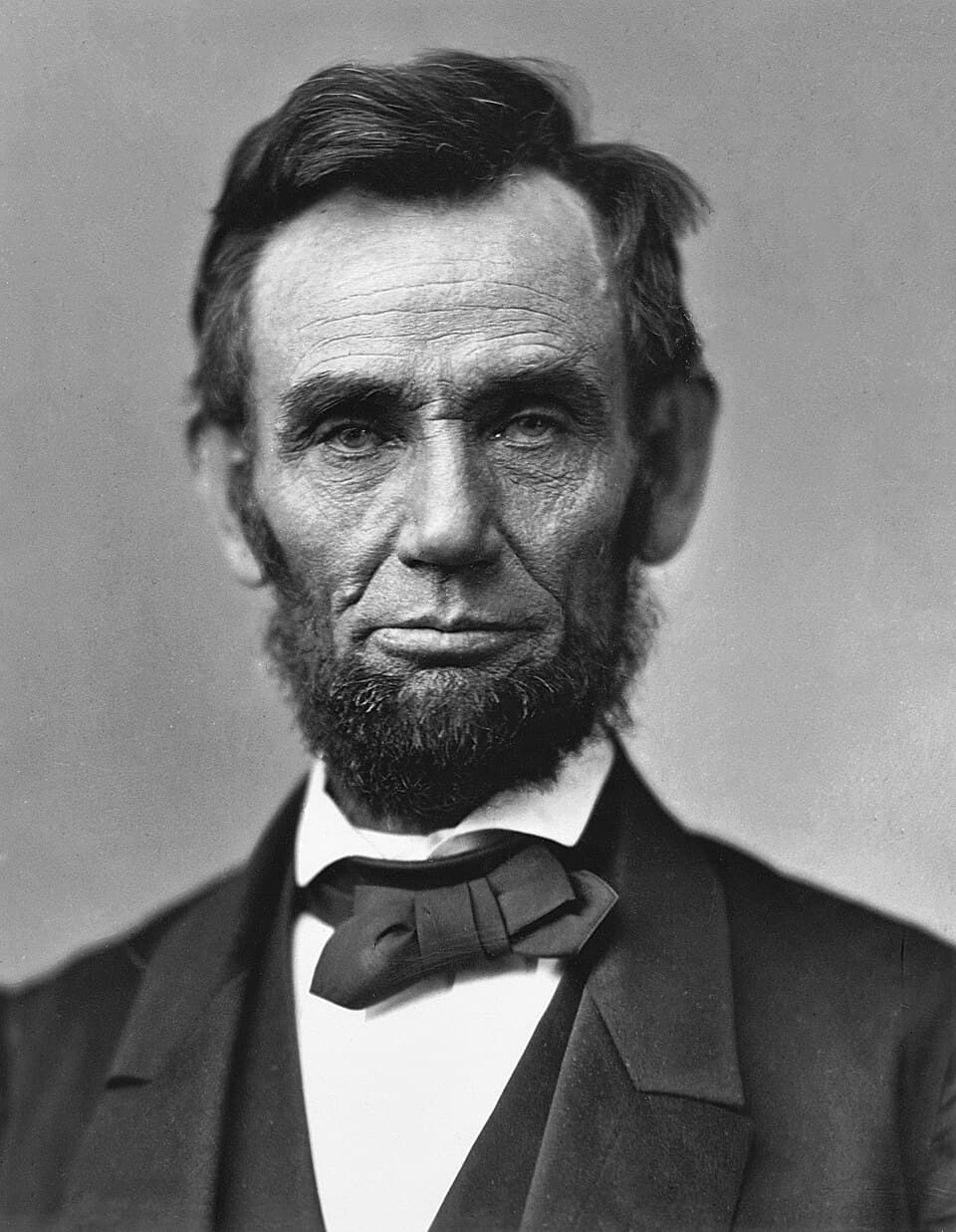 Wikimedia Commons
Abraham Lincoln Biography
Biography
Early Life
Abraham Lincoln was born on February 12, 1809, in Kentucky to Thomas Lincoln and Nancy Hanks Lincoln. His family lived on the frontier, and his childhood was marked by hard work and limited formal schooling.
In 1816, the Lincoln family moved to Indiana. Lincoln's mother died in 1818, and his father later remarried Sarah Bush Johnston, who became an important influence in his upbringing. Lincoln received only limited formal education but became an avid reader and largely educated himself.
Move to Illinois
In 1830, Lincoln moved with his family to Illinois. He worked at various jobs, including as a laborer, store clerk, and flatboat worker.
His experiences on the frontier helped develop the practical skills and communication abilities that later became important in his legal and political career.
Early Political Career
Lincoln entered politics in Illinois and was elected to the Illinois House of Representatives in 1834. He served four terms in the state legislature.
During this period, he also studied law and established a successful legal practice. He became known for his ability to argue cases and communicate complex ideas clearly.
Marriage and Family
Lincoln married Mary Todd in 1842. They had four sons: Robert, Edward, William, and Thomas, known as Tad.
The family lived in Springfield, Illinois, where Lincoln continued practicing law and developing his political career.
Congressional Career
In 1846, Lincoln was elected to the U.S. House of Representatives, where he served one term.
After leaving Congress, he returned primarily to his legal career for several years. The growing national conflict over slavery eventually brought him back into major political activity.
Opposition to the Expansion of Slavery
During the 1850s, Lincoln became increasingly prominent within the emerging Republican Party. He opposed the expansion of slavery into U.S. territories.
His debates with Senator Stephen A. Douglas, particularly during the 1858 Illinois Senate campaign, brought Lincoln national attention.
Although Lincoln lost the Senate election, the debates helped establish him as an important national political figure.
Election as President
Lincoln won the Republican presidential nomination in 1860 and was elected president on November 6, 1860.
His victory was followed by the secession of Southern states. South Carolina seceded in December 1860, and other states soon followed.
Lincoln opposed secession and maintained that the Union should not be dissolved.
The American Civil War
Lincoln was inaugurated as the 16th president on March 4, 1861. The Civil War began soon afterward, with the Confederate attack on Fort Sumter in April.
As commander in chief, Lincoln directed the Union war effort and worked with military commanders throughout the conflict.
The war became both a struggle to preserve the Union and, increasingly, a struggle against slavery.
Emancipation Proclamation
On January 1, 1863, Lincoln issued the Emancipation Proclamation.
The proclamation declared enslaved people in areas under rebellion against the United States to be free. It did not immediately abolish slavery throughout the country, but it transformed the purpose of the war and established emancipation as a major Union war aim.
Gettysburg Address
On November 19, 1863, Lincoln delivered the Gettysburg Address at the dedication of a military cemetery in Gettysburg, Pennsylvania.
The short speech connected the Civil War with the principles of equality and representative government. It became one of the most famous speeches in American history.
Reelection
Despite the enormous human and political costs of the Civil War, Lincoln won reelection in 1864.
His second inauguration took place in March 1865, as Union victory was approaching. Lincoln increasingly emphasized reconciliation and the need to rebuild the nation after the war.
Thirteenth Amendment
Lincoln supported constitutional abolition of slavery. Congress passed the Thirteenth Amendment in 1865, and Lincoln strongly supported its adoption.
The amendment was ratified after his death on December 18, 1865, permanently abolishing slavery throughout the United States.
Assassination
On the evening of April 14, 1865, Lincoln attended a performance of Our American Cousin at Ford's Theatre in Washington, D.C.
Actor John Wilkes Booth entered the presidential box and shot Lincoln. Lincoln was carried to a boarding house across the street from the theater, where doctors attempted to treat him.
He died at 7:22 a.m. on April 15, 1865.
Death and Burial
Lincoln's death occurred only days after the effective end of the Civil War. His assassination shocked the United States and led to a period of national mourning.
His body was transported by train from Washington to Springfield, Illinois, where he was buried at Oak Ridge Cemetery on May 4, 1865.
Legacy
Abraham Lincoln is remembered as one of the most consequential presidents in American history. His leadership during the Civil War preserved the Union, while his actions on emancipation helped bring about the end of slavery.
His speeches, particularly the Gettysburg Address and his Second Inaugural Address, remain important works of American political rhetoric.
Lincoln's life also became an enduring example of how a largely self-educated frontier lawyer could rise to the highest political office in the United States. His legacy continues to be studied in connection with democracy, civil war, slavery, constitutional government, and American national identity.
Did you know?
Abraham Lincoln had less than one year of formal schooling in total, yet he became a lawyer, author, and one of the most influential presidents in American history through extensive self-education and reading.