Politician · Bangladesh
Sheikh Hasina
Sheikh Hasina is a Bangladeshi politician who served as the Prime Minister of Bangladesh for multiple terms, most recently from January 2009 until August 2024. Born on September 28, 1947, in Tungipara, then part of British India, she is the daughter of Sheikh Mujibur Rahman, Bangladesh’s founding leader. Her political career has significantly influenced the country’s government, economy, and international relations, while also drawing substantial controversy over democratic governance, civil liberties, and human rights.
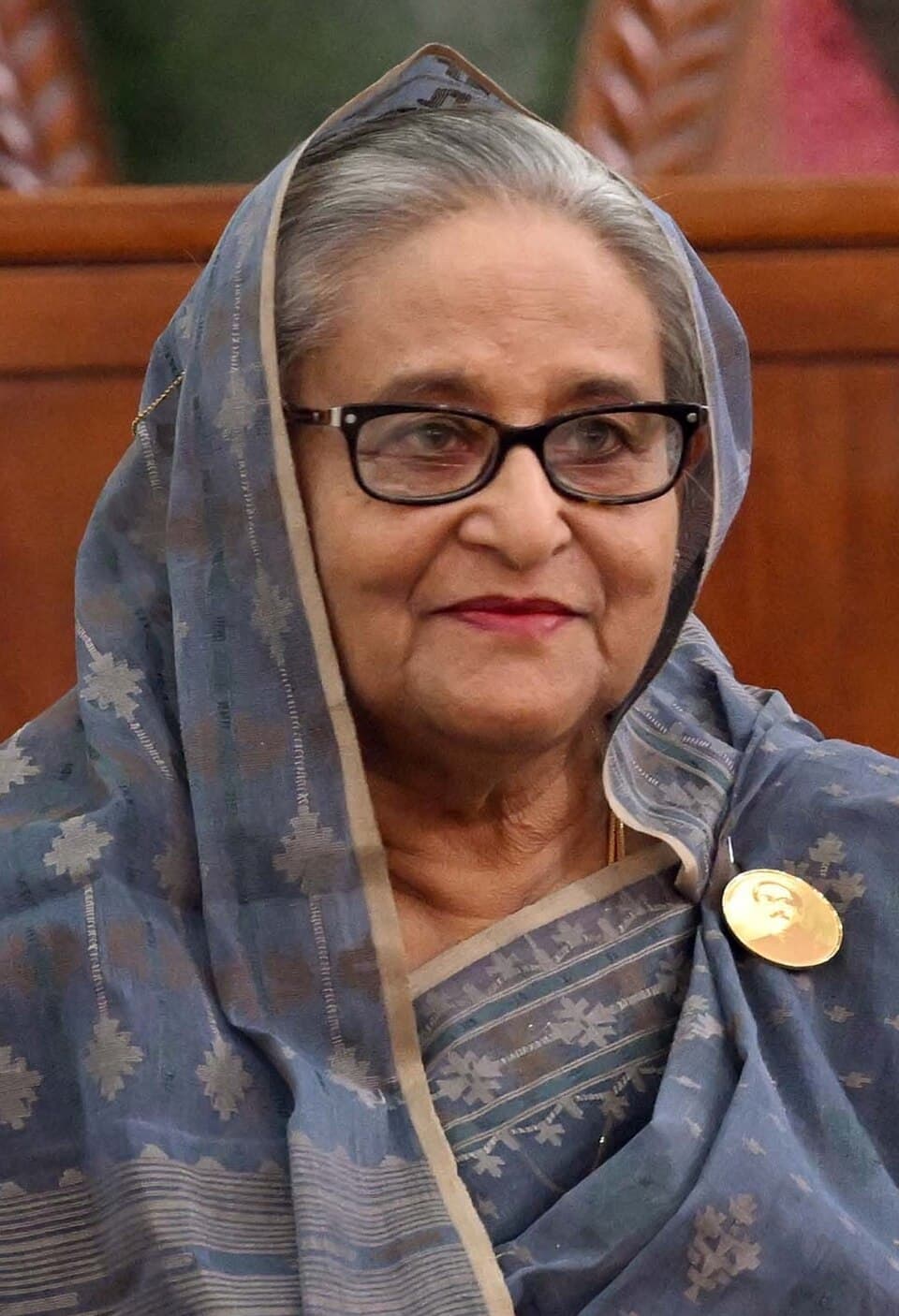 Wikimedia Commons
Sheikh Hasina: Full Biography
Positions held
| Years | Office | Tenure |
|---|---|---|
| 2009— | Member of the Parliament of Bangladesh | — |
| 2009— | Leader of the House | — |
| 2009—2024 | Prime Minister of Bangladesh | 15 yr |
| 2001—2006 | Leader of the Opposition | 4 yr |
| 1996—2001 | Leader of the House | 4 yr |
| 1996—2001 | Prime Minister of Bangladesh | 5 yr |
| 1991—1995 | Leader of the Opposition | 4 yr |
| 1991—2006 | Member of the Parliament of Bangladesh | 15 yr |
| 1986—1987 | Leader of the Opposition | 16 mo |
| 1986—1987 | Member of the Parliament of Bangladesh | 16 mo |
Biography
Early Life
Sheikh Hasina was born on September 28, 1947, in Tungipara, in what was then British India and is now Bangladesh. She is the eldest daughter of Sheikh Mujibur Rahman, the founding leader of Bangladesh, and Sheikh Fazilatunnesa Mujib. Her childhood was closely connected to the political movement that eventually led to Bangladesh's independence.
Family Background
Hasina grew up in a politically active family. Her father played a central role in the Bengali nationalist movement and became Bangladesh's first president and later prime minister. Her family's political involvement profoundly influenced her future career.
Education
Sheikh Hasina studied at institutions in Dhaka and attended the University of Dhaka. She graduated in 1973. During her student years, she became involved in political activities and participated in the Bangladesh Chhatra League, the student organization associated with the Awami League.
Bangladesh Liberation War
During the Bangladesh Liberation War of 1971, Hasina's family experienced the political turmoil and violence surrounding the country's struggle for independence. Her father was detained by Pakistani authorities during the war, while other members of her family remained in Bangladesh.
Family Tragedy in 1975
On August 15, 1975, Sheikh Mujibur Rahman and most of his family members were assassinated during a military coup in Bangladesh. Hasina and her younger sister, Sheikh Rehana, survived because they were abroad at the time. The tragedy became a defining event in Hasina's life and subsequent political career.
Years in Exile
Following the 1975 assassinations, Hasina and her sister lived outside Bangladesh for several years. During this period, she remained connected to the country's political developments and continued to oppose military rule.
Leadership of the Awami League
In 1981, Sheikh Hasina was elected president of the Bangladesh Awami League while she was still abroad. She returned to Bangladesh on May 17, 1981, and became a leading figure in the opposition movement against military rule.
Movement Against Military Rule
During the 1980s, Hasina participated in political movements opposing the government of Hussain Muhammad Ershad. She worked with opposition groups to demand democratic reforms and the restoration of parliamentary government. Her political activities also exposed her to arrests, restrictions, and threats.
First Term as Prime Minister
The Awami League won the June 1996 parliamentary election, and Hasina became prime minister on June 23, 1996. Her first government pursued economic development, social programs, and agreements with neighboring countries.
Major Achievements of the First Government
During her first term, the government signed the Ganges Water Sharing Treaty with India in 1996 and the Chittagong Hill Tracts Peace Accord in the same year. The government also continued infrastructure development and social welfare initiatives.
Opposition Years
The Awami League lost the 2001 general election, and Hasina returned to the opposition. She remained a major political figure and continued to lead her party through a period marked by political confrontations and disputes over elections and governance.
Return to Power in 2009
The Awami League won the December 2008 parliamentary election, and Hasina became prime minister again in January 2009. Her government remained in power for more than 15 years, making this the longest continuous period of her leadership.
Economic Development and Infrastructure
During her governments, Bangladesh experienced substantial growth in areas including manufacturing, exports, electricity generation, and digital services. Major infrastructure projects included the Padma Bridge and the expansion of transport and energy networks. Supporters credited her administrations with promoting development, while critics raised concerns about public spending, debt, inequality, and the distribution of economic benefits.
Digital Bangladesh
Hasina's government promoted the Digital Bangladesh initiative, which aimed to expand digital services, internet access, technology education, and online public administration. The initiative contributed to the expansion of digital services, although access and freedom of expression remained subjects of public debate.
Social Programs and Education
Her governments expanded various social protection programs and continued initiatives involving education, healthcare, women's participation, and rural development. The distribution of free school textbooks became a prominent education policy. The scale and effectiveness of these programs have been discussed alongside wider questions about public service quality and inequality.
Foreign Relations
Sheikh Hasina's governments maintained important diplomatic and economic relationships with India, China, Japan, the United States, and other countries. Her administration worked on regional connectivity, trade, security cooperation, and infrastructure investment. Relations with neighboring India were particularly significant because of shared borders, rivers, and security interests.
Elections and Democratic Governance
Elections held during Hasina's later years in office generated substantial controversy. Opposition parties and critics questioned the fairness and competitiveness of several elections, particularly those held in 2014, 2018, and 2024. Her government defended its electoral record, while human rights organizations and political opponents raised concerns about political repression, restrictions on media, arrests, and the treatment of opposition figures.
Protests in 2024
In 2024, student-led protests initially focused on public-sector job quotas and developed into a wider movement against Hasina's government. The authorities' response resulted in widespread violence and a large number of deaths. The handling of the protests drew international scrutiny and intensified demands for political change.
Departure from Office
On August 5, 2024, Sheikh Hasina left office amid mass protests and departed Bangladesh for India. An interim government subsequently took responsibility for governing the country. Her departure marked a major turning point in Bangladesh's political history after more than 15 years of uninterrupted rule.
Legal Proceedings
After leaving Bangladesh, Hasina faced legal proceedings related to the 2024 crackdown on protesters. In November 2025, a Bangladeshi tribunal sentenced her to death in absentia over crimes against humanity connected to the crackdown. Hasina has rejected the allegations against her. The proceedings and their implications have remained subjects of national and international attention.
Personal Life
Sheikh Hasina married nuclear scientist M. A. Wazed Miah in 1968. They had two children, Sajeeb Wazed and Saima Wazed. Her family background and her father's political legacy have remained important aspects of her public identity.
Awards and Recognition
Throughout her political career, Hasina received various national and international awards and honors, including recognition connected to development, food security, and women's empowerment. Her international reputation has varied considerably, reflecting both recognition of Bangladesh's development achievements and criticism of her government's record on democratic rights and political freedoms.
Legacy
Sheikh Hasina has played a major role in Bangladesh's politics for several decades. Her time in office was associated with economic expansion, infrastructure projects, and the growth of digital services. It was also marked by sustained criticism concerning electoral credibility, civil liberties, human rights, and the response to political opposition.
Conclusion
Sheikh Hasina's political career has shaped modern Bangladesh through periods of democratic activism, extended government, economic development, and intense political controversy. Her legacy remains closely tied to both the achievements claimed by her administrations and the serious questions raised about governance and human rights during her rule.
Did you know?
- Sheikh Hasina was born on September 28, 1947, in Tungipara, Bangladesh. - She is the eldest daughter of Sheikh Mujibur Rahman. - She became president of the Awami League in 1981 while living abroad. - She returned to Bangladesh on May 17, 1981, after several years in exile. - Her first term as prime minister began in June 1996. - She led the government during the construction and opening of the Padma Bridge. - She left office on August 5, 2024, following mass protests.