Tennis Player · Spain
Rafael Nadal
**Rafael Nadal** (born June 3, 1986) is a retired Spanish professional tennis player widely regarded as one of the greatest tennis players of all time. Nicknamed the **“King of Clay,”** he won 22 Grand Slam men's singles titles, including a record 14 French Open championships. Nadal reached world No. 1, won two Olympic gold medals, and became famous for his fighting spirit, powerful left-handed play, and remarkable consistency. He retired from professional tennis in November 2024 after more than two decades at the highest level. Since retirement, he has focused on family life, the Rafa Nadal Academy, and charitable work through the Rafa Nadal Foundation. <Cite refs={["turn486143search0","turn486143search1","turn486143search2"]} />
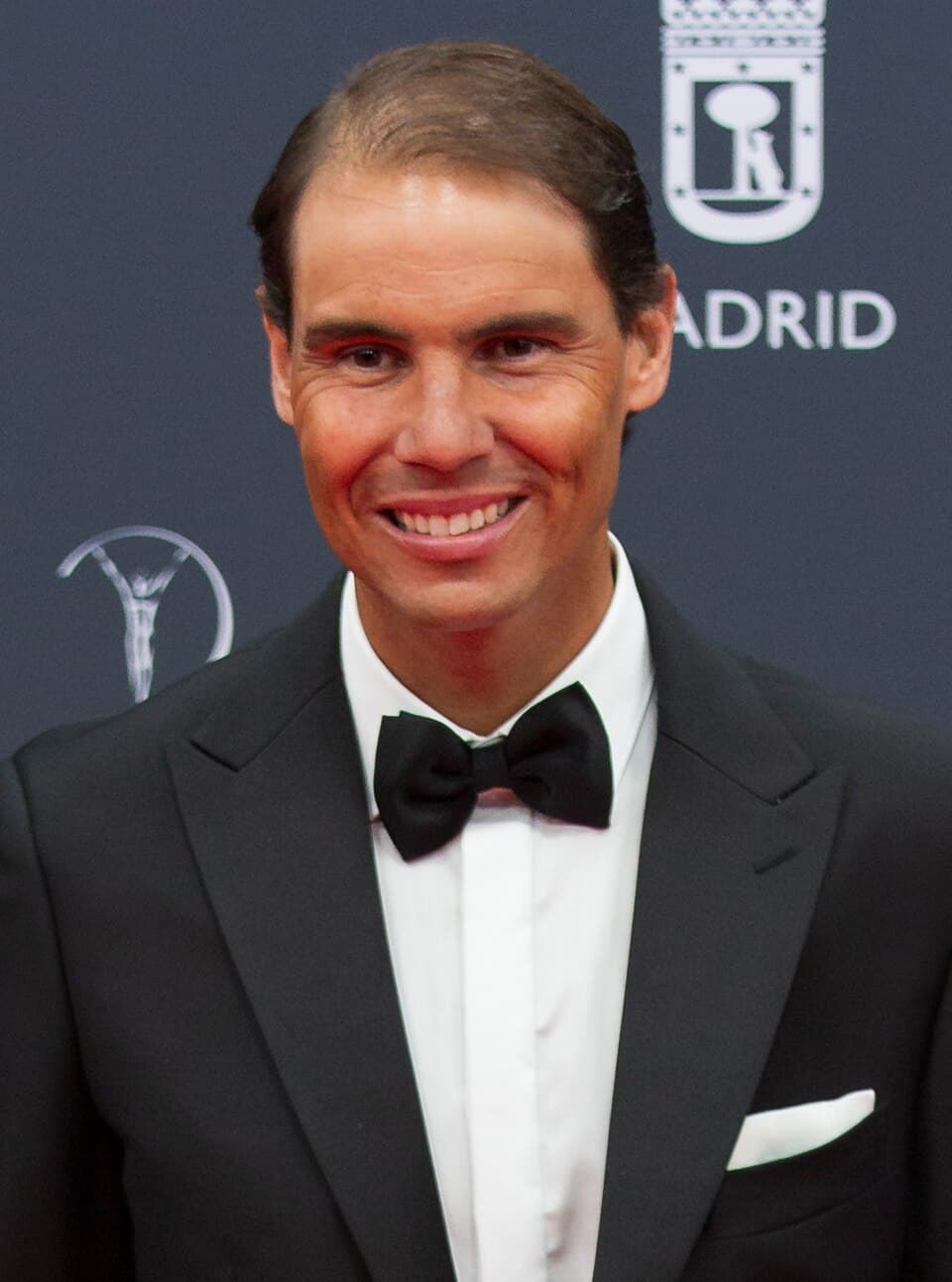 Wikimedia Commons
Rafael Nadal: Full Biography
Biography
1. Introduction
Rafael Nadal is a Spanish tennis legend who dominated men's professional tennis for more than two decades. Known for his extraordinary determination, athleticism, and dominance on clay courts, he became one of the most successful athletes in tennis history.
Nadal won 22 Grand Slam singles titles, including 14 French Open championships at Roland-Garros. His remarkable achievements, famous rivalries, and never-give-up attitude earned him admiration from fans around the world.
Alongside Roger Federer and Novak Djokovic, Nadal formed part of tennis's celebrated Big Three, an era that transformed the sport.
2. Birth and Early Life
Rafael Nadal Parera was born on June 3, 1986, in Manacor, Mallorca, Spain. He grew up on the Spanish island of Mallorca, surrounded by family and a strong sporting culture.
His father, Sebastián Nadal, was a businessman, while his mother, Ana María Parera, supported the family and later became involved in charitable activities.
Nadal developed an interest in sports at a young age. His early childhood was shaped by discipline, physical activity, and encouragement from his family.
3. Family Background
Nadal grew up in a close-knit family. His younger sister, María Isabel Nadal, has remained an important part of his life.
His uncle Miguel Ángel Nadal was a professional footballer who played for clubs including Barcelona and Mallorca and represented Spain internationally.
Having a successful athlete in the family exposed Nadal to professional sports from an early age. However, it was his uncle Toni Nadal who played the most important role in shaping his tennis career.
4. Early Interest in Tennis
Nadal began playing tennis at approximately four years old. His uncle Toni introduced him to the sport and became his first major coach.
Toni emphasized discipline, concentration, effort, and respect for opponents. These values became defining characteristics of Nadal's playing style and public personality.
Although Nadal also played football as a child, tennis gradually became his primary sporting focus. His natural athletic ability and willingness to train helped him progress rapidly.
5. Training Under Toni Nadal
Toni Nadal played a central role in developing Rafael's technique and competitive mentality. He encouraged him to work hard, remain humble, and treat every point as important.
Nadal learned to play left-handed even though he naturally writes with his right hand. This decision helped him develop a powerful left-handed forehand that became one of the most recognizable weapons in tennis.
Their coaching relationship lasted for many years and was instrumental in Nadal's rise to the top of the sport.
6. Junior Tennis Career
As a teenager, Nadal began attracting attention in Spanish and international tennis. His speed, physical strength, and fighting spirit distinguished him from many players his age.
He competed successfully in junior tournaments and began challenging experienced professionals while still a teenager.
In 2002, at just 15 years old, Nadal won his first ATP-level match. This achievement provided an early indication of his potential to become a major force in professional tennis.
7. Turning Professional
Nadal turned professional in 2001. His early career involved competing against established players and learning how to handle the physical and mental demands of the professional tour.
His breakthrough accelerated in 2003 and 2004, when he began recording important victories and winning his first ATP Tour title.
In 2004, he also helped Spain win the Davis Cup. Although injuries occasionally interrupted his progress, his results established him as one of the most promising young players in the sport.
8. Breakthrough at the French Open
Nadal's international breakthrough came at the 2005 French Open. He won the men's singles championship on his debut at the tournament, defeating Mariano Puerta in the final.
He was only 19 years old when he claimed his first Grand Slam title. The victory announced the arrival of a remarkable clay-court specialist.
Nadal won the French Open again in 2006, 2007, and 2008. His exceptional movement, heavy topspin, and ability to sustain long rallies made him extraordinarily difficult to defeat on clay.
9. Becoming the King of Clay
Nadal earned the nickname “King of Clay” because of his extraordinary success on clay courts.
His game was particularly effective on this surface. He combined powerful topspin shots with excellent defensive movement, patience, and the ability to turn difficult situations into winning opportunities.
He went on to win 14 French Open men's singles titles, a record unmatched by any other player at a single Grand Slam tournament.
His overall record at Roland-Garros became one of the most remarkable achievements in modern sport.
10. First Wimbledon Title
Although Nadal initially became famous for his clay-court dominance, he worked hard to improve his performance on grass and hard courts.
In 2008, he defeated Roger Federer in the Wimbledon final in a match widely regarded as one of the greatest tennis matches ever played.
The five-set contest lasted nearly five hours and featured dramatic momentum changes and exceptional shot-making.
Winning Wimbledon demonstrated that Nadal could succeed beyond clay and established him as a serious contender for the world's No. 1 ranking.
11. Reaching World No. 1
Nadal became the world's No. 1 men's singles player on August 18, 2008, ending Roger Federer's long period at the top.
His rise reflected years of consistent performances, major titles, and success across different surfaces.
He won the French Open and Wimbledon in 2008 and followed those achievements with an Olympic singles gold medal in Beijing.
Nadal would later return to the top of the rankings several times, spending a total of 209 weeks as world No. 1.
12. Olympic Gold Medal in Beijing
One of the most important achievements of Nadal's career came at the 2008 Beijing Olympics.
He won the men's singles gold medal, defeating Chile's Fernando González in the final.
The victory made Nadal an Olympic champion and added another major achievement to an already impressive season.
Winning an Olympic gold medal was particularly meaningful because it represented success for both Nadal personally and Spain internationally.
13. Rivalry with Roger Federer
Nadal's rivalry with Roger Federer became one of the most famous in sports history.
Federer was celebrated for his elegant technique, attacking play, and all-court versatility, while Nadal was known for his relentless defense, physical intensity, and heavy topspin.
Their matches included several historic encounters at Wimbledon, the French Open, and other major tournaments.
The 2008 Wimbledon final remains one of their most celebrated matches. Despite their competitive rivalry, the two players developed mutual respect and later appeared together at charity events and exhibitions.
14. Rivalry with Novak Djokovic
Nadal's rivalry with Novak Djokovic was another defining feature of his career.
Djokovic's exceptional movement, defensive skills, and powerful groundstrokes created some of the most demanding matches in men's tennis.
Their contests took place at all four Grand Slam tournaments and numerous Masters events. They repeatedly challenged one another physically and mentally, often producing long and dramatic matches.
The rivalry helped elevate the standard of men's tennis and contributed to one of the sport's most competitive eras.
15. Rivalry with Andy Murray
Nadal also developed a major rivalry with British tennis star Andy Murray.
Murray was known for his defensive intelligence, tactical flexibility, and strong returning ability. Matches between Nadal and Murray frequently involved long rallies and detailed strategic battles.
Although Nadal's most famous rivalries were with Federer and Djokovic, his encounters with Murray were also important to the Big Four era of men's tennis.
Together, these players dominated many major tournaments during the late 2000s and 2010s.
16. Australian Open Victory in 2009
Nadal won his first Australian Open title in 2009, defeating Roger Federer in the final.
The victory was particularly significant because it made Nadal the first Spanish man to win the Australian Open singles championship.
It also demonstrated his ability to compete successfully on hard courts, further strengthening his position among the world's leading players.
The emotional final became another memorable chapter in his rivalry with Federer.
17. US Open Championships
Nadal completed his career Grand Slam by winning the US Open in 2010. He defeated Novak Djokovic in the final and became one of the youngest men to achieve the career Grand Slam during the Open Era.
He won the US Open again in 2013, 2017, and 2019.
These victories confirmed that Nadal could dominate on hard courts as well as clay and grass. His success across all three surfaces established him as one of the most versatile champions of his generation.
18. Completing the Career Grand Slam Twice
Nadal became the first man in tennis history to complete the career Grand Slam twice.
A career Grand Slam means winning the singles title at all four major tournaments: the Australian Open, French Open, Wimbledon, and US Open.
Achieving this feat twice highlighted the breadth of his talent and his ability to adapt to different playing conditions.
It also distinguished him as one of the most accomplished all-court players in the history of the men's game.
19. Injuries and Challenges
Despite his achievements, Nadal's career was repeatedly interrupted by injuries.
He experienced problems involving his knees, wrists, abdominal muscles, and feet. One particularly significant condition was Müller-Weiss syndrome, a rare disorder affecting bones in the foot.
These physical challenges sometimes forced him to miss important tournaments or withdraw from competitions.
Nevertheless, Nadal repeatedly returned to the sport and won major titles after periods of rehabilitation. His ability to recover from setbacks became a central part of his sporting reputation.
20. Comeback and Success in 2013
After a prolonged absence caused by injury, Nadal returned to competition in 2013 and produced one of the most impressive comeback seasons in tennis.
He won the French Open and US Open, along with numerous other tournaments.
His performances demonstrated that he could return to the highest level despite extended periods away from competition.
The season reinforced his reputation for resilience and earned him widespread recognition as one of the sport's greatest competitors.
21. Historic French Open Achievements
Nadal's achievements at Roland-Garros became the defining element of his legacy.
He won his tenth French Open title in 2017, a landmark that further established his dominance on clay.
He continued to add championships, winning his 13th title in 2020 and his 14th in 2022.
His 2022 victory was particularly remarkable because he overcame significant physical difficulties during the season. His 14 French Open titles remain one of the most extraordinary records in tennis.
22. Australian Open Comeback in 2022
Nadal won the Australian Open in 2022 after recovering from a difficult period involving injuries.
In the final, he defeated Daniil Medvedev after losing the first two sets. The comeback made it one of the most memorable matches of his career.
The victory gave Nadal his 21st Grand Slam singles title at the time, moving him ahead of Federer and Djokovic in the men's singles major-title race at that moment.
He later won the French Open that year, bringing his Grand Slam total to 22.
23. Olympic Gold Medal in Doubles
Nadal won his second Olympic gold medal at the 2016 Rio de Janeiro Olympics.
This time, he partnered with fellow Spaniard Marc López in men's doubles.
The pair defeated Romania's Florin Mergea and Horia Tecău in the final.
Winning gold in both singles and doubles made Nadal one of the most accomplished Olympic tennis players of his generation and added to his achievements representing Spain.
24. Davis Cup Success
Nadal was an important member of Spain's Davis Cup team throughout his career.
He helped Spain win multiple Davis Cup titles, contributing to the country's success in international team tennis.
The competition allowed him to represent his country alongside other leading Spanish players.
In 2024, Nadal chose the Davis Cup Finals as the final event of his professional career, giving his retirement a meaningful connection to Spanish tennis.
25. Marriage and Personal Life
Nadal married María Francisca Perelló, commonly known as Mery Perelló or Xisca, in October 2019.
The couple had known each other for many years and maintained a relatively private relationship despite Nadal's international fame.
They welcomed their first son, Rafael, in October 2022, and their second son, Miquel, in 2024.
Nadal has often emphasized the importance of family and maintaining a sense of normality outside professional sport.
26. Philanthropy and the Rafa Nadal Foundation
Nadal established the Rafa Nadal Foundation in 2008. The organization supports educational and sporting opportunities for children and young people, particularly those facing social or economic disadvantages.
The foundation uses sport and education as tools for personal development and social inclusion.
Through its programs, it seeks to help young people develop confidence, skills, and opportunities for the future.
His charitable activities reflect his interest in using the influence he gained through tennis to support others.
27. The Rafa Nadal Academy
Nadal established the Rafa Nadal Academy in Manacor, Mallorca, to support tennis development and education.
The academy provides training facilities and programs for young players and other athletes. It also offers educational opportunities alongside sporting development.
The institution reflects Nadal's long-term commitment to tennis beyond his own competitive career.
Following his retirement, the academy became an increasingly important part of his professional activities and plans for the future.
28. Playing Style and Strengths
Nadal was known for his powerful left-handed forehand, exceptional footwork, physical endurance, and tactical awareness.
His heavy topspin made the ball bounce high and forced opponents into uncomfortable positions. He was also an outstanding defensive player who could turn difficult rallies into opportunities to attack.
His mental strength was equally important. Nadal was famous for concentrating on each point and continuing to compete intensely even when behind.
Although he was especially dominant on clay, his Grand Slam titles on grass and hard courts demonstrated his adaptability.
29. Awards and Achievements
Nadal's career includes an extraordinary collection of records and honors.
His major achievements include:
- 22 Grand Slam men's singles titles.
- 14 French Open singles championships.
- Four US Open singles titles.
- Two Wimbledon singles titles.
- Two Australian Open singles titles.
- Two Olympic gold medals: singles in 2008 and doubles in 2016.
- 209 total weeks ranked world No. 1.
- 92 ATP Tour-level singles titles.
- Multiple Davis Cup victories with Spain.
- Two Laureus World Sportsman of the Year awards.
These achievements place him among the most successful tennis players in history.
30. Retirement from Professional Tennis
On October 10, 2024, Nadal announced that he would retire from professional tennis at the end of the season.
He explained that recurring injuries and physical limitations had made it increasingly difficult to compete at the level he expected of himself.
His final tournament was the Davis Cup Finals in Málaga, Spain, in November 2024. Spain was eliminated by the Netherlands in the quarter-finals, ending Nadal's professional playing career.
His retirement marked the end of an era for tennis and prompted tributes from players, officials, and fans around the world.
31. Life After Retirement
After retiring, Nadal shifted his attention toward family, the Rafa Nadal Academy, and charitable initiatives.
In 2026, a new museum titled Inside the Legend opened at the Rafa Nadal Academy in Manacor, presenting his sporting achievements and personal journey.
A four-part Netflix documentary series titled Rafa, released in 2026, also explored his career and final season as a professional player.
Nadal has described retirement as a new stage of life and has indicated that he is comfortable with his decision to stop competing professionally.
32. Legacy and Influence
Rafael Nadal's influence extends beyond his collection of trophies. He became a symbol of perseverance, humility, discipline, and competitive determination.
His dominance on clay transformed the record books at the French Open, while his rivalries with Federer and Djokovic helped define a generation of men's tennis.
He also inspired countless young athletes to pursue tennis and demonstrated the value of persistence in the face of physical and professional challenges.
33. Conclusion
Rafael Nadal's journey from a young tennis player in Mallorca to a 22-time Grand Slam champion is one of the most remarkable stories in modern sport.
His achievements include historic success at the French Open, Olympic gold medals, world No. 1 rankings, and memorable rivalries that captivated tennis fans worldwide.
Although his professional playing career ended in 2024, his influence continues through his academy, foundation, and enduring place in tennis history. Nadal remains a symbol of determination, sportsmanship, and excellence.
Did you know?
**Did You Know?** - Rafael Nadal began playing tennis at just four years old. - He naturally writes with his right hand but plays tennis left-handed. - He won 14 French Open singles titles, a record for the tournament. - He won the 2008 Wimbledon final against Roger Federer in one of the sport's most famous matches. - He won Olympic gold in singles in 2008 and doubles in 2016. - He completed the men's career Grand Slam twice. - He won 22 Grand Slam men's singles titles during his professional career. - His uncle Toni Nadal was his longtime coach during much of his rise to international fame. - He founded the Rafa Nadal Foundation in 2008 to support children and young people. - He retired from professional tennis in November 2024 after representing Spain at the Davis Cup Finals.