Activist · South Africa
Nelson Mandela
Nelson Mandela (1918–2013) was a South African anti-apartheid revolutionary, political leader, and philanthropist who became the country's first Black president from 1994 to 1999. He spent 27 years in prison for his opposition to the apartheid system of racial segregation. After his release in 1990, Mandela helped negotiate the transition to multiracial democracy in South Africa. In 1993, he received the Nobel Peace Prize jointly with F. W. de Klerk for their efforts to end apartheid peacefully. He remains a global symbol of freedom, equality, reconciliation, and human dignity.
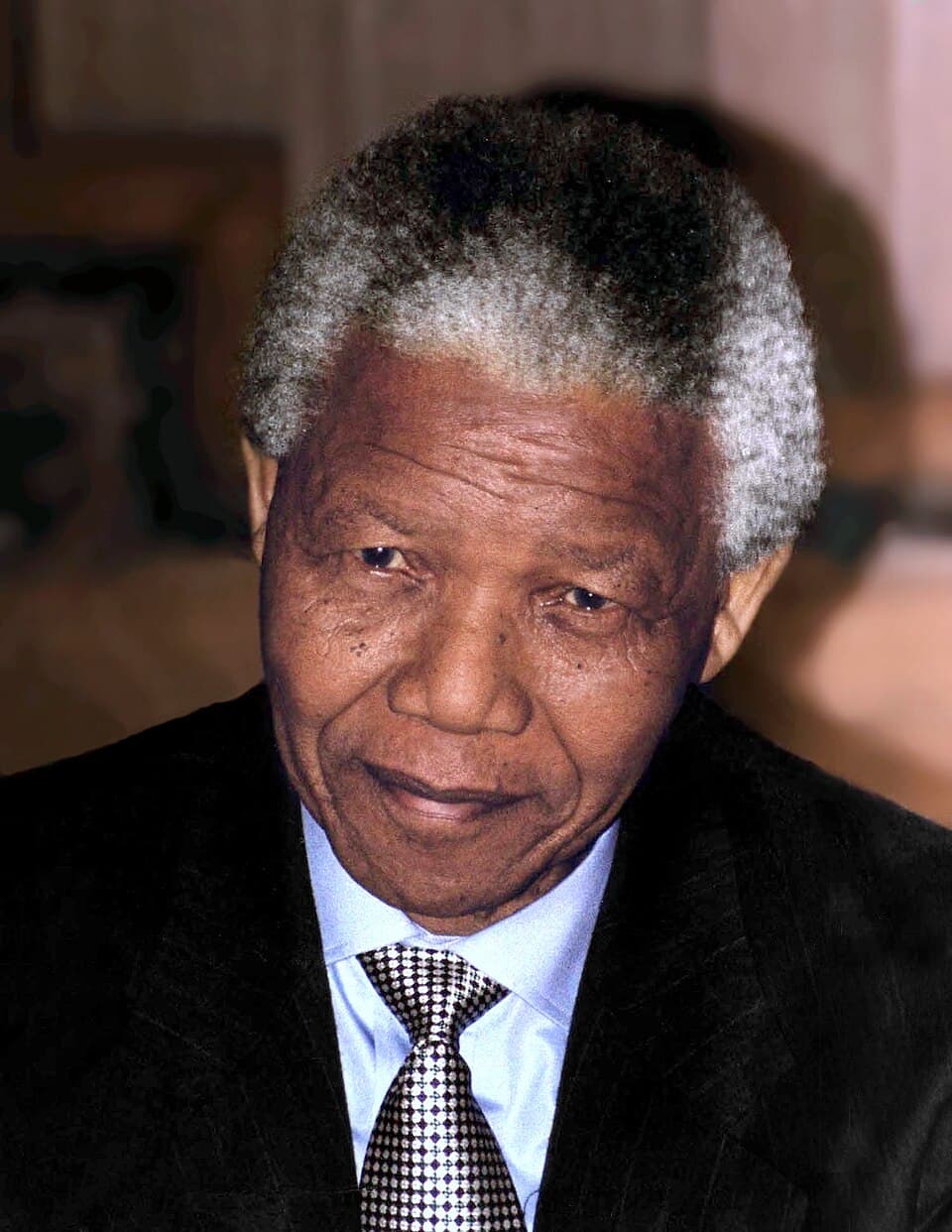 Wikimedia Commons
Nelson Mandela: Full Biography
Biography
Early Life and Family Background
Nelson Rolihlahla Mandela was born on July 18, 1918, in the village of Mvezo in the Eastern Cape region of South Africa. He belonged to the Thembu royal family, part of the Xhosa-speaking community.
His father, Gadla Henry Mphakanyiswa, was a local chief and adviser to the Thembu royal family. His mother, Nosekeni Fanny, was one of his father's wives. Mandela grew up in a society shaped by traditional African customs, community responsibilities, and the growing influence of British colonial rule.
His birth name was Rolihlahla, a Xhosa expression commonly interpreted as “pulling the branch of a tree” and figuratively associated with causing trouble. The name Nelson was given to him by a teacher during his early schooling.
Childhood and Education
After his father's death, Mandela spent part of his childhood under the guardianship of Jongintaba Dalindyebo, the acting regent of the Thembu people. This upbringing exposed him to traditional leadership, public discussion, and the responsibilities of serving a community.
Mandela attended local schools and later studied at Clarkebury Boarding Institute and Healdtown, a Methodist secondary school. He subsequently enrolled at the University of Fort Hare, one of the few institutions offering higher education to Black South Africans at the time.
At Fort Hare, Mandela became involved in student affairs. After participating in a student protest, he left the institution before completing his degree. His early experiences helped develop his interest in politics, leadership, and social justice.
Moving to Johannesburg
In 1941, Mandela moved to Johannesburg, partly to avoid an arranged marriage and seek greater independence. There, he encountered the harsh realities of racial discrimination under white-minority rule.
He worked in several jobs and began studying law. Johannesburg exposed him to political organizations, workers' movements, and activists who opposed the segregationist system.
He later completed his undergraduate studies through the University of South Africa and continued legal education at the University of the Witwatersrand, where he studied alongside people from different racial and political backgrounds.
Beginning His Political Career
Mandela became involved in the African National Congress (ANC), a political organization established in 1912 to oppose racial discrimination and defend the rights of Black South Africans.
In 1944, he helped establish the ANC Youth League with Walter Sisulu, Oliver Tambo, and other young activists. The group wanted the ANC to adopt a more active approach to challenging white-minority rule.
The Youth League promoted mass participation, strikes, boycotts, and civil disobedience. Its emergence marked an important change in the movement,
Did you know?
- Nelson Mandela spent 27 years in prison, including 18 years on Robben Island. - His birth name was Rolihlahla; “Nelson” was given to him by a teacher at school. - He was a founding member of the ANC Youth League in 1944. - Mandela helped establish Umkhonto we Sizwe in 1961, which initially carried out sabotage against apartheid government targets. - He shared the 1993 Nobel Peace Prize with F. W. de Klerk. - Mandela became South Africa's first Black president after the country's first fully inclusive national election in 1994. - His prison number, 46664, later became the name of a campaign raising awareness about HIV/AIDS. - He stepped down as president in 1999 after one term, reinforcing the importance of democratic succession.