Activist · Poland
Lech Wałęsa
**Short Bio** Lech Wałęsa, born on 29 September 1943, is a Polish labor leader, democracy activist, author, and former president of Poland. He rose to international prominence as a co-founder and leader of the Solidarity (Solidarność) independent trade union, which challenged communist rule in Poland during the 1980s. A trained electrician who worked at the Gdańsk Shipyard, Wałęsa helped organize strikes and negotiate agreements that strengthened workers' rights. He received the 1983 Nobel Peace Prize for his nonviolent struggle for free trade unions and human rights. In 1990, he became Poland's first president elected by popular vote and served until 1995. His role in Poland's transition from communism to democracy made him a significant figure in modern European history.
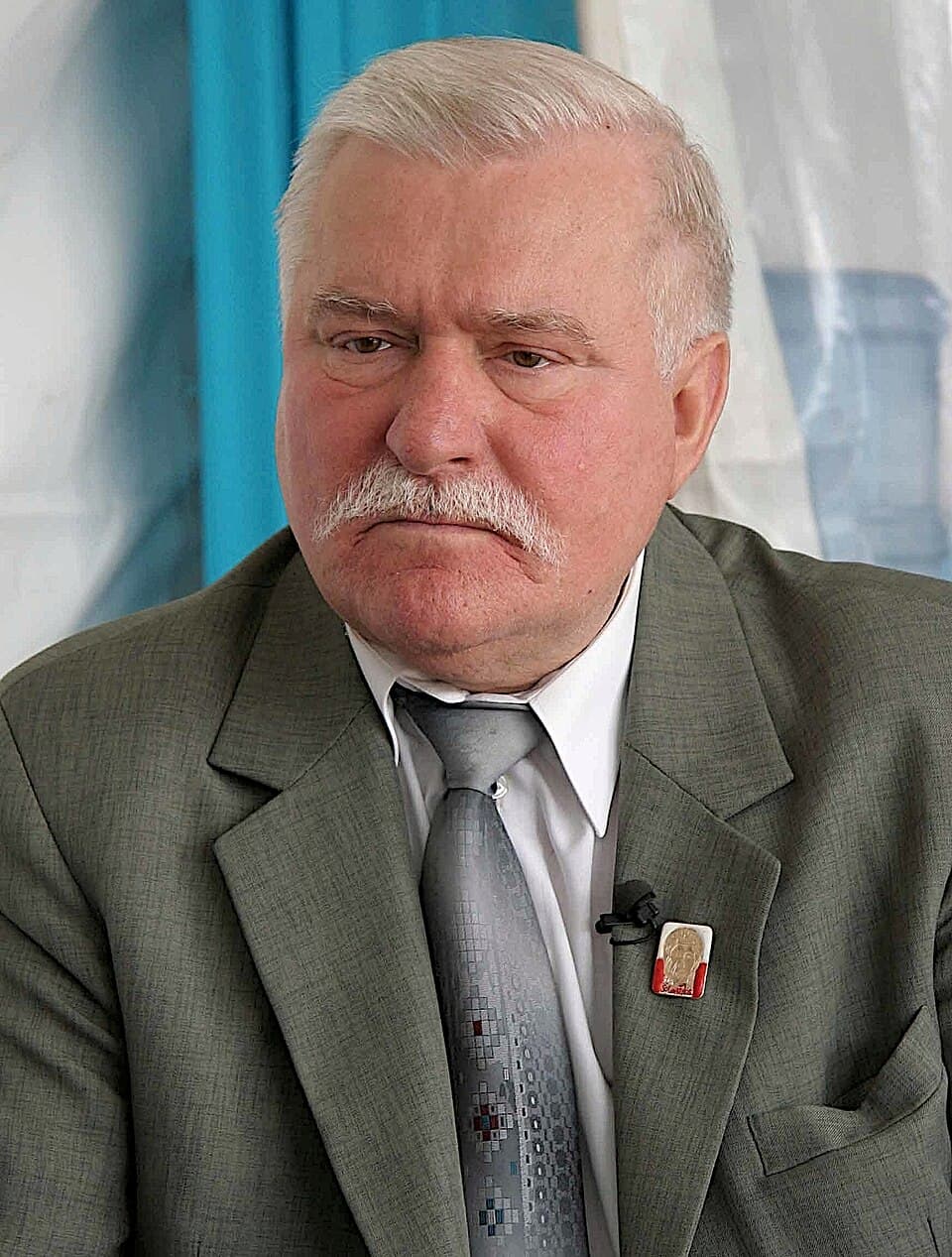 Wikimedia Commons
Lech Wałęsa: Full Biography
Biography
1. Introduction
Lech Wałęsa is a Polish political figure, former electrician, labor organizer, and Nobel Peace Prize laureate. He became internationally known for leading the Solidarity movement, an independent trade union that challenged Poland's communist government during the Cold War.
Wałęsa helped organize workers, negotiate with government officials, and mobilize public support for political and economic reform. His activities contributed to the negotiations and political changes that ended communist rule in Poland in 1989.
In 1990, he became president of Poland and helped guide the country through an important period of political and economic transformation.
2. Early Life and Birth
Lech Wałęsa was born on 29 September 1943 in Popowo, a village in German-occupied Poland during the Second World War.
His childhood took place during a period of enormous political upheaval. Poland experienced Nazi occupation during the war and later came under a communist government aligned with the Soviet Union.
Growing up in a rural community, Wałęsa developed practical skills and eventually trained as an electrician. His working-class background later became central to his public identity as a representative of industrial workers.
3. Family Background
Wałęsa was born to Bolesław Wałęsa and Feliksa Wałęsa. His father died when Lech was still young, and his family continued living in the difficult circumstances of postwar Poland.
His upbringing in a modest rural household shaped his understanding of working life and economic hardship.
These early experiences later became part of his public image as a labor activist who emerged from the industrial working class rather than from the traditional political establishment.
4. Education and Technical Training
Wałęsa attended local schools before completing vocational training in electrical and mechanical work.
Rather than pursuing a university education, he entered the workforce and developed the technical skills needed for industrial employment.
His training helped him secure work in Poland's industrial sector. It also placed him among the workers whose conditions and rights would later become the focus of his political activism.
5. Early Career as an Electrician
Wałęsa initially worked as an electrician-mechanic before moving into shipyard employment.
In 1967, he began working as a ship electrician at the Lenin Shipyard in Gdańsk, a major industrial center on Poland's Baltic coast.
The shipyard employed thousands of workers and became an important center of labor organizing. Working conditions, wages, rising prices, and restrictions on independent unions contributed to growing dissatisfaction among employees.
Wałęsa's experience at the shipyard gave him a direct understanding of the concerns that would eventually fuel the Solidarity movement.
6. Entry into Labor Activism
Wałęsa became involved in workers' protests during the late 1960s and early 1970s.
In December 1970, workers in several Polish coastal cities protested against price increases and difficult living conditions. The government's response included a violent crackdown in which numerous protesters were killed.
Wałęsa participated in the labor unrest and became increasingly involved in organizing workers. The events strengthened his opposition to government restrictions on independent labor activity.
He subsequently became associated with efforts to establish independent trade unions outside the control of the communist state.
7. Government Surveillance and Dismissal
Wałęsa's labor activism brought him into conflict with Poland's communist authorities. He was questioned, detained, and placed under surveillance at various times.
In 1976, he lost his job at the Gdańsk Shipyard after his involvement in labor organizing.
Losing his employment created financial difficulties, but it did not end his political activities. He continued cooperating with opposition activists and supporting efforts to improve workers' rights.
His experiences illustrated the risks faced by people who challenged the government's monopoly over trade unions and public political activity.
8. Founding of Solidarity
A decisive turning point came in August 1980, when strikes spread across Poland following labor disputes and rising public dissatisfaction.
Wałęsa returned to the Gdańsk Shipyard and emerged as a leader of the strike. Workers presented demands that included the right to establish independent trade unions, better working conditions, and greater civil freedoms.
On 31 August 1980, Wałęsa signed an agreement with government representatives. The agreement allowed the establishment of an independent trade union, later known as Solidarity.
The development was unprecedented in the communist bloc and marked a major achievement for Poland's organized labor movement.
9. Leadership of the Solidarity Movement
Solidarity quickly grew beyond a conventional trade union. It became a broad social movement that brought together industrial workers, intellectuals, religious figures, and other citizens seeking greater freedom.
Wałęsa became its most recognizable leader and served as chairman.
The movement called for workers' rights, freedom of association, and reforms to the political system. Its size and influence made it a significant challenge to the communist government's authority.
Solidarity also attracted international attention because it demonstrated that organized, largely nonviolent public action could challenge an authoritarian political system.
10. Martial Law and Internment
On 13 December 1981, Poland's communist authorities declared martial law in an attempt to suppress the opposition and restore government control.
Solidarity was effectively prohibited, its activities were driven underground, and many activists were arrested or detained.
Wałęsa was interned for approximately eleven months. Although isolated from much of the movement's public activity, he remained an internationally recognized symbol of resistance to communist rule.
After his release in November 1982, he continued to support the opposition despite surveillance and restrictions.
11. Receiving the Nobel Peace Prize
In 1983, Wałęsa received the Nobel Peace Prize for his nonviolent struggle for free trade unions and human rights in Poland.
The award recognized his leadership of Solidarity and his efforts to achieve political change through negotiation and organized civic action.
Because the Polish authorities restricted his travel, Wałęsa did not personally attend the award ceremony in Oslo. His wife, Danuta Wałęsa, accepted the prize on his behalf.
The award strengthened international attention on Poland's opposition movement and helped keep the struggle for workers' rights and civil liberties in the global spotlight.
12. Continued Opposition Activities
Throughout the 1980s, Wałęsa remained an important figure in Poland's opposition movement.
Although Solidarity was officially banned, its supporters continued organizing underground publications, meetings, and protests. Economic difficulties and public dissatisfaction weakened the communist government's position.
Wałęsa supported efforts to revive organized labor and negotiate with the authorities.
His leadership helped maintain a recognizable opposition movement during a period when open political activity remained restricted.
13. The 1988 Strikes
In 1988, another wave of strikes spread through Poland, including renewed industrial action at the Gdańsk Shipyard.
The protests reflected continuing dissatisfaction with economic conditions and the government's refusal to permit independent labor organizations.
Wałęsa played a central role in discussions intended to resolve the crisis. The renewed strikes helped persuade the authorities to enter negotiations with Solidarity representatives.
These developments paved the way for the Round Table Talks in 1989.
14. The Round Table Talks
In early 1989, representatives of the communist government and the opposition met for negotiations known as the Round Table Talks.
Wałęsa led the Solidarity side in important discussions. The talks resulted in agreements that allowed Solidarity to operate legally again and established a framework for partially free parliamentary elections.
The negotiations were a major step toward ending communist political dominance in Poland.
They demonstrated the importance of compromise and dialogue in the country's transition to a new political system.
15. The 1989 Elections
Poland held partially free parliamentary elections in June 1989. Candidates associated with Solidarity won an overwhelming victory in the seats open to free competition.
The result weakened the communist government's authority and helped lead to the formation of a government led by Tadeusz Mazowiecki, a noncommunist prime minister.
The political changes in Poland became an important part of the wider transformation of Eastern Europe at the end of the Cold War.
Wałęsa's leadership during this period made him one of the most recognizable figures associated with the collapse of communist rule in the region.
16. Election as President of Poland
In 1990, Wałęsa ran for president of Poland in the country's first direct presidential election.
He won the election and took office on 22 December 1990, becoming the first Polish president elected by popular vote under the new political system.
His victory represented a major personal achievement for a man who had once been dismissed from his industrial job because of his labor activism.
As president, he faced the challenge of transforming a country emerging from decades of communist rule.
17. Presidential Leadership
Wałęsa served as president from 1990 to 1995. His presidency took place during a period of major political, economic, and institutional change.
Poland was moving toward a multiparty democracy and a market-based economy. The transition involved reforms to government institutions, state-owned enterprises, public administration, and economic policy.
Wałęsa supported the country's integration with Western political and security institutions. However, his presidency also involved disagreements with political parties, government officials, and former allies from the Solidarity movement.
His leadership reflected the difficulties of turning a broad opposition movement into a stable democratic political system.
18. Economic Transformation
After the end of communist rule, Poland undertook major economic reforms to move away from central planning toward a market economy.
These reforms included price liberalization, changes to state-owned enterprises, and efforts to stabilize public finances.
The transition created opportunities for private businesses and new economic activity, but it also caused hardship for many workers and communities. Unemployment and economic uncertainty became major concerns.
Wałęsa's presidency was closely associated with this difficult period of transformation, although economic reforms were designed and implemented by successive governments and policymakers.
19. Foreign Policy and European Integration
Wałęsa supported stronger relations between Poland and Western democracies. His administration pursued closer ties with Western Europe and the United States.
He also supported Poland's eventual membership in NATO and the European Union, viewing closer Western integration as important for the country's security and long-term development.
Poland joined NATO in 1999 and the European Union in 2004, after Wałęsa's presidency had ended.
These later milestones formed part of the broader foreign-policy direction supported by Wałęsa and other post-communist Polish leaders.
20. Family and Personal Life
Wałęsa married Danuta Gołoś in 1969. After their marriage, she became known as Danuta Wałęsa.
The couple have eight children. During his years in labor activism and politics, his family lived through periods of uncertainty, government surveillance, and public scrutiny.
Danuta Wałęsa later wrote a memoir about her life and her experiences as the wife of a prominent political leader.
Although Wałęsa's political activities often placed him at the center of international attention, his family remained an important part of his personal life.
21. The 1995 Presidential Election
Wałęsa sought re-election in 1995 but lost to Aleksander Kwaśniewski in the second round of voting.
The election marked the end of his presidency and reflected changes in Polish political preferences during the country's democratic transition.
After leaving office, Wałęsa remained active in public discussions about democracy, international relations, and Poland's political development.
His defeat also demonstrated the competitive nature of Poland's emerging electoral system.
22. Life After the Presidency
Following his presidency, Wałęsa continued participating in international conferences, public lectures, and democracy-related activities.
He became associated with the Lech Wałęsa Institute, established in 1995 to promote democratic values, civic society, and the historical legacy of Solidarity.
He also continued commenting on Polish and international politics. His public statements have sometimes generated debate, reflecting his continuing visibility and his distinctive role in Poland's modern history.
23. Controversies and Public Debate
Wałęsa's career has included controversies and disputes over political decisions, leadership style, and aspects of his relationship with Poland's former communist security services.
Questions about documents concerning alleged contacts with state security officials during the communist period have been the subject of public and historical debate. Wałęsa has disputed allegations that he collaborated as claimed by his critics.
His presidency has also been assessed differently by supporters and critics, particularly regarding economic reform, political conflicts, and relations with former Solidarity allies.
These debates form part of the wider historical discussion surrounding Poland's transition from communism.
24. Awards and International Recognition
Wałęsa's most prominent international honor is the 1983 Nobel Peace Prize.
He has also received numerous awards and honorary distinctions recognizing his contribution to labor rights, democracy, and human rights.
His name remains closely associated with Solidarity and Poland's transition from communist rule. He is frequently invited to speak about democratic transitions, civic activism, and the history of the Cold War.
25. Legacy and Historical Significance
Wałęsa played a central role in one of the most significant democratic transitions in modern European history.
As a labor organizer, he helped establish Solidarity, a movement that challenged communist authority and mobilized millions of people. His leadership contributed to negotiations that opened the way for democratic elections and political reform.
His presidency took place during a difficult period of economic restructuring and institutional change. Although his political record remains subject to debate, his contribution to the Solidarity movement and Poland's transition from communism remains historically significant.
26. Conclusion
Lech Wałęsa's journey from shipyard electrician to labor leader, Nobel Peace Prize laureate, and president of Poland is closely connected with the country's struggle for democracy.
Through Solidarity, he helped workers organize independently and challenged a political system that restricted civil liberties. His role in the negotiations of 1989 and his subsequent presidency placed him at the center of Poland's transformation.
His life continues to be studied as an example of labor activism, civic mobilization, and the challenges involved in building democracy after authoritarian rule.
Did you know?
**Did You Know?** - Lech Wałęsa was born on 29 September 1943 in Popowo, Poland. - Before becoming a political leader, he worked as an electrician at the Gdańsk Shipyard. - He helped lead the 1980 strikes that resulted in the creation of the Solidarity trade union. - Poland's communist government interned him after declaring martial law in December 1981. - He received the 1983 Nobel Peace Prize for his nonviolent struggle for workers' rights and human rights. - His wife, Danuta Wałęsa, accepted the Nobel Prize on his behalf because he could not attend the ceremony. - In 1990, he became Poland's first president elected by popular vote. - He served as president from 1990 to 1995 and later continued working to promote democracy and civic society.