Politician · German Reich
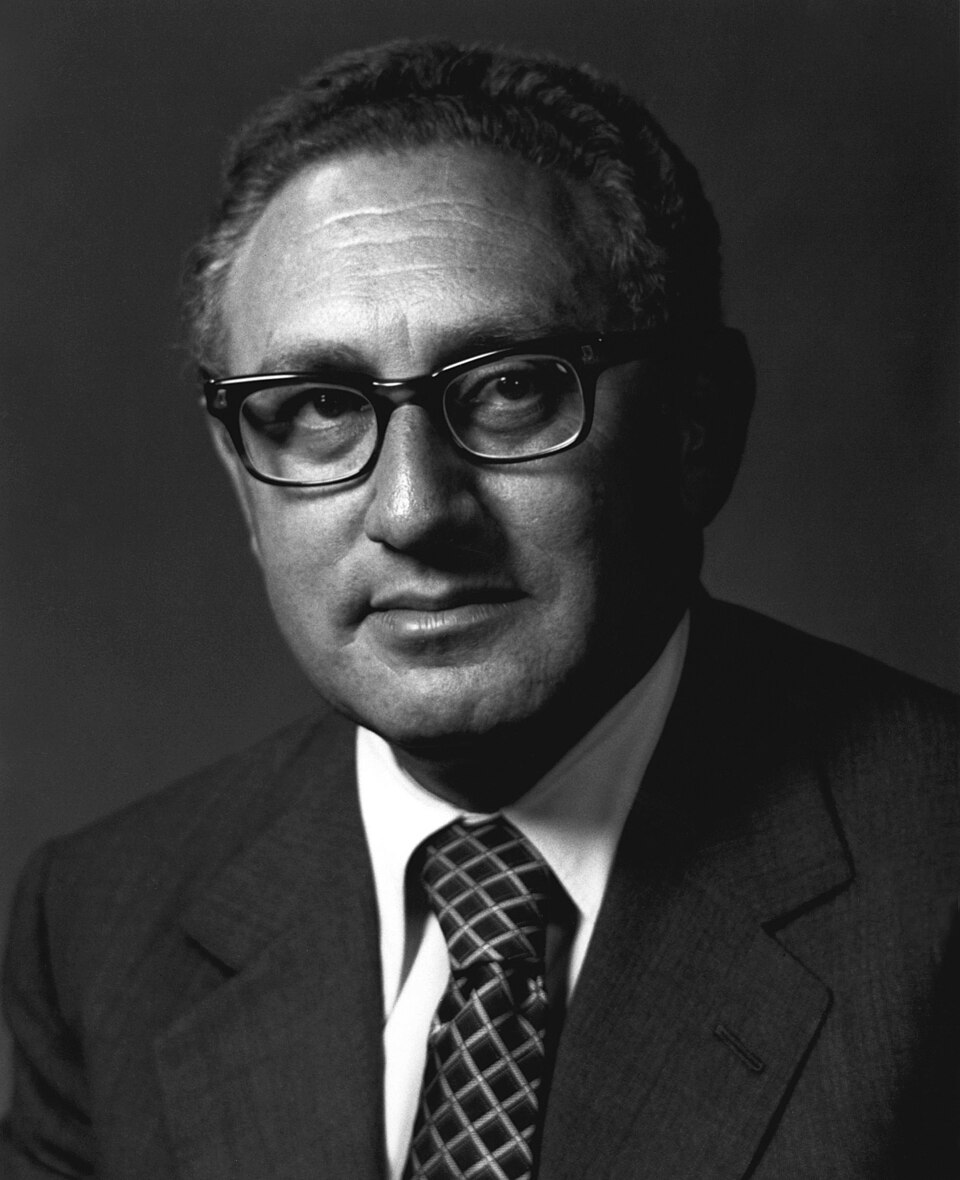
Henry Kissinger
Henry Kissinger was a German-born American diplomat, political scientist, and foreign policy strategist who served as United States Secretary of State from 1973 to 1977 and National Security Advisor from 1969 to 1975 under Presidents Richard Nixon and Gerald Ford. Born Heinz Alfred Kissinger on May 27, 1923, in Fürth, Germany, he fled Nazi persecution with his family and immigrated to the United States in 1938. Kissinger became a central figure in American foreign policy during the Cold War, contributing to the opening of diplomatic relations with China, negotiations to end American involvement in the Vietnam War, and efforts to improve relations with the Soviet Union. He received the Nobel Peace Prize in 1973. His diplomatic achievements and role in controversial U.S. foreign policy decisions made him one of the most influential and debated figures in modern international relations. He died on November 29, 2023, at the age of 100.
 Wikimedia Commons
Henry Kissinger: Foreign Policy, Books, and Legacy
Biography
1. Introduction
Henry Kissinger was one of the most prominent American diplomats of the Cold War era. As National Security Advisor and Secretary of State, he influenced major decisions involving China, the Soviet Union, Vietnam, the Middle East, and several countries in Latin America and Africa.
His diplomatic approach emphasized national interests, strategic balance, and negotiations between competing powers. Supporters credited him with opening diplomatic channels and reducing tensions between major countries, while critics questioned the humanitarian consequences of policies associated with his tenure.
2. Early Life and Immigration
Kissinger was born Heinz Alfred Kissinger on May 27, 1923, in Fürth, Bavaria, Germany. He grew up in a Jewish family during the rise of Adolf Hitler and the Nazi Party.
As antisemitism and persecution intensified in Germany, his family emigrated to the United States in 1938. They settled in New York City, where Kissinger adapted to a new language and culture while continuing his education.
His experience as a Jewish refugee profoundly shaped his understanding of international politics, security, and the dangers of authoritarian government.
3. Education and Academic Career
Kissinger attended George Washington High School in New York and later studied at the City College of New York. During World War II, his education was interrupted by military service.
After the war, he attended Harvard University, earning his bachelor's degree in 1950, a master's degree in 1952, and a doctorate in 1954.
He subsequently joined Harvard's faculty, teaching government and international relations. His research focused on diplomacy, nuclear strategy, and the balance of power among nations.
His academic work established his reputation as a foreign policy thinker and helped open the door to government advisory positions.
4. Military Service During World War II
Kissinger became a naturalized American citizen in 1943 and served in the United States Army during World War II.
Because he spoke German, he worked in military intelligence and counterintelligence. His duties included interpreting German information and assisting American forces in occupied Europe.
His wartime experiences provided direct exposure to the consequences of conflict and the challenges of rebuilding political order after war.
After military service, he returned to his academic studies and began developing the ideas that would later influence his diplomatic career.
5. Entry into American Foreign Policy
During the 1950s and 1960s, Kissinger served as an adviser and consultant to government organizations concerned with national security and international affairs.
He developed a reputation for strategic analysis and argued that international stability depended partly on maintaining a balance among powerful states.
Kissinger also advised Nelson Rockefeller, a prominent Republican politician. His work with Rockefeller helped strengthen his political connections and introduced him to national-level policymaking.
In 1968, President-elect Richard Nixon selected Kissinger to serve as National Security Advisor. He assumed the position when Nixon took office in January 1969.
6. National Security Advisor under Richard Nixon
As National Security Advisor from 1969, Kissinger became a central figure in the Nixon administration's foreign policy.
He worked closely with Nixon on negotiations, military strategy, relations with major powers, and efforts to reshape the international balance of power.
Kissinger often favored confidential negotiations and direct communication between national leaders. This approach sometimes enabled rapid diplomatic progress but also raised concerns about secrecy and limited public accountability.
His role gave him considerable influence over decisions concerning Vietnam, China, the Soviet Union, and other international conflicts.
7. Opening Relations with China
One of Kissinger's most significant diplomatic initiatives involved improving relations between the United States and the People's Republic of China.
In 1971, he made a secret visit to China to prepare for Nixon's historic visit the following year. In February 1972, Nixon met Chinese leader Mao Zedong and Premier Zhou Enlai.
The visit helped transform relations between the two countries after decades of hostility and limited official contact.
The Shanghai Communiqué, issued during Nixon's visit, established a framework for continued dialogue and addressed major disagreements, including the status of Taiwan.
Full diplomatic relations between the United States and China were not formally established until January 1979, after Kissinger had left office. Nevertheless, the diplomatic opening he helped arrange became a defining development in Cold War history.
8. Vietnam War and the Nobel Peace Prize
Kissinger played a major role in negotiations intended to end American military involvement in the Vietnam War.
He participated in secret talks with North Vietnamese representatives, including Le Duc Tho, while the United States continued military operations.
In January 1973, the Paris Peace Accords established a ceasefire framework and provided for the withdrawal of American forces from Vietnam.
Kissinger and Le Duc Tho were awarded the Nobel Peace Prize in 1973 for their efforts to negotiate a ceasefire. Le Duc Tho declined the award, citing the situation in Vietnam and the lack of a lasting peace.
The award was controversial because fighting continued after the agreement, and South Vietnam fell to North Vietnamese forces in 1975.
Kissinger's role in the war remains one of the most debated aspects of his career. Discussions of his legacy include the prolonged conflict, civilian suffering, the secret bombing of Cambodia, and questions about the effectiveness and consequences of American negotiating strategies.
9. Secretary of State
In September 1973, President Nixon appointed Kissinger as Secretary of State while he continued serving as National Security Advisor.
He became the first person to hold both positions simultaneously. He remained Secretary of State under President Gerald Ford following Nixon's resignation in 1974.
As the United States' chief diplomat, Kissinger traveled extensively, met foreign leaders, negotiated agreements, and managed major international crises.
His tenure coincided with shifting alliances, energy insecurity, Cold War competition, and conflicts in the Middle East.
10. Middle East Diplomacy
The 1973 Arab-Israeli War was a major challenge during Kissinger's time as Secretary of State.
After Egypt and Syria launched attacks against Israel in October 1973, the United States supported Israel with military supplies. The conflict was followed by an oil embargo imposed by Arab oil-producing states against the United States and several other countries.
Kissinger then pursued what became known as shuttle diplomacy, traveling between regional capitals to negotiate agreements between opposing parties.
His efforts contributed to disengagement agreements between Israel and Egypt in 1974 and between Israel and Syria in the same year. Further negotiations produced an additional Israeli-Egyptian agreement in 1975.
These agreements helped reduce immediate military tensions, although a comprehensive regional peace settlement remained unresolved during his tenure.
11. Relations with the Soviet Union
Kissinger supported détente, a policy intended to reduce tensions between the United States and the Soviet Union while maintaining strategic competition.
During the Nixon and Ford administrations, the two superpowers negotiated arms-control arrangements and expanded diplomatic communication.
The 1972 Strategic Arms Limitation Talks agreements, including the Anti-Ballistic Missile Treaty and an interim agreement on strategic offensive arms, represented important milestones in limiting aspects of the nuclear competition.
Kissinger also participated in the negotiations surrounding the Helsinki Accords of 1975, signed by 35 countries. The accords addressed European security, cooperation, and human rights.
Détente did not eliminate the underlying rivalry between Washington and Moscow, but it created mechanisms for managing some of their disagreements.
12. Controversies in Chile and Latin America
Kissinger's foreign policy record has drawn sustained criticism over American involvement in Latin America.
In Chile, the Nixon administration opposed the government of President Salvador Allende, a democratically elected socialist leader. Declassified records and historical investigations document American efforts to undermine Allende's government and support opposition forces.
Chile's military coup in September 1973 brought General Augusto Pinochet to power. The ensuing dictatorship committed extensive human rights abuses.
The precise relationship between American policy and the coup has been the subject of extensive historical study. The record documents American intervention and hostility toward Allende, while distinguishing that involvement from the Chilean military's direct execution of the coup.
Kissinger's role in American policy toward Chile remains a major source of criticism and debate about the relationship between Cold War strategy, democracy, and human rights.
13. Cambodia and Southeast Asia
The Vietnam War also extended into Cambodia and Laos, where American military operations caused extensive destruction and civilian suffering.
Under Nixon, the United States conducted secret bombing operations in Cambodia beginning in 1969 and expanded military operations in the region. Kissinger was closely involved in the administration's national security decision-making.
Critics argue that these policies violated national sovereignty, increased civilian suffering, and contributed to the destabilization of Cambodia. The wider history of Cambodia also includes the rise of the Khmer Rouge and its subsequent mass atrocities.
Assessments of Kissinger's responsibility differ in emphasis, but the bombing campaign remains among the most controversial elements of his record.
14. Angola and African Policy
Kissinger was also involved in American policy toward Angola during the country's struggle for independence and the civil war that followed Portuguese colonial rule.
The conflict drew in Angolan political and military movements, regional powers, and external supporters, including the United States, the Soviet Union, and Cuba.
The Ford administration supported efforts to counter Soviet and Cuban influence in Angola. Critics questioned the consequences of American intervention and its effects on regional stability.
Angola illustrates how Cold War policymakers frequently interpreted regional conflicts through the wider competition between Washington and Moscow, sometimes giving strategic priorities precedence over local political dynamics.
15. Life After Government
Kissinger left office as Secretary of State in January 1977, when President Jimmy Carter took office.
He continued to participate in international affairs as a consultant, author, lecturer, and adviser. In 1982, he founded Kissinger Associates, a consulting firm focused on international relations and strategic business issues.
He also served on advisory bodies and participated in public discussions concerning diplomacy, national security, and global economic relations.
Over the following decades, presidents, business leaders, and foreign officials continued to seek his views on international developments.
His continued public influence also ensured that debates about his decisions during the Cold War remained active long after he left government.
16. Books and Publications
Kissinger wrote extensively about diplomacy, strategy, history, and international politics.
His major publications include:
- A World Restored (1957): Examines European diplomacy following the Napoleonic Wars and the restoration of political order.
- Nuclear Weapons and Foreign Policy (1957): Explores nuclear strategy and the role of military power in international relations.
- The White House Years (1979): His memoir of the Nixon administration's first term.
- Years of Upheaval (1982): Discusses foreign policy during the later Nixon years and the early Ford administration.
- Diplomacy (1994): Surveys the history of international relations and the development of modern statecraft.
- Does America Need a Foreign Policy? (2001): Examines America's role in the post-Cold War world.
- On China (2011): Explores Chinese history, political strategy, and relations with the United States.
- World Order (2014): Examines competing ideas about international order and political legitimacy.
His books have influenced discussions of international relations, particularly the study of realism, strategic competition, and diplomatic negotiation.
17. Awards and Recognition
Kissinger received several major honors during his lifetime.
His notable awards included:
- Nobel Peace Prize (1973): Shared with Le Duc Tho for negotiating a ceasefire agreement in Vietnam; Le Duc Tho declined the award.
- Presidential Medal of Freedom (1977): Awarded by President Gerald Ford.
- Medal of Liberty (1986): Awarded in recognition of his contributions as a foreign-born American leader.
- Bronze Star (1945): Recognized his military service during World War II.
These honors reflect the recognition he received for diplomacy and public service, although they do not resolve the historical disagreements surrounding the consequences of his policies.
18. Personal Life and Family
Kissinger married Ann Fleischer in 1949. They had two children, Elizabeth and David, before divorcing in 1964.
In 1974, he married Nancy Maginnes, who remained his wife until his death.
Despite his public prominence, Kissinger generally maintained a distinction between his political career and family life. He continued writing and participating in international affairs well into old age.
He remained a prominent commentator on geopolitics, international security, and relations between major powers for decades after leaving government.
19. Death and Final Years
Henry Kissinger died on November 29, 2023, at his home in Connecticut, United States. He was 100 years old.
His death prompted responses from political leaders, diplomats, academics, and members of the public around the world.
Many tributes emphasized his influence on American diplomacy and the opening of relations with China. Others highlighted the wars, interventions, and human rights controversies associated with his policy decisions.
The wide range of reactions reflected the complexity of his historical legacy.
20. Legacy and Historical Significance
Kissinger remains a major figure in the study of modern diplomacy and international relations.
His supporters emphasize his role in opening relations with China, pursuing arms-control negotiations with the Soviet Union, negotiating Middle East disengagement agreements, and shaping American foreign policy during a pivotal period of the Cold War.
Critics focus on the human costs of policies in Vietnam and Cambodia, American intervention in Chile, and the prioritization of strategic objectives over democratic governance and human rights in several countries.
His career illustrates the tensions between diplomatic pragmatism, military power, national security, and moral responsibility. Historians continue to examine how his decisions shaped both immediate events and longer-term international developments.
21. Conclusion
Henry Kissinger's life connected the experience of a Jewish refugee from Nazi Germany with a career at the center of American global power. As an academic, National Security Advisor, Secretary of State, and author, he influenced major diplomatic developments during the Cold War and remained active in international affairs long after leaving office.
His diplomatic initiatives changed relations between major powers and contributed to several important negotiations. At the same time, his involvement in controversial military and political decisions continues to generate serious debate.
Understanding Kissinger's legacy requires examining both his diplomatic achievements and the consequences of the policies he helped shape. His career remains an important case study in the opportunities, limitations, and ethical challenges of modern statecraft.
Did you know?
- Henry Kissinger was born Heinz Alfred Kissinger in Germany and immigrated to the United States in 1938. - He became a naturalized American citizen in 1943 and served in the U.S. Army during World War II. - He earned his bachelor's, master's, and doctoral degrees at Harvard University. - He was the first person to serve simultaneously as U.S. Secretary of State and National Security Advisor. - His secret 1971 visit to China helped prepare for President Richard Nixon's historic visit in 1972. - He received the 1973 Nobel Peace Prize jointly with North Vietnamese diplomat Le Duc Tho, who declined the award. - Kissinger helped negotiate Middle East disengagement agreements through shuttle diplomacy. - His 1994 book *Diplomacy* examines the history and practice of international relations. - He lived to the age of 100 and remained a public figure in international affairs for decades after leaving government.