Entrepreneur · United States
Henry Ford
Henry Ford was an American industrialist, inventor, and businessman best known for founding the Ford Motor Company and transforming automobile manufacturing. Born on July 30, 1863, in Springwells Township, Michigan, he helped make automobiles more affordable for ordinary Americans through improved production methods and the widespread use of the moving assembly line. His Model T, introduced in 1908, became one of the most influential vehicles in automotive history. Ford also introduced new labor practices, including a widely publicized five-dollar daily wage for many factory workers in 1914. Although his industrial achievements had a lasting impact, his legacy is also controversial because of his antisemitic publications and political views. He died on April 7, 1947, leaving a major influence on modern manufacturing and business.
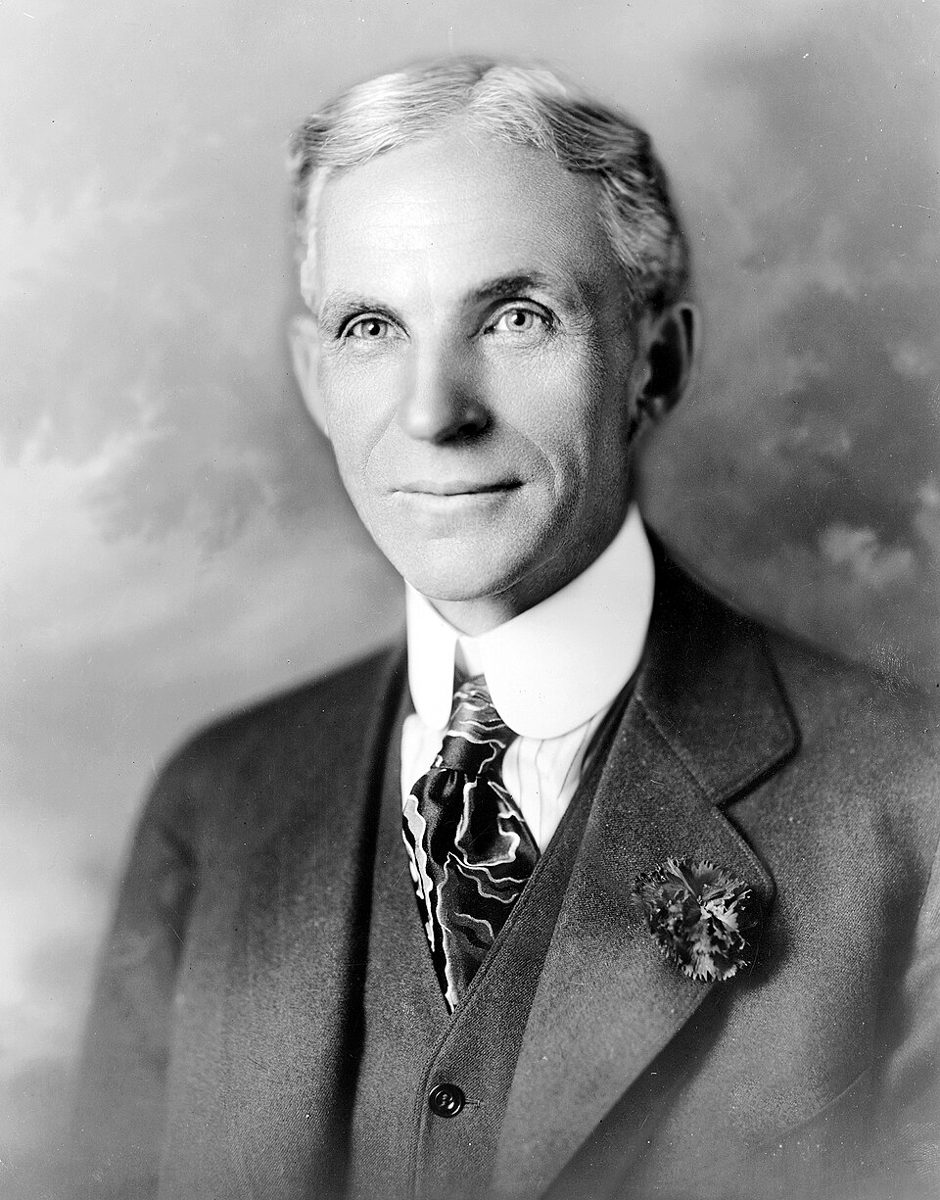 Wikimedia Commons
Henry Ford: Full Biography
Biography
1. Introduction
Henry Ford was an American industrialist, engineer, and businessman who transformed the automobile industry through mass production. As the founder of Ford Motor Company, he helped make cars more affordable and changed how factories manufactured products.
Ford did not invent the automobile, but he helped popularize it by developing efficient manufacturing methods and producing vehicles for a broad market. His most famous creation, the Model T, became a symbol of early twentieth-century American industrial growth.
His influence extended beyond automobiles into factory organization, labor practices, transportation, and modern consumer culture. However, his legacy is also marked by his antisemitic publications, opposition to labor unions, and controversial political views.
2. Early Life and Family Background
Henry Ford was born on July 30, 1863, on his family's farm in Springwells Township, Michigan, near present-day Dearborn. His parents were William Ford, an Irish immigrant, and Mary Litogot Ford. Henry was the eldest of six children.
Growing up on a farm introduced Ford to machinery and practical mechanical work. Although his family expected him to participate in farming, he developed a strong interest in engines, tools, and mechanical devices.
As a teenager, Ford spent considerable time learning how machines worked. At the age of 16, he left the family farm and moved to Detroit to pursue work as a machinist. This decision marked the beginning of his journey toward becoming an influential industrialist.
3. Education and Mechanical Training
Ford received his early education in local schools but did not attend a university. Instead, he gained technical knowledge through practical experience and apprenticeships.
In Detroit, he worked at machine shops, where he learned to operate tools, repair equipment, and understand mechanical systems. He later worked for the Detroit Dry Dock Company, gaining further industrial experience.
After completing his apprenticeship, Ford returned to the family farm for a period. He continued experimenting with machinery and worked on repairing steam engines.
His education was largely hands-on. Through observation, experimentation, and practical problem-solving, he developed the skills that later helped him design automobiles and improve manufacturing processes.
4. Early Career and Work with Edison Illuminating Company
In 1891, Ford moved back to Detroit and joined the Edison Illuminating Company as an engineer. He was promoted to chief engineer in 1893.
The position gave him experience with electrical power systems and industrial technology. It also provided him with the time and resources to pursue his growing interest in gasoline-powered engines.
During this period, Ford built experimental engines and explored ways to create a practical motor vehicle. His professional relationship with Thomas Edison became an important part of his personal and professional life.
In 1896, Ford completed his first experimental automobile, known as the Quadricycle. The lightweight vehicle used four bicycle wheels and a small gasoline engine. Its successful operation encouraged Ford to continue developing automobiles.
5. Early Automobile Ventures
After completing the Quadricycle, Ford sought financial backing to establish an automobile business. His first major company, the Detroit Automobile Company, was organized in 1899 but struggled commercially and closed in 1901.
Ford continued developing experimental vehicles and became involved in automobile racing. His racing cars helped demonstrate his engineering skills and attracted attention from potential investors.
He later joined another automotive venture, the Henry Ford Company, but left it in 1902 after disagreements with other stakeholders. The company subsequently became associated with the establishment of Cadillac.
These early setbacks taught Ford important lessons about financing, manufacturing, product development, and business management. They also encouraged him to pursue greater control over his next automobile enterprise.
6. Founding Ford Motor Company
On June 16, 1903, Henry Ford and a group of investors established Ford Motor Company in Detroit, Michigan. The company began with relatively modest financial resources but had an ambitious goal: to manufacture reliable automobiles for a growing market.
Ford became president and later acquired greater control over the business. The company initially produced several vehicle models, gradually refining its manufacturing methods and expanding its customer base.
In 1906, Ford became the company's controlling owner. His leadership emphasized practical engineering, standardized components, production efficiency, and reducing manufacturing costs.
The company's early success laid the foundation for the introduction of the Model T, the vehicle most closely associated with Ford's name.
7. The Model T Revolution
Ford introduced the Model T in October 1908. Designed to be relatively simple to operate, maintain, and repair, the automobile was intended to serve a broad range of customers.
The Model T became popular because it was practical and suitable for many of the roads and driving conditions of its time. Its growing demand encouraged Ford to develop more efficient production methods.
The vehicle became popularly known as the "Tin Lizzie." Over its production period, the Model T underwent improvements, while manufacturing efficiencies helped reduce its price.
By 1927, Ford had produced approximately 15 million Model Ts. The vehicle helped expand automobile ownership in the United States and influenced transportation, rural mobility, tourism, and the development of road infrastructure.
The Model T was one of the most important products in early automotive history and helped establish Ford Motor Company as a major industrial enterprise.
8. The Moving Assembly Line
One of Ford's most influential contributions was the development and implementation of the moving assembly line for automobile production.
Ford's manufacturing team drew ideas from several industries, including meatpacking, watchmaking, and other forms of mass production. In 1913, the Highland Park factory in Michigan introduced a moving assembly line for automobile manufacturing.
Instead of having workers assemble most of a vehicle in one place, the process moved vehicles through a series of workstations. Each worker performed a specific task, while standardized and interchangeable parts helped maintain consistency.
This approach substantially reduced the time required to assemble a car. Faster production lowered costs and enabled Ford to manufacture large numbers of vehicles.
Ford did not invent every element of the assembly line, but his company's implementation helped establish it as a defining feature of modern mass manufacturing. Similar methods later spread throughout the automotive industry and other sectors.
9. Labor Policies and the Five-Dollar Workday
In January 1914, Ford announced a basic wage of five dollars per day for many qualifying factory workers working an eight-hour shift. At the time, this was a significant increase over many prevailing industrial wages.
The policy attracted widespread attention and helped Ford recruit and retain employees during a period of high worker turnover. It was also associated with the company's efforts to stabilize production and improve productivity.
The wage policy had conditions and did not apply uniformly to every worker from the beginning. Ford's company also used strict workplace rules and monitored employees' conduct outside the factory through its Sociological Department.
Ford's labor record was complex. Although the wage policy became influential, he opposed independent labor unions for many years. Ford Motor Company signed its first contract with the United Automobile Workers union in 1941 after a prolonged conflict over union organization.
His approach illustrates both the potential benefits and the limitations of the labor policies used in early mass-production industries.
10. Expansion of Ford Motor Company
As demand for Ford automobiles increased, the company expanded production facilities and developed a wider manufacturing network.
The Highland Park plant became an important center for mass production. Ford later developed the massive River Rouge industrial complex in Dearborn, Michigan, which brought several stages of manufacturing together at one site.
The company also expanded internationally, establishing factories, sales operations, and distribution networks in multiple countries.
Ford's manufacturing model demonstrated how standardized products, large-scale production, and organized supply chains could reduce costs and serve a mass market.
In 1927, the company ended Model T production and introduced the Model A. The new model included updated features and represented an attempt to respond to changing consumer expectations and competition.
11. Personal Life and Family
Henry Ford married Clara Jane Bryant on April 11, 1888. Clara supported him during the early stages of his engineering and business career, including the period when he was developing experimental automobiles.
Their only child, Edsel Bryant Ford, was born on November 6, 1893. Edsel later became president of Ford Motor Company in 1919 and helped guide the company through an important period of expansion and product development.
Henry and Edsel did not always agree about business strategy. Henry preferred to maintain strong personal control over company decisions, while Edsel often supported changes in design and management.
Edsel died in 1943, and Henry briefly returned to the company's presidency. In 1945, Henry transferred the presidency to his grandson, Henry Ford II, who later led the company through another period of development.
The Ford family remained closely associated with the company for generations.
12. Publications and Political Views
Ford was not only an industrialist but also a public figure who expressed strong views about society, economics, politics, and international affairs.
He supported certain forms of pacifism during the early years of World War I and participated in an unsuccessful peace mission to Europe in 1915. In 1918, he ran unsuccessfully for a U.S. Senate seat.
Ford also promoted his views through newspapers and books. He purchased the Dearborn Independent newspaper in 1918, and it published antisemitic articles and conspiracy theories, some of which were later compiled into a series known as The International Jew.
These publications spread harmful stereotypes and contributed to antisemitic propaganda. Ford faced widespread criticism for this material. In 1927, he issued a public apology and expressed regret, and the newspaper ceased publication that year.
Despite his apology, the publications remain a major and deeply troubling part of his historical legacy. Ford's record demonstrates that major industrial achievements do not erase the consequences of discriminatory beliefs and public actions.
13. Later Career and Final Years
During the 1930s, Ford Motor Company faced increasing competition from other automobile manufacturers. General Motors and Chrysler developed products and business strategies that challenged Ford's market position.
Ford's resistance to labor unions also created serious conflict. In 1937, a confrontation between Ford security personnel and union organizers at the River Rouge complex became known as the Battle of the Overpass.
The dispute over unionization continued for several years. In 1941, Ford Motor Company finally signed a labor agreement with the United Automobile Workers.
After Edsel Ford's death in 1943, Henry returned to the presidency, but his grandson Henry Ford II took over the position in 1945. Henry Ford had already begun stepping back from the company's daily management.
He spent his final years at Fair Lane, his estate in Dearborn, Michigan. He died on April 7, 1947, at the age of 83.
14. Achievements and Recognition
Ford's industrial achievements brought him international recognition. His company transformed automobile manufacturing by combining standardized components, large factories, and efficient production processes.
His most notable achievements included:
- Founding Ford Motor Company in 1903.
- Introducing the Model T in 1908.
- Helping popularize the moving assembly line in automobile manufacturing.
- Expanding mass production and reducing the cost of automobiles.
- Introducing the widely publicized five-dollar daily wage for many factory workers in 1914.
- Developing large-scale manufacturing facilities, including the River Rouge complex.
- Influencing industrial production methods used by businesses around the world.
Ford received various honors during his lifetime and after his death. His impact on industry remains a major subject in business history, engineering, economics, and labor studies.
15. Death and Historical Remembrance
Henry Ford died on April 7, 1947, at his home in Dearborn, Michigan. He was 83 years old.
His death marked the end of a life closely connected with the growth of the American automobile industry. By that time, Ford Motor Company had become a major international manufacturer, and the methods associated with Ford's factories had influenced industrial production worldwide.
The Henry Ford museum complex in Dearborn preserves historical artifacts related to American innovation, manufacturing, transportation, and everyday life. The Ford family and company have also played an important role in preserving records of the industry's development.
Historians continue to examine Ford's achievements alongside the controversies surrounding his labor practices and antisemitic writings.
16. Legacy and Influence
Henry Ford's legacy is multifaceted. His manufacturing innovations helped make automobiles more accessible and changed the organization of industrial work. The moving assembly line became a model for producing large quantities of standardized goods, influencing industries far beyond automotive manufacturing.
The Model T helped reshape daily life by expanding access to personal transportation. Ford's approach to production also influenced debates about wages, productivity, consumer markets, and the relationship between workers and employers.
However, his opposition to unions and his antisemitic publications remain essential parts of any balanced account of his life. These aspects reveal the social and ethical consequences of his public influence.
Ford is therefore remembered both for his transformative role in modern manufacturing and for views and actions that caused lasting harm.
17. Conclusion
Henry Ford helped transform the automobile from a relatively expensive product into something that a much wider population could afford. Through Ford Motor Company, the Model T, and the development of efficient mass-production methods, he left a lasting mark on transportation and industry.
His career also demonstrates the complexity of historical figures whose achievements coexist with serious controversies. Understanding Henry Ford requires examining both his industrial innovations and the consequences of his labor policies and discriminatory public statements.
His influence continues to be felt in modern manufacturing, business management, and the history of the automobile.
Did you know?
## Did You Know About Henry Ford? - Henry Ford was born on July 30, 1863, on a farm in Michigan. - He completed his first experimental automobile, the Quadricycle, in 1896. - Ford Motor Company was founded on June 16, 1903. - The Model T was introduced in 1908 and became one of the most influential automobiles in history. - Ford's Highland Park factory introduced a moving automobile assembly line in 1913. - In 1914, Ford announced a widely publicized five-dollar daily wage for many qualifying factory workers. - More than 15 million Model Ts were produced before the model was discontinued in 1927. - His son, Edsel Ford, became president of Ford Motor Company in 1919. - Ford's antisemitic writings, published through the *Dearborn Independent*, remain a significant controversy in his legacy. - Henry Ford died on April 7, 1947, at the age of 83.