Activist · United States
Helen Keller
**Short Bio** Helen Keller (27 June 1880 – 1 June 1968) was an American author, lecturer, educator, and disability rights advocate. She became deaf and blind at 19 months old following an illness, but with the help of her teacher, Anne Sullivan, she learned to communicate, read, and write. Keller graduated from Radcliffe College in 1904, becoming one of the first deafblind people to earn a Bachelor of Arts degree. Through her books, speeches, and activism, she promoted education for people with disabilities, women's rights, workers' rights, and social equality. Her autobiography, *The Story of My Life*, remains one of her best-known works.
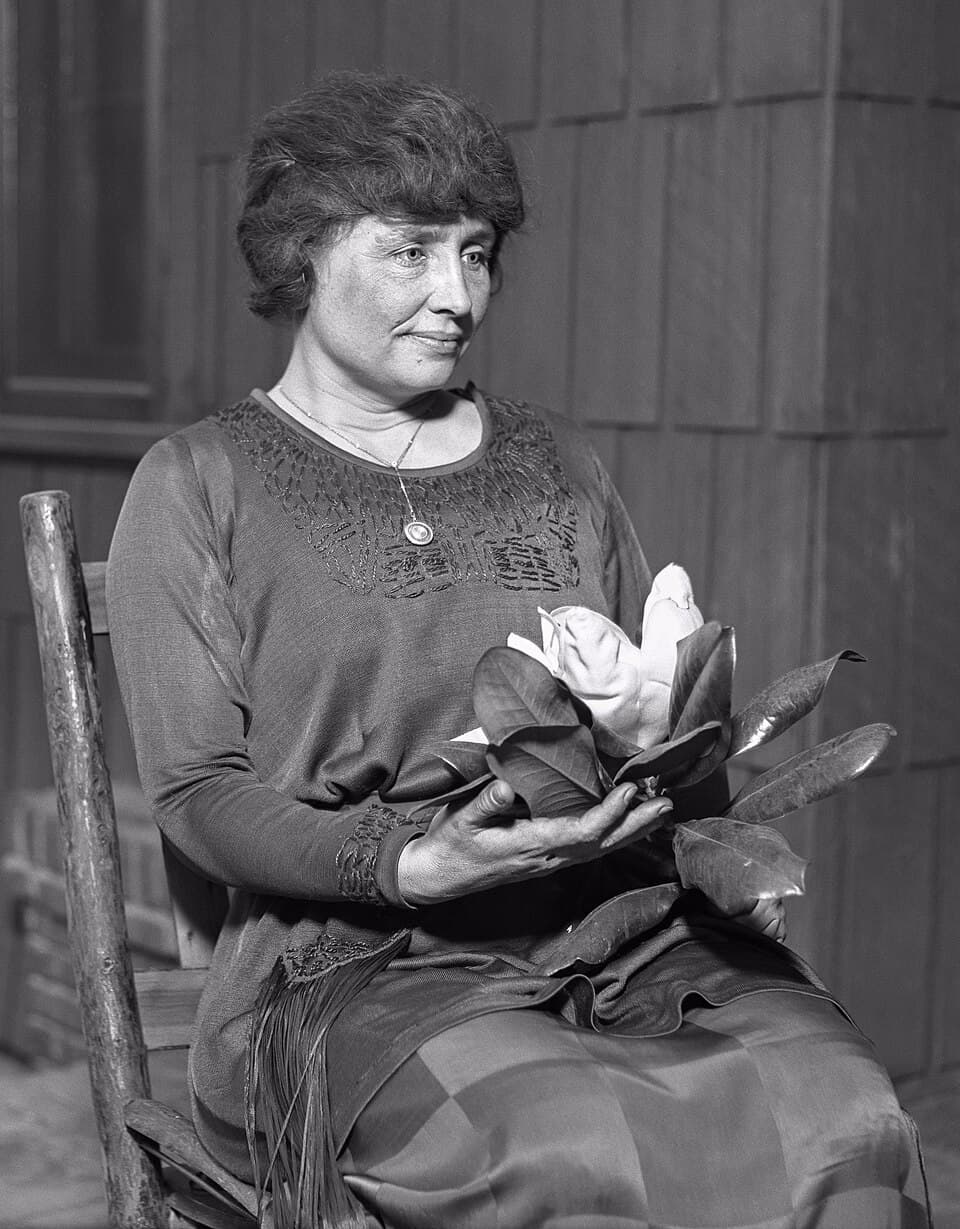 Wikimedia Commons
Helen Keller: Full Biography
Biography
1. Introduction
Helen Keller was an American author, educator, lecturer, and activist whose life became an enduring example of perseverance, education, and human determination. Although she lost both her sight and hearing during early childhood, she learned to communicate and went on to become an internationally recognized writer and advocate.
With the guidance of her teacher, Anne Sullivan, Keller developed methods of communication that enabled her to study, write books, deliver speeches, and engage in public life. Her achievements challenged common assumptions about the abilities of people with disabilities.
2. Early Life and Birth
Helen Adams Keller was born on 27 June 1880 in Tuscumbia, Alabama, United States. Her parents were Arthur Henley Keller, a newspaper editor and former Confederate Army officer, and Katherine Adams Keller.
Helen grew up in a family that lived in the American South during the late nineteenth century. As a young child, she developed normally and began learning basic words before a serious illness changed the course of her life.
3. Illness and Loss of Sight and Hearing
When Helen was approximately 19 months old, she suffered a severe illness that left her deaf and blind. The exact medical cause remains uncertain, although it has often been described as scarlet fever or meningitis.
The sudden loss of sight and hearing made communication extremely difficult. As she grew older, Helen developed her own gestures to express basic needs, but she struggled to communicate more complex thoughts.
Her family searched for ways to support her development and help her gain greater independence.
4. The Arrival of Anne Sullivan
A major turning point came in March 1887, when Anne Sullivan arrived to teach Helen. Sullivan was a young educator who had experienced visual impairment herself and had studied at the Perkins School for the Blind.
She began by teaching Helen words through a manual alphabet, spelling letters into the palm of her hand. At first, Helen struggled to understand that the hand movements represented objects and ideas.
Sullivan's patient, structured approach eventually helped Helen make a breakthrough that transformed her education.
5. The Famous Water-Pump Moment
One of the best-known events in Keller's life occurred at a water pump in April 1887. As Anne Sullivan let water flow over Helen's hand, she repeatedly spelled the word “water” into the other hand.
Helen suddenly understood that the hand spelling represented the substance she could feel. She began asking for the names of other objects and quickly expanded her vocabulary.
This experience opened the door to language learning and became a defining moment in Keller's autobiography and in popular accounts of her life.
6. Education at the Perkins School
After learning to communicate more effectively, Helen studied at the Perkins School for the Blind in Boston and worked with other educators who helped develop her reading, writing, and communication skills.
She learned to read through raised letters and Braille and practiced understanding speech by feeling the movements of a speaker's lips and throat with her fingers, a technique known as Tadoma.
Her education required considerable patience and adaptation, but she continued to advance academically.
7. Learning to Speak
Helen Keller also worked to develop spoken language. She received instruction in speech and learned to produce words by studying the movements and vibrations associated with speech.
Although her spoken communication was not always easy for unfamiliar listeners to understand, she continued practicing and later delivered public speeches.
Her efforts reflected her determination to communicate directly with people who did not know sign language or other tactile methods.
8. Higher Education at Radcliffe College
In 1900, Keller entered Radcliffe College, the women's college associated with Harvard University. Anne Sullivan accompanied her and helped make educational materials accessible.
Keller studied literature, history, languages, and other academic subjects. She completed her degree in 1904, graduating cum laude with a Bachelor of Arts.
Her graduation was a significant achievement and helped challenge prevailing assumptions about the educational potential of deafblind people.
9. Anne Sullivan's Lasting Influence
Anne Sullivan remained Keller's teacher, companion, and close friend for decades. Their relationship was central to Helen's education and public life.
Sullivan helped interpret lectures, prepare accessible study materials, and support Keller as she pursued writing and activism. Their partnership demonstrated the importance of individualized education and consistent support.
After Sullivan's health declined, Polly Thomson, who had worked with the pair, became an important companion and assistant to Keller.
10. Writing Career
Helen Keller became a successful author, publishing books, essays, and articles about her experiences, beliefs, and social concerns.
Her writing combined personal reflection with arguments for education, inclusion, and social reform. She used her own experiences to explain the challenges faced by people who were deafblind and to encourage broader understanding of disability.
Her work reached readers in the United States and abroad, helping establish her reputation as a prominent public intellectual and advocate.
11. The Story of My Life
Keller's most famous work, The Story of My Life, was published in 1903. The autobiography describes her early childhood, the arrival of Anne Sullivan, her language development, and her educational journey.
The book became widely read and has been translated into many languages. It remains an important account of disability, learning, and the relationship between a student and teacher.
Its enduring popularity helped make Keller one of the most recognizable figures associated with deafblind education.
12. Other Important Books
Keller published several other works throughout her life. These included The World I Live In (1908), in which she explored how she experienced the world through touch, smell, taste, and other senses.
Her book Out of the Dark (1913) presented essays on social and political issues, reflecting her growing interest in reform movements.
She also wrote My Religion, later published under the title Light in My Darkness, discussing her spiritual outlook and the influence of the writings of Emanuel Swedenborg.
13. Public Speaking and Lecturing
Keller became an internationally known lecturer who spoke about disability, education, and social responsibility. She traveled widely, often with the assistance of Anne Sullivan and other companions.
Her public appearances demonstrated that deafblind people could participate in public debate and communicate ideas to large audiences.
Keller also used her fame to encourage better educational opportunities, improved services, and greater social acceptance for people with disabilities.
14. Disability Rights Advocacy
Keller devoted much of her public life to improving the treatment and opportunities of people who were blind, deafblind, and otherwise disabled.
She worked with organizations serving blind people and supported efforts to expand access to education, rehabilitation, employment, and reading materials.
She also helped raise public awareness of preventable blindness and the need for better services. Her advocacy encouraged audiences to look beyond disability and recognize the abilities and rights of disabled people.
15. Work with the American Foundation for the Blind
In 1924, Keller began working with the American Foundation for the Blind, an organization dedicated to improving opportunities for blind people.
Through her association with the organization, she helped raise funds, promote accessible reading materials, and advocate for services that supported independence.
She traveled throughout the United States and internationally, meeting government officials, community groups, and supporters. Her work helped bring greater visibility to blindness-related issues.
16. Women's Rights and Social Reform
Keller's activism extended beyond disability rights. She supported women's suffrage and argued for greater equality in education, employment, and public life.
She also became involved in campaigns related to poverty, labor conditions, and access to social services. Her political views developed during a period of major industrial and social change in the United States.
Keller believed that the challenges faced by disabled people could not be separated entirely from wider questions of economic opportunity and social justice.
17. Political Beliefs and Socialism
Keller became a socialist and publicly criticized economic inequality and the conditions faced by poor and working-class people. She wrote articles and supported movements seeking social and economic reform.
Her political positions sometimes attracted criticism, particularly from people who preferred to present her solely as an inspirational figure rather than as a political activist.
Nevertheless, Keller continued expressing her views and participating in public debates. Her life illustrates that disability advocacy can intersect with broader political and social concerns.
18. Personal Life and Relationships
Helen Keller never married. Her life was closely connected to Anne Sullivan and, later, Polly Thomson, who provided assistance and companionship.
In 1916, Keller developed a romantic relationship with Peter Fagan, a young man who briefly served as her secretary. They reportedly hoped to marry, but the relationship ended amid strong opposition from members of her family and the restrictions imposed on her personal independence.
Keller's private life received less attention than her public achievements, but it reveals the personal challenges she faced while navigating expectations about disability, relationships, and autonomy.
19. International Humanitarian Work
Keller traveled to many countries to promote education and services for people with disabilities. Her international visits helped draw attention to blindness prevention, rehabilitation, and accessible education.
During the Second World War and afterward, she visited wounded military personnel and encouraged people who had acquired disabilities to pursue rehabilitation and independent living.
Her work crossed national boundaries and helped establish her as a global advocate for people with disabilities.
20. Awards and Recognition
Keller received numerous honors during her lifetime. In 1936, she was awarded the Theodore Roosevelt Distinguished Service Medal. In 1964, President Lyndon B. Johnson awarded her the Presidential Medal of Freedom, one of the United States' highest civilian honors.
She also received honorary degrees from universities and recognition from organizations dedicated to education and humanitarian service.
Her achievements became part of the broader history of disability rights and accessible education.
21. Helen Keller in Popular Culture
Keller's life has inspired books, plays, films, and educational works. One of the most influential dramatizations was The Miracle Worker, a play by William Gibson that portrayed the relationship between Keller and Anne Sullivan.
The play was adapted into successful film versions, introducing their story to new generations.
Although popular portrayals often emphasize the water-pump episode and Keller's perseverance, her political activism, writing, and international work are also important parts of her historical legacy.
22. Final Years
In her later years, Keller lived more quietly while remaining connected to disability advocacy and humanitarian causes. Anne Sullivan died in 1936, a profound loss for Keller.
Keller continued working with Polly Thomson and maintained her interest in improving the lives of blind people. After suffering a stroke in 1961, she gradually withdrew from much of her public activity.
She spent her final years at her home, Arcan Ridge, in Easton, Connecticut.
23. Death
Helen Keller died on 1 June 1968, at the age of 87, in Easton, Connecticut, United States. Her ashes were placed at the Washington National Cathedral in Washington, D.C., alongside those of Anne Sullivan and Polly Thomson.
Her death was widely mourned, and tributes highlighted her achievements as an author, educator, and advocate.
24. Legacy and Historical Significance
Helen Keller's legacy extends far beyond her personal experience of deafblindness. Her education and writing helped change public understanding of disability, while her advocacy supported broader access to learning, employment, and community life.
She challenged the assumption that deafblind people could not become educated or contribute to society. At the same time, her political activism demonstrated that she was not simply a symbol of perseverance but also a person with strong views on social change.
Her life continues to be studied in education, literature, disability history, and social reform.
25. Conclusion
Helen Keller overcame extraordinary barriers to become a respected author, lecturer, and activist. With the support of Anne Sullivan and other companions, she developed communication skills, earned a university degree, and built an international platform for advocacy.
Her achievements helped expand opportunities for people with disabilities and encouraged wider discussion of education, equality, and independence. Helen Keller remains a significant historical figure whose life and work continue to inspire and challenge readers around the world.
Did you know?
**Did You Know?** - Helen Keller became deaf and blind when she was about 19 months old. - Her teacher, Anne Sullivan, began working with her in March 1887. - The famous water-pump episode helped Keller understand that words represented objects. - In 1904, Keller graduated from Radcliffe College with a Bachelor of Arts degree. - Her autobiography, *The Story of My Life*, was published in 1903. - She was a supporter of women's rights and became involved in socialist politics. - In 1964, she received the Presidential Medal of Freedom. - Her ashes were placed at Washington National Cathedral alongside those of Anne Sullivan and Polly Thomson.