Comedian · United States
Groucho Marx
Groucho Marx was an American comedian, actor, writer, and television personality best known as one of the five Marx Brothers. Born Julius Henry Marx on October 2, 1890, in New York City, he became famous for his sharp wit, rapid-fire wordplay, exaggerated eyebrows, painted-on mustache, cigar, and distinctive comic persona. He starred in classic comedy films such as *Duck Soup*, *A Night at the Opera*, *Animal Crackers*, and *Horse Feathers*. He later reached a new generation of audiences as the host of the television quiz show *You Bet Your Life*. Renowned for his clever one-liners and satirical humor, Groucho Marx remains one of the most influential comedians in American entertainment history.
 Wikimedia Commons
Groucho Marx: Full Biography, Career, Movies, and Legacy
Biography
1. Introduction
Groucho Marx was an American comedian, actor, writer, and television personality who became one of the most recognizable entertainers of the twentieth century. Famous for his quick wit, clever insults, playful wordplay, and unmistakable appearance, he helped transform American comedy through stage performances, films, radio, and television.
As a leading member of the Marx Brothers, Groucho starred in classic comedy films including Duck Soup, Animal Crackers, Horse Feathers, and A Night at the Opera. He later achieved enormous popularity as the host of the quiz and interview show You Bet Your Life.
His influence extended beyond acting. He was also an accomplished writer whose humor appeared in books, magazine articles, letters, and interviews. His distinctive comic style continues to influence comedians and entertainers around the world.
2. Early Life and Family Background
Julius Henry Marx, known professionally as Groucho Marx, was born on October 2, 1890, in New York City, United States. He grew up in a Jewish immigrant family in Manhattan's Upper East Side.
His father, Samuel Marx, was a tailor, while his mother, Minnie Marx, was ambitious and deeply interested in entertainment. She encouraged her children to pursue performing careers and helped organize their early theatrical activities.
Groucho was one of five brothers who became associated with the famous Marx Brothers entertainment team. His brothers were Leonard, known as Chico; Adolph, known as Harpo; Milton, known as Gummo; and Herbert, known as Zeppo.
The family experienced financial difficulties, and entertainment offered a possible path toward greater stability. Groucho developed an early interest in singing, comedy, and performance, which eventually led him to the professional stage.
3. Education and Early Interests
Groucho attended school in New York City but left formal education at a young age to help support his family and pursue entertainment work.
Despite his limited schooling, he developed a strong interest in literature, language, and writing. He became an enthusiastic reader and cultivated a sharp understanding of words, expressions, and social behavior.
These interests became essential to his comedy. Rather than depending only on physical humor, Groucho built his performances around clever dialogue, unexpected answers, satire, and verbal tricks.
His ability to turn ordinary conversations into comic exchanges became one of the defining features of his career.
4. Beginning of His Entertainment Career
Groucho began performing professionally as a child singer in the early 1900s. He initially worked in musical and vaudeville acts before gradually developing his own comic personality.
Vaudeville was a popular form of live entertainment that combined comedy, music, dance, and other short performances. It gave Groucho the opportunity to learn how to entertain audiences and refine his timing.
His early work included singing and character performances. As he gained experience, his act became more focused on humor and satire.
His brothers eventually joined him in various combinations, and the family developed a successful group performance. Their act evolved over time, moving from musical entertainment toward the fast-paced comedy that would make them famous.
5. The Rise of the Marx Brothers
The Marx Brothers became a major theatrical attraction during the 1910s and 1920s. Their performances combined verbal jokes, slapstick, musical interludes, absurd situations, and attacks on authority and social conventions.
Groucho usually played a fast-talking, self-confident character who used sarcasm and wordplay to confuse, embarrass, or outwit other people.
Chico was known for his distinctive accent and verbal misunderstandings, while Harpo communicated largely through physical comedy and pantomime. Zeppo often played a more conventional romantic or supporting character in the earlier films.
The brothers achieved significant success on Broadway with productions such as I'll Say She Is, The Cocoanuts, and Animal Crackers.
Their theatrical success opened the door to Hollywood, where their unusual comedic style could reach a much larger audience.
6. Famous Appearance and Comic Personality
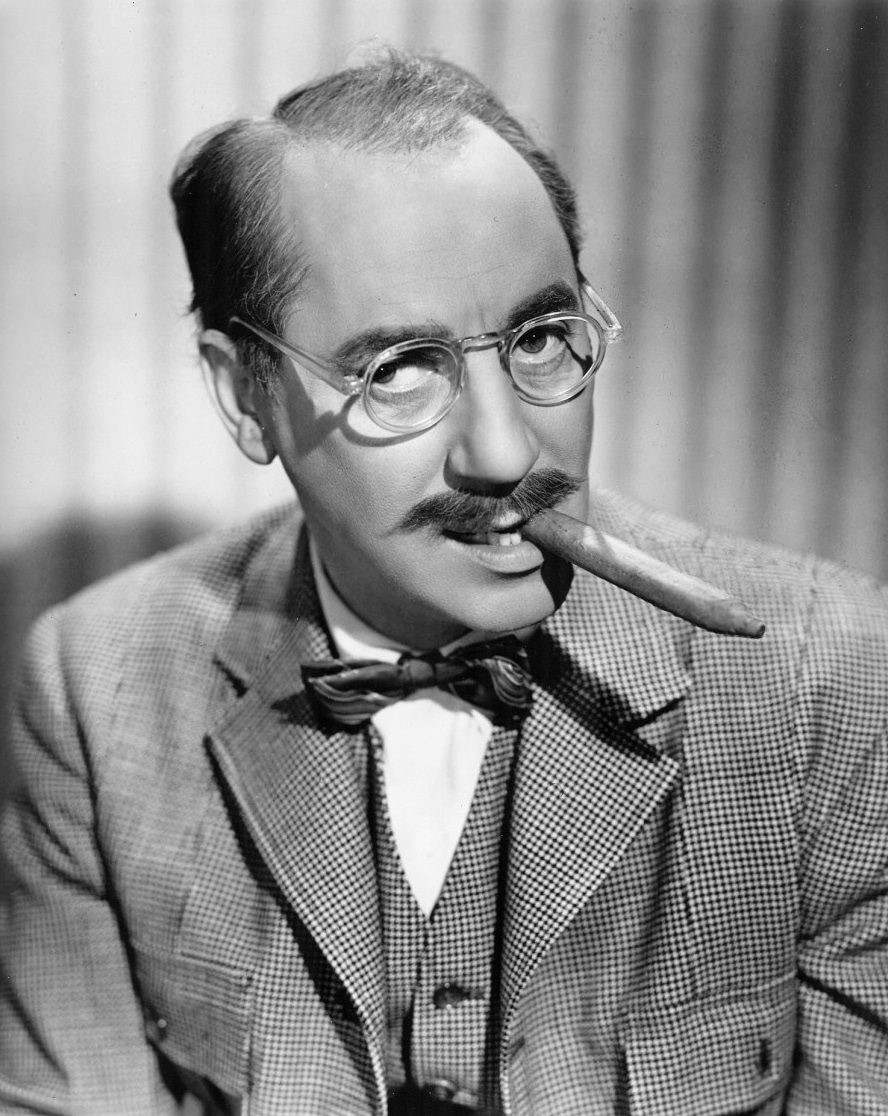
Groucho's appearance became an essential part of his public identity. His familiar look included exaggerated eyebrows, a thick mustache, round glasses, a cigar, and a slightly bent posture.
The mustache and eyebrows originally formed part of his stage makeup. Over time, the look became so recognizable that audiences associated it with his comic persona.
His delivery was equally distinctive. He often spoke rapidly, interrupted other characters, and responded to serious statements with unexpected jokes.
His comedy frequently targeted hypocrisy, bureaucracy, wealth, pretension, and people who took themselves too seriously. Rather than relying on physical action alone, he used language as a weapon.
This combination of appearance, timing, and sharp dialogue helped make him one of the most easily recognized comedians in entertainment history.
7. Major Marx Brothers Films
The Cocoanuts (1929)
The Cocoanuts was one of the Marx Brothers' first major motion pictures. Based on their Broadway success, the film introduced their unusual comedy to cinema audiences.
Groucho played a hotel manager who became involved in a series of misunderstandings, schemes, and comic exchanges. The film established many of the elements that would define their movie careers.
Animal Crackers (1930)
In Animal Crackers, Groucho portrayed Captain Jeffrey T. Spaulding, an eccentric explorer returning from an expedition.
The film features absurd dialogue, elaborate wordplay, and musical comedy. It remains one of the important early works in the Marx Brothers' filmography.
Monkey Business (1931)
Monkey Business followed the brothers aboard an ocean liner, where they became involved in a series of chaotic situations.
The film gave Groucho and his brothers opportunities to challenge social conventions and create humor from authority figures, wealthy passengers, and elaborate misunderstandings.
Horse Feathers (1932)
In Horse Feathers, Groucho played Professor Quincy Adams Wagstaff, the new president of a college.
The film satirized academic institutions, college sports, and social respectability. It remains one of the best-known examples of the Marx Brothers' irreverent style.
Duck Soup (1933)
Duck Soup is widely considered one of the Marx Brothers' greatest films. Groucho played Rufus T. Firefly, the leader of the fictional country of Freedonia.
The story mocks political authority, nationalism, diplomatic behavior, and the absurdity of war. Groucho's performance combines sharp insults with ridiculous leadership decisions and surreal situations.
Although the film was not initially as commercially successful as some later Marx Brothers productions, its reputation grew over time. It is now widely regarded as a landmark of political satire and film comedy.
A Night at the Opera (1935)
A Night at the Opera marked an important stage in the group's career after moving to Metro-Goldwyn-Mayer.
Groucho played Otis B. Driftwood, a scheming character who becomes involved in a plan to help an opera singer and his romantic interests.
The film became a major commercial success and contains several famous comedy sequences, including the crowded-stateroom scene. It helped introduce the Marx Brothers to a new generation of moviegoers.
A Day at the Races (1937)
In A Day at the Races, Groucho played Dr. Hugo Z. Hackenbush, a veterinarian who becomes involved in a medical institution's efforts to raise money.
The film combined musical numbers, slapstick, and verbal comedy. It became another successful production for the brothers.
Later Films
The Marx Brothers continued making films, including Room Service (1938), At the Circus (1939), Go West (1940), and The Big Store (1941).
Their later movies did not always achieve the same level of success as their most celebrated earlier work. Nevertheless, these productions helped preserve the group's distinctive comic legacy.
Their final feature film together, Love Happy, was released in 1949.
8. Solo Career in Radio
Groucho pursued opportunities outside the Marx Brothers' film productions, particularly in radio. He had long hoped to establish himself as a successful radio personality.
During the 1930s and 1940s, he appeared on various programs and experimented with different formats. Some early shows had limited success, but he eventually found a format that suited his conversational humor.
In 1947, You Bet Your Life began as a radio program. The show combined a quiz competition with interviews and spontaneous conversation.
The questions were part of the format, but Groucho's interactions with contestants often became the main attraction. He asked unexpected questions, reacted with sarcastic humor, and turned ordinary personal stories into entertaining exchanges.
The program became a major success and established Groucho as a popular solo entertainer.
9. Television Success with You Bet Your Life
In 1950, You Bet Your Life moved to television, expanding Groucho's popularity.
The show featured contestants answering questions while Groucho entertained them through conversation and spontaneous jokes. George Fenneman served as the announcer and a frequent partner in the show's comedic exchanges.
Unlike many quiz programs that focused primarily on competition, You Bet Your Life emphasized personality and humor. Groucho's quick reactions and ability to improvise made each interview distinctive.
The television program ran until 1961 and became one of the defining achievements of his solo career.
Its success demonstrated that Groucho's comedy could work just as effectively in an intimate television setting as it had on the stage and in films.
10. Writing Career and Books
Groucho was also a successful humor writer. He contributed articles, essays, letters, and other humorous pieces to publications throughout his career.
His books include:
- Beds (1930), an early collection of humorous writing.
- Many Happy Returns (1942), which included his observations on taxes and everyday life.
- Groucho and Me (1959), his autobiography.
- Memoirs of a Mangy Lover (1963), a collection of comic reflections.
- The Groucho Letters (1967), a collection of correspondence.
- The Groucho Phile (1976), another book reflecting his distinctive humor and personality.
His writing shared many qualities with his performances: irreverence, sharp observations, playful language, and a willingness to challenge conventional thinking.
His letters became particularly well known for their wit. They also revealed his interests beyond comedy, including literature, friendships, politics, and the entertainment industry.
11. Personal Life and Family
Groucho Marx married three times. His first marriage was to Ruth Johnson, a chorus girl, in 1920. They had two children, Arthur and Miriam, before divorcing in 1942.
He married actress Kay Marvis in 1945. They had one daughter, Melinda, before their marriage ended in divorce in 1951.
In 1954, he married actress Eden Hartford. Their marriage lasted until 1969, when they divorced.
Groucho maintained relationships with his children and continued working for much of his life. His family and personal relationships sometimes attracted public attention, particularly during his later years.
Although his public persona was often confident and irreverent, his private life included ordinary family concerns, professional pressures, and health challenges associated with aging.
12. Awards and Achievements
Groucho received recognition for his contributions to entertainment during his lifetime.
His notable achievements include:
- Honorary Academy Award (1974): Recognized his contribution to the art of motion pictures through his work with the Marx Brothers.
- Peabody Award: His radio work on You Bet Your Life received recognition for its entertainment value.
- Television success: The long-running television version of You Bet Your Life established him as a major television personality.
- Commandeur des Arts et des Lettres (1972): He received this French cultural honor in recognition of his contributions to the arts.
- Literary legacy: His books and correspondence remain part of the record of twentieth-century American humor.
His achievements reflect a career that successfully crossed several entertainment formats, from vaudeville and Broadway to movies, radio, television, and publishing.
13. Final Years and Death
Groucho continued to appear in public and participate in entertainment projects during his later years. In 1972, he performed a successful one-man show at Carnegie Hall in New York City, demonstrating that audiences still appreciated his humor and personality.
He received renewed recognition from critics and entertainment organizations as his contribution to comedy became more widely celebrated.
During the final years of his life, Groucho experienced declining health and spent time in hospital care.
He died on August 19, 1977, in Los Angeles, California, at the age of 86. His death marked the end of a career that had lasted more than seven decades.
His passing came only days after the death of Elvis Presley, which dominated much of the news coverage at the time. Nevertheless, Groucho's contribution to American entertainment continued to receive recognition in the years that followed.
14. Influence on Comedy and Popular Culture
Groucho Marx influenced generations of comedians through his command of language, timing, satire, and improvisation.
His comedy challenged social conventions and exposed the contradictions of people who considered themselves important. He often used a clever question or unexpected reply to reverse the power dynamic of a conversation.
His style helped demonstrate that comedy could be built around intelligence and language as much as physical performance. His influence can be seen in later television comedians, talk-show hosts, satirists, and writers.
The Marx Brothers' films also helped establish absurdist comedy as a major force in cinema. Their willingness to ridicule politics, business, education, and social respectability gave their work an enduring relevance.
Groucho's recognizable look and distinctive delivery remain common references in cartoons, television, stage performances, and popular culture.
15. Legacy
Groucho Marx remains one of the most influential comedians in American entertainment history. His career crossed multiple generations and technological changes, from live vaudeville to silent-era theater traditions, sound films, radio, and television.
His work with the Marx Brothers produced some of the most celebrated comedy films of the twentieth century. His solo success with You Bet Your Life demonstrated his ability to remain entertaining outside the group that first made him famous.
His books and letters preserved his wit in written form, while his performances helped shape the language of modern satire.
Today, Groucho is remembered for his intelligence, irreverence, memorable characters, and extraordinary ability to turn a conversation into a comic performance.
16. Conclusion
Groucho Marx was much more than a film comedian. He was an accomplished stage performer, writer, radio personality, and television host whose distinctive style reshaped American comedy.
Through classic films such as Duck Soup and A Night at the Opera, as well as his long-running work on You Bet Your Life, he created an enduring body of work that continues to entertain audiences.
His quick wit, memorable appearance, and fearless satire made him a unique figure in popular culture. Decades after his death, Groucho Marx remains a lasting symbol of intelligent, irreverent, and inventive comedy.
Did you know?
- Groucho Marx's birth name was Julius Henry Marx. - He was born in New York City on October 2, 1890. - His famous mustache and eyebrows originally came from stage makeup. - He was one of five brothers who formed the Marx Brothers entertainment team. - *Duck Soup* later became celebrated as a classic of political satire. - His television show *You Bet Your Life* ran from 1950 to 1961. - Groucho was also a successful author and published several books, including his autobiography *Groucho and Me*. - He received an Honorary Academy Award in 1974. - He performed a celebrated one-man show at Carnegie Hall in 1972. - Groucho Marx died on August 19, 1977, at the age of 86.