Politician · United States
George H. W. Bush
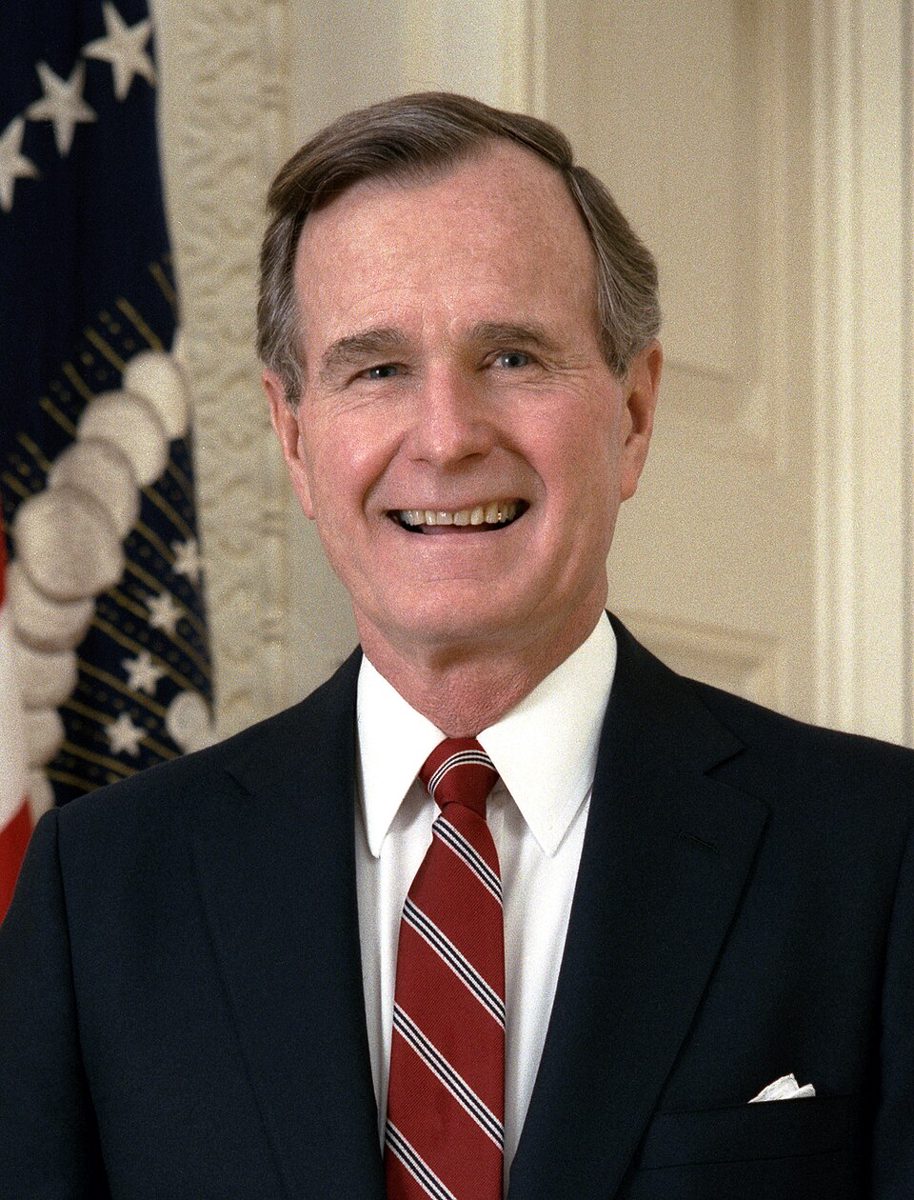
George H. W. Bush was the 41st president of the United States, serving from 1989 to 1993. Born on June 12, 1924, in Milton, Massachusetts, he was a Republican politician, diplomat, naval aviator, and public servant. Before becoming president, Bush served as vice president under Ronald Reagan, director of the Central Intelligence Agency, U.S. ambassador to the United Nations, and U.S. envoy to China. His presidency was shaped by the end of the Cold War, the fall of the Berlin Wall, German reunification, and the 1991 Gulf War following Iraq’s invasion of Kuwait. He also signed the Americans with Disabilities Act of 1990. Bush died on November 30, 2018, at the age of 94, leaving a significant legacy in American foreign policy and public service.
 Wikimedia Commons
George H. W. Bush: Full Biography
Biography
1. Introduction
George Herbert Walker Bush was the 41st president of the United States, serving from January 20, 1989, to January 20, 1993. A member of the Republican Party, he was an experienced diplomat, military veteran, businessman, and political leader whose career spanned several decades.
Bush became president during a period of major international change. His administration witnessed the end of the Cold War, the fall of the Berlin Wall, and the dissolution of the Soviet Union. He also led an international coalition during the 1991 Gulf War after Iraq invaded Kuwait in 1990.
Before becoming president, Bush served as vice president under Ronald Reagan, director of the Central Intelligence Agency, U.S. ambassador to the United Nations, and chief of the U.S. Liaison Office in China. His career reflected a longstanding involvement in American foreign policy and government.
2. Early Life and Family Background
George Herbert Walker Bush was born on June 12, 1924, in Milton, Massachusetts. He was the son of Prescott Sheldon Bush, a businessman and later U.S. senator from Connecticut, and Dorothy Walker Bush.
Bush grew up in a family that emphasized education, discipline, community involvement, and public service. His upbringing exposed him to business and politics from an early age.
He attended Phillips Academy in Andover, Massachusetts, where he participated in student activities and sports. He served as captain of the baseball and soccer teams and became involved in school leadership.
On his 18th birthday in June 1942, shortly after the United States entered World War II, Bush enlisted in the U.S. Navy. His decision to enter military service interrupted his plans for immediate university education and began a formative chapter in his life.
3. Military Service During World War II
Bush trained as a naval aviator and became one of the youngest pilots in the U.S. Navy at the time he received his wings. He flew torpedo bombers in the Pacific theater during World War II.
On September 2, 1944, while participating in a mission against Japanese military installations on Chichijima, his aircraft was hit by enemy fire. Bush bailed out and was rescued from the ocean by a U.S. submarine. The two other crew members aboard his aircraft did not survive.
For his actions during the war, he received the Distinguished Flying Cross and other military decorations. By the end of his service, he had flown 58 combat missions.
The experience of military service became an important part of Bush's public identity. Throughout his political career, he frequently referred to the responsibilities of leadership, the costs of war, and the importance of international security.
4. Education and Entry into Business
After completing his military service, Bush enrolled at Yale University. He graduated in 1948 with a degree in economics.
At Yale, he participated in athletics and student activities and was associated with the university's Skull and Bones society. His university experience helped prepare him for a career in business and public life.
After graduation, Bush moved with his family to Texas, where he entered the oil industry. He worked in the developing petroleum sector and helped establish and manage oil-related businesses.
His business activities included involvement with Zapata Petroleum and Zapata Offshore Company. These ventures helped him build professional relationships and develop experience in management, investment, and the energy industry.
His time in Texas also strengthened his connections with Republican political networks. Although he initially pursued a business career, he gradually became more involved in electoral politics and public service.
5. Early Political Career
Bush's political career developed during a period when the Republican Party was expanding its presence in Texas. In 1964, he ran unsuccessfully for the U.S. Senate. He later sought a seat in the U.S. House of Representatives and won election in 1966.
He represented Texas's 7th congressional district from 1967 to 1971. During his two terms, he participated in congressional debates on domestic policy, national security, and government affairs.
In 1970, Bush ran for the Senate again but lost to Democratic incumbent Lloyd Bentsen. Despite the defeat, he remained active in national Republican politics and continued building his experience in government.
His congressional service established a foundation for his later diplomatic appointments. It also gave him experience working with political institutions and developing relationships with lawmakers from different backgrounds.
6. Diplomatic and Government Positions
During the 1970s, Bush held several important government positions.
From 1971 to 1973, he served as the U.S. ambassador to the United Nations, representing American interests in an international organization that was central to diplomacy and global security.
He then became chairman of the Republican National Committee from 1973 to 1974. In this position, he dealt with party organization during a difficult period marked by the Watergate scandal and President Richard Nixon's resignation.
From 1974 to 1975, Bush served as chief of the U.S. Liaison Office in the People's Republic of China. The appointment came during the gradual normalization of relations between Washington and Beijing. His work in China gave him valuable experience in international diplomacy.
In 1976, he became director of the Central Intelligence Agency. He served until 1977, overseeing the agency during a period of scrutiny and institutional reform following revelations about intelligence activities.
These roles provided Bush with extensive experience in diplomacy, intelligence, national security, and political administration.
7. Vice Presidency Under Ronald Reagan
In 1980, Bush campaigned for the Republican presidential nomination. Although he did not win the nomination, Ronald Reagan selected him as his running mate.
Reagan and Bush won the 1980 election, and Bush became vice president in January 1981. The pair won reelection in 1984, allowing Bush to serve two terms as vice president from 1981 to 1989.
During his vice presidency, Bush participated in diplomatic missions, attended meetings with foreign leaders, and represented the administration on domestic and international matters.
His experience included work related to federal regulation, drug policy, and international relations. He also traveled extensively on behalf of the United States.
The vice presidency strengthened his credentials for the presidency. Unlike many candidates who entered the White House with limited executive experience, Bush had held several senior government positions and spent eight years in the administration of a sitting president.
8. Election as President in 1988
Bush became the Republican Party's presidential nominee in 1988. He selected Indiana senator Dan Quayle as his running mate.
In the general election, Bush faced Democratic nominee Michael Dukakis, then governor of Massachusetts. Bush won the election and took office on January 20, 1989, becoming the 41st president of the United States.
His inaugural address emphasized public service and the idea of building a kinder and gentler nation. He also called for Americans to contribute to their communities through volunteerism and civic engagement.
Bush entered office with substantial foreign policy experience. However, his administration also faced domestic challenges, including federal budget pressures, debates over taxation, and an economy that would later experience a recession.
9. Presidency and the End of the Cold War
One of the defining features of Bush's presidency was the rapid transformation of international relations.
During the late 1980s and early 1990s, communist governments across Eastern Europe lost power, and the Berlin Wall fell in November 1989. Germany moved toward reunification, which was completed in October 1990.
Bush worked with Soviet leader Mikhail Gorbachev during the final years of the Cold War. Their discussions helped support negotiations on arms control and the changing relationship between the United States and the Soviet Union.
In 1991, the Soviet Union dissolved, bringing an end to the superpower rivalry that had shaped international politics for decades.
Bush's administration sought to manage these developments while maintaining cooperation with allies and avoiding unnecessary confrontation. His approach relied heavily on diplomacy, consultations with international partners, and negotiations over security arrangements.
The period also raised new questions about the future of European security, the role of NATO, and the relationship between the United States and newly independent states.
10. The Gulf War and the Invasion of Panama
Bush's presidency included two major military operations: the intervention in Panama in 1989 and the Gulf War in 1991.
In December 1989, U.S. forces invaded Panama during Operation Just Cause. The operation aimed to remove Panamanian leader Manuel Noriega, who faced U.S. criminal charges and whose government was involved in a dispute over political legitimacy and security. Noriega was captured and taken to the United States.
The most prominent military crisis of Bush's presidency began on August 2, 1990, when Iraq invaded Kuwait. Iraqi leader Saddam Hussein's forces occupied the neighboring country, prompting international condemnation.
Bush assembled a broad international coalition and secured United Nations support for measures intended to reverse the invasion. The United States deployed troops to Saudi Arabia and helped organize Operation Desert Storm.
The coalition launched an air campaign in January 1991, followed by a ground offensive in February. Kuwait was liberated, and the fighting ended after a short ground campaign.
The operation strengthened Bush's international profile and demonstrated the capacity of a large coalition to coordinate military action. However, Saddam Hussein remained in power in Iraq, and the conflict left continuing questions about regional stability and future relations with Baghdad.
11. Domestic Policy and Major Legislation
Although foreign policy dominated much of Bush's presidency, his administration also addressed domestic issues.
In July 1990, Bush signed the Americans with Disabilities Act, a major civil rights law prohibiting discrimination against people with disabilities in employment, public accommodations, transportation, and other areas.
He also signed amendments to the Clean Air Act in 1990. These changes strengthened federal efforts to address air pollution and established mechanisms to reduce emissions associated with acid rain and other environmental problems.
Another important development was the 1990 budget agreement, negotiated with congressional leaders. The agreement included spending limits and tax increases intended to reduce the federal deficit. The decision disappointed some conservative supporters who had opposed raising taxes.
Bush also promoted volunteerism through his Points of Light initiative, which encouraged Americans to participate in community service.
His domestic agenda reflected an effort to balance fiscal concerns, environmental regulation, civil rights protections, and voluntary public service.
12. Economic Challenges and the 1992 Election
Despite achievements in foreign policy, Bush faced growing dissatisfaction at home as the American economy weakened.
The early 1990s recession contributed to job losses, business difficulties, and public concerns about economic security. Critics questioned the administration's handling of the downturn, while supporters pointed to the economic conditions inherited from earlier years and the difficulty of balancing budget priorities.
Bush's 1990 decision to accept tax increases also created tension within parts of the Republican Party. Some voters viewed the agreement as a departure from his campaign pledge not to raise taxes.
In the 1992 presidential election, Bush faced Democratic nominee Bill Clinton and independent candidate Ross Perot. Clinton won the election, and Bush left office in January 1993.
The result ended his presidency after one term. It also demonstrated how domestic economic concerns can shape public assessments of an administration even during a period of significant international change.
13. Family and Personal Life
Bush married Barbara Pierce on January 6, 1945, while he was serving in the Navy. Their marriage lasted more than seven decades, and Barbara became a prominent public figure during his political career.
They had six children: George W. Bush, Robin Bush, Jeb Bush, Neil Bush, Marvin Bush, and Dorothy Bush Koch. Their daughter Robin died of leukemia in 1953 at the age of three.
The loss of Robin was a deeply significant event for the family. In later years, the Bush family supported charitable causes, including cancer-related initiatives.
Two of their sons entered major political roles. George W. Bush became the 43rd president of the United States, serving from 2001 to 2009, while Jeb Bush served as governor of Florida from 1999 to 2007.
The family's political involvement made the Bush name a prominent part of American public life across several generations.
14. Life After the Presidency
After leaving office, Bush remained active in charitable work, public speaking, and international humanitarian efforts.
He developed a close friendship with former president Bill Clinton. Despite their political differences and the fact that Clinton had defeated him in the 1992 election, the two worked together on fundraising and disaster-relief efforts.
Their joint work included fundraising for victims of the 2004 Indian Ocean tsunami and Hurricane Katrina in 2005. Their collaboration became a notable example of former political rivals working together on humanitarian projects.
Bush also supported the Points of Light initiative and other volunteer-service programs. His post-presidential activities reflected his longstanding interest in civic engagement and public service.
In 2011, President Barack Obama awarded him the Presidential Medal of Freedom, the highest civilian honor in the United States.
15. Death and National Remembrance
Barbara Bush died in April 2018. George H. W. Bush died on November 30, 2018, in Houston, Texas, at the age of 94.
His death prompted tributes from political leaders, former colleagues, international figures, and members of the public. A state funeral was held in Washington, D.C., and he was buried at the George H. W. Bush Presidential Library and Museum in College Station, Texas.
His funeral brought together former presidents and national leaders, reflecting the significance of his long career in public service.
The presidential library preserves records and materials related to his life, administration, and historical period. It also provides resources for researchers studying American politics, diplomacy, and the end of the Cold War.
16. Legacy and Historical Significance
George H. W. Bush's legacy is closely associated with the end of the Cold War, the management of the Gulf War, and his decades of diplomatic and government service.
Supporters have emphasized his experience in foreign affairs, his work with international partners, and his ability to manage a rapidly changing world. Assessments of his presidency also consider domestic economic difficulties, his decision to accept tax increases, and the outcome of the 1992 election.
His administration's support for the Americans with Disabilities Act and amendments to the Clean Air Act represents an important part of his domestic policy record.
Bush also left a personal legacy through volunteerism, humanitarian fundraising, and his cooperation with former political opponents after leaving office.
His career illustrates the influence of diplomacy, military experience, executive leadership, and long-term public service in American political life.
17. Conclusion
George H. W. Bush served as the 41st president of the United States during a turning point in modern history. His life included military service during World War II, a career in the oil industry, congressional service, senior diplomatic appointments, eight years as vice president, and four years in the White House.
His presidency was shaped by the collapse of communist governments in Eastern Europe, the dissolution of the Soviet Union, the Gulf War, and major domestic legislation. Although he lost his reelection campaign in 1992, he continued to contribute to humanitarian and public-service initiatives for many years.
George H. W. Bush died in 2018, but his role in American diplomacy, the end of the Cold War, and the development of modern presidential history remains an important subject of study.
Did you know?
## Did You Know About George H. W. Bush? - George H. W. Bush was born on June 12, 1924, and became the 41st president of the United States. - He enlisted in the U.S. Navy on his 18th birthday during World War II. - He flew 58 combat missions as a naval aviator in the Pacific. - Before becoming president, he served as director of the CIA from 1976 to 1977. - He was the first sitting vice president since Martin Van Buren to be elected president in his own right. - His presidency coincided with the fall of the Berlin Wall and the dissolution of the Soviet Union. - He helped assemble the international coalition that liberated Kuwait during the 1991 Gulf War. - He signed the Americans with Disabilities Act into law in 1990. - His son George W. Bush later became the 43rd president of the United States. - After leaving office, he worked with former political rival Bill Clinton on humanitarian fundraising initiatives.