Footballer · Argentina
Diego Maradona
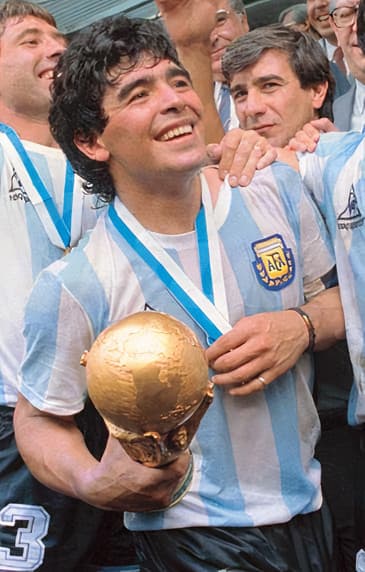
Diego Maradona was an Argentine professional footballer and manager widely regarded as one of the greatest players in football history. Born on October 30, 1960, in Lanús, Argentina, he became famous for his exceptional dribbling, creativity, vision, and leadership. Maradona captained Argentina to victory at the 1986 FIFA World Cup and achieved legendary status at Napoli, where he helped the club win major domestic titles. He died on November 25, 2020, at the age of 60.
 Wikimedia Commons
Diego Maradona: Full Biography
Biography
Early Life
Diego Armando Maradona was born on October 30, 1960, in Lanús, Buenos Aires Province, Argentina. He grew up in Villa Fiorito, a poor neighborhood on the outskirts of Buenos Aires. Despite facing financial difficulties, he developed a strong passion for football from an early age.
Childhood and Football Development
Maradona began playing football as a child and quickly demonstrated remarkable ball control, balance, and creativity. His talent attracted attention when he played for local youth teams, and football soon became the central focus of his life.
Youth Career at Argentinos Juniors
Maradona joined the youth system of Argentinos Juniors, where he played for the youth team known as Los Cebollitas. The team achieved an impressive unbeaten run, and Maradona emerged as its standout player. His performances helped establish his reputation as an exceptional young talent.
Professional Debut
Maradona made his senior debut for Argentinos Juniors in October 1976, shortly before his 16th birthday. His confidence, dribbling, and attacking creativity quickly distinguished him from other young players.
Rise to Stardom
During his time at Argentinos Juniors, Maradona became one of Argentina's most exciting footballers. He finished as the Argentine Primera División's top scorer in several seasons, attracting interest from the country's biggest clubs.
Move to Boca Juniors
In 1981, Maradona joined Boca Juniors. He helped the club win the Argentine league title that year and quickly became a favorite among supporters. His performances strengthened his reputation as one of Argentina's leading players.
European Career at Barcelona
Maradona joined Barcelona in 1982. His time in Spain included impressive individual performances, but injuries and difficult circumstances disrupted his progress. Despite these challenges, he helped Barcelona win the Copa del Rey, the Spanish League Cup, and the Spanish Super Cup.
Move to Napoli
In 1984, Maradona transferred to Napoli in Italy. The move became a defining moment in his career and in the history of the club. He quickly developed a special relationship with Napoli's supporters and became a symbol of pride for the city.
Napoli's Golden Era
Maradona led Napoli to its first Serie A championship in the 1986–87 season. The club also won the Coppa Italia that season. In 1989, Napoli won the UEFA Cup, and in 1990, the team captured another Serie A title. These achievements transformed Napoli into one of Italy's leading clubs.
Argentina National Team
Maradona represented Argentina at four FIFA World Cups: 1982, 1986, 1990, and 1994. His international career included extraordinary triumphs, controversial moments, and memorable performances that made him a defining figure in Argentine sporting history.
1986 FIFA World Cup
The 1986 FIFA World Cup in Mexico was the highlight of Maradona's international career. As Argentina's captain, he led his team to the championship and delivered a series of outstanding performances. Argentina defeated West Germany 3–2 in the final, with Maradona playing a central role throughout the tournament.
The Hand of God Goal
During Argentina's quarterfinal against England in 1986, Maradona scored a controversial goal by using his hand. The incident became known as the Hand of God. The goal was allowed by the officials and remains one of the most discussed moments in World Cup history.
The Goal of the Century
In the same quarterfinal, Maradona scored a remarkable solo goal after dribbling past several English players. The goal was later voted the Goal of the Century in a FIFA poll. It demonstrated his acceleration, balance, close control, and ability to create opportunities under pressure.
1990 FIFA World Cup
Maradona captained Argentina to the final of the 1990 FIFA World Cup in Italy. Argentina defeated Brazil in the round of 16 and advanced through the knockout stages before losing 1–0 to West Germany in the final.
Later Playing Career
After leaving Napoli, Maradona played for Sevilla, returned to Argentina with Newell's Old Boys, and later played again for Boca Juniors. His later years as a player were affected by injuries, suspensions, and personal challenges, but he remained a major public figure in football.
Retirement
Maradona retired from professional football in 1997 after his second spell at Boca Juniors. His career had included remarkable achievements at club and international level, alongside controversies that attracted worldwide attention.
Career as a Manager
After retiring, Maradona moved into football management. He coached several clubs and was appointed head coach of Argentina's national team in 2008. He led Argentina at the 2010 FIFA World Cup, where the team reached the quarterfinals before being eliminated by Germany.
Individual Awards
Maradona received numerous honors during and after his playing career. He was named FIFA Player of the Century jointly with Pelé in a 2000 award, and he received recognition for his performances at the 1986 World Cup. His individual brilliance became a central part of his football legacy.
Personal Life
Maradona's personal life often attracted extensive media coverage. He had children and maintained close connections with Argentina and Naples throughout his life. His public image combined footballing genius with a complex personal history.
Death
Diego Maradona died on November 25, 2020, at the age of 60, while recovering at a residence in Tigre, Argentina. His death prompted tributes from football clubs, players, political leaders, and supporters around the world.
Legacy
Maradona remains one of football's most influential figures. His performances at the 1986 World Cup, achievements with Napoli, and distinctive playing style inspired generations of footballers. In Argentina, he became a cultural icon whose influence extended far beyond sport.
Conclusion
From his humble beginnings in Argentina to World Cup glory and legendary status at Napoli, Diego Maradona built one of football's most memorable careers. His creativity, determination, and extraordinary technical ability continue to shape the way fans remember the game.
Did you know?
- Diego Maradona made his professional debut just before his 16th birthday. - He captained Argentina to the 1986 FIFA World Cup title. - His two famous goals against England in 1986 became known as the Hand of God and the Goal of the Century. - He helped Napoli win two Serie A titles in 1987 and 1990. - Maradona won the UEFA Cup with Napoli in 1989. - He was named FIFA Player of the Century jointly with Pelé in 2000. - Napoli retired the number 10 shirt in his honor after his death.