Actor · United Kingdom
Charlotte Rampling
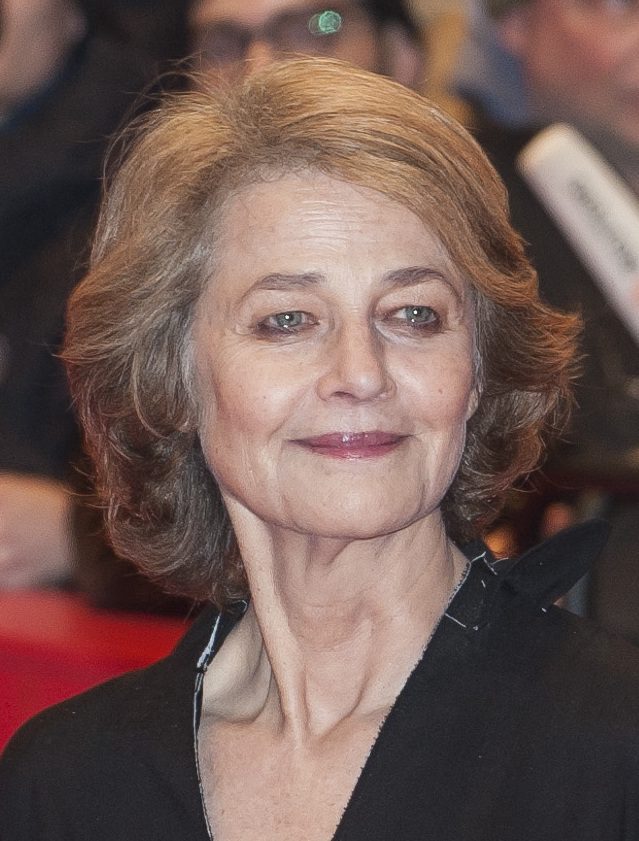
Charlotte Rampling is an acclaimed English actress and former model known for her distinctive screen presence and performances in European art-house cinema and international films. Born on February 5, 1946, in Sturmer, Essex, England, she rose to prominence during the 1960s and became internationally recognized for films such as *The Damned*, *The Night Porter*, *Swimming Pool*, and *45 Years*. Her performance in *45 Years* earned her an Academy Award nomination for Best Actress. She has also appeared in *Dune: Part Two* as Reverend Mother Mohiam and received numerous international honors for her contribution to cinema.
 Wikimedia Commons
Charlotte Rampling: Full Biography
Biography
1. Introduction
Charlotte Rampling is an English actress whose career spans more than six decades. Recognized for her expressive eyes, understated acting style, and willingness to explore complicated characters, she has established herself as a distinctive figure in British and European cinema.
Throughout her career, Rampling has worked with celebrated filmmakers and appeared in films ranging from psychological dramas and art-house productions to major international releases. Her performances often explore themes of identity, memory, desire, relationships, and human vulnerability.
2. Early Life and Birth
Charlotte Rampling was born Tessa Charlotte Rampling on February 5, 1946, in Sturmer, Essex, England. She grew up in a family with strong connections to the arts and athletics.
Her childhood involved living in several European locations, including France and Spain, because of her father's professional responsibilities. These experiences exposed her to different languages, cultures, and ways of life from an early age.
3. Family Background
Rampling's mother, Isabel Anne Gurteen, was a painter, while her father, Godfrey Rampling, was an Olympic gold-medal-winning athlete and a British Army officer.
Her father's achievements and military career meant that family life included periods of travel and relocation. Her mother's artistic interests also provided a connection to creative expression.
4. Education
Rampling received part of her education in France and attended Académie Jeanne d'Arc in Versailles. She later studied at St Hilda's School in Bushey, Hertfordshire, England.
Her international upbringing helped develop her familiarity with different European cultures, which later became relevant to her career in British, French, and Italian cinema.
5. Early Career and Modeling
Before becoming an established actress, Rampling worked as a model. Her appearance and distinctive presence helped her enter the entertainment industry during the 1960s, a period of significant cultural and fashion change in Britain.
She began appearing in films during her late teens. Early screen appearances introduced her to the filmmaking process and helped her develop the experience needed for more substantial acting roles.
6. Early Film Appearances
One of Rampling's early screen appearances was in Richard Lester's The Knack ...and How to Get It (1965). She subsequently appeared in Rotten to the Core (1965) and gained wider attention with the British comedy Georgy Girl (1966).
These early projects helped establish her as a promising performer during the period often associated with London's Swinging Sixties.
7. Breakthrough with The Damned
In 1969, Rampling appeared in Luchino Visconti's The Damned, a historical drama that explored the corruption and moral collapse of a wealthy German industrial family during the rise of Nazism.
The film became an important part of her development as an actress. Working in European cinema also helped her move beyond the conventional roles commonly offered to young British performers.
8. The Night Porter
Rampling's performance in Liliana Cavani's The Night Porter (1974) became one of the most discussed roles of her career. She portrayed Lucia, a concentration camp survivor who encounters a former Nazi officer after the Second World War.
The film explores disturbing psychological themes, trauma, power, and the lasting effects of violence. Its controversial subject matter attracted considerable debate, while Rampling's performance contributed to her reputation for taking on challenging and unconventional roles.
9. Zardoz and International Cinema
In 1974, Rampling appeared alongside Sean Connery in John Boorman's science-fiction film Zardoz. The film developed a distinctive following because of its unusual setting, philosophical themes, and unconventional visual style.
The project expanded her experience in international productions and demonstrated her ability to work in genres beyond psychological and historical drama.
10. Farewell, My Lovely
Rampling starred opposite Robert Mitchum in Farewell, My Lovely (1975), an adaptation of Raymond Chandler's detective novel featuring private investigator Philip Marlowe.
The film allowed her to participate in a classic crime story and further strengthened her profile among English-speaking audiences.
11. Career in the 1970s and 1980s
During the 1970s and 1980s, Rampling continued to work across European and American productions. Rather than limiting herself to one type of character, she explored dramas, thrillers, comedies, and experimental films.
Her credits from this period include The Verdict (1982), directed by Sidney Lumet and starring Paul Newman, and Stardust Memories (1980), directed by Woody Allen.
Her career choices established a pattern of pursuing roles that emphasized psychological complexity and artistic experimentation.
12. Stardust Memories
In Woody Allen's Stardust Memories (1980), Rampling appeared in a film about a filmmaker confronting questions of artistic purpose, fame, and personal relationships.
The movie's reflective approach to celebrity and creativity complemented the introspective quality often associated with Rampling's performances.
13. The Verdict
Rampling appeared in Sidney Lumet's legal drama The Verdict (1982), alongside Paul Newman. The film follows an alcoholic lawyer who takes on a medical malpractice case and confronts powerful institutional interests.
Her participation in the production added another notable American film to a career that was increasingly international in scope.
14. Experimentation with Unconventional Roles
Rampling has repeatedly demonstrated a willingness to explore unusual characters. One example is Max, Mon Amour (1986), directed by Nagisa Oshima, a provocative comedy built around an unconventional relationship.
Such projects reflect her interest in cinema that challenges familiar expectations about relationships, behavior, and social conventions.
15. Return to Prominence in the 2000s
During the late 1990s and early 2000s, Rampling appeared in a new wave of critically discussed films. She became particularly associated with the work of French director François Ozon.
Their collaborations offered roles built around ambiguity, secrets, and emotional tension, introducing her performances to new audiences while reinforcing her reputation among art-house cinema enthusiasts.
16. Under the Sand
In François Ozon's Under the Sand (2000), Rampling played Marie, a woman whose husband disappears during a seaside holiday.
The film examines grief, uncertainty, and the difficulty of accepting an unexplained loss. Rampling's restrained performance helped communicate the character's inner turmoil without relying on overt emotional displays.
17. Swimming Pool
Rampling starred as Sarah Morton, a British crime novelist, in Ozon's Swimming Pool (2003). The story develops around her stay at a French country house, where the arrival of a younger woman disrupts her routine and creative process.
The film blends psychological suspense with questions about imagination, authorship, and reality. It became one of Rampling's best-known later-career performances.
18. Other Notable Films
Rampling's extensive filmography includes The Wings of the Dove (1997), Spy Game (2001), Basic Instinct 2 (2006), The Duchess (2008), and Melancholia (2011).
These films demonstrate the breadth of her career, from period dramas and thrillers to philosophical science-fiction and psychological cinema.
19. Television Career
Rampling has also worked in television. In 2013, she played Dr. Evelyn Vogel, a neuropsychiatrist, in the eighth season of the crime drama Dexter.
Her television work has allowed her to explore characters within longer narratives as well as the more concentrated storytelling of feature films.
20. Restless
In the television miniseries Restless (2012), Rampling portrayed Sally Gilmartin, a woman whose past as a wartime intelligence operative becomes central to the story.
Her performance received recognition from major television-industry organizations, including nominations for a Primetime Emmy Award and a Screen Actors Guild Award.
21. The Success of 45 Years
One of the most celebrated performances of Rampling's later career came in Andrew Haigh's 45 Years (2015). She portrayed Kate Mercer, a woman whose marriage is unsettled by the discovery of information about her husband's past.
The film explores aging, memory, trust, and the hidden complexities of long-term relationships. Rampling's quiet and emotionally detailed performance received widespread critical attention.
22. Academy Award Nomination
For 45 Years, Rampling received an Academy Award nomination for Best Actress at the 88th Academy Awards in 2016.
The nomination brought renewed international attention to her work and recognized a performance built largely on subtle expressions, pauses, and carefully controlled emotion.
23. Awards and Honors
Rampling has received significant recognition throughout her career. Her honors include the Silver Bear for Best Actress at the Berlin International Film Festival for 45 Years, the European Film Award for Best Actress for the same film, and the Volpi Cup for Best Actress at the Venice Film Festival for Hannah (2017).
She received an Honorary César in 2001, was appointed an Officer of the Order of the British Empire (OBE) in 2000, and was awarded France's Legion of Honour in 2002. In 2015, the European Film Awards recognized her with a Lifetime Achievement Award.
24. Hannah
In Andrea Pallaoro's Hannah (2017), Rampling portrayed a woman confronting the emotional consequences of her husband's imprisonment.
Her performance earned her the Volpi Cup for Best Actress at the Venice Film Festival. The film continued her exploration of characters dealing with isolation, uncertainty, and complicated personal circumstances.
25. The Dune Films
Rampling entered the world of large-scale science-fiction filmmaking through Denis Villeneuve's Dune (2021), in which she played Reverend Mother Mohiam.
She returned to the role in Dune: Part Two (2024). The character is associated with the Bene Gesserit, an influential order that uses specialized training and political maneuvering to shape events across the universe.
Her involvement introduced her to a new generation of viewers while connecting her career to one of modern cinema's major science-fiction adaptations.
26. Music and Creative Interests
In addition to acting, Rampling has explored music. In 2002, she released Like a Woman, an album featuring recordings in a cabaret-inspired style.
She has also been associated with photography and other creative interests. These activities reflect a broader artistic identity beyond her screen performances.
27. Autobiography
Rampling published a French-language autobiography titled Qui Je Suis in 2015. An English-language edition, Who I Am, followed in 2017.
The books offered readers an opportunity to learn more about her experiences, reflections, and perspective on her personal and professional life.
28. Personal Life and Relationships
Rampling married actor and publicist Bryan Southcombe in 1972. They had a son, Barnaby Southcombe, who later worked as a director. The marriage ended in divorce in 1976.
In 1978, she married French composer Jean-Michel Jarre. They had a son, David Jarre, and she also became part of the life of Jarre's daughter, Émilie. The relationship later ended.
Rampling subsequently had a long-term relationship with French journalist and businessman Jean-Noël Tassez, who died in 2015.
29. Influence on Fashion and Culture
Rampling became associated with the fashion and cultural shifts of the 1960s and 1970s. Her personal style, distinctive appearance, and unconventional screen roles helped establish her as a recognizable figure in fashion and cinema.
She has continued to attract attention for her understated elegance and willingness to maintain an individual approach to public life.
30. Acting Style
Rampling's acting is frequently associated with restraint, psychological subtlety, and expressive silences. She often portrays characters whose emotions are not immediately obvious, inviting audiences to interpret their behavior and motivations.
Her performances demonstrate how small gestures and changes in expression can convey complicated inner experiences.
31. International Recognition
Rampling's ability to work across English-language, French, and Italian cinema has contributed to her international reputation. She has collaborated with filmmakers from different traditions and moved between independent productions and larger studio projects.
This international career distinguishes her from performers whose work remains concentrated in one national film industry.
32. Career in the 2020s
Rampling continued appearing in major productions during the 2020s, including Dune: Part Two. Her continued screen presence has demonstrated the longevity of a career built around varied roles rather than a single genre.
In 2026, she also attracted renewed attention through her work with filmmaker Jim Jarmusch and public discussion of her long career.
33. Legacy
Charlotte Rampling's legacy rests on her willingness to take creative risks, her collaborations with influential filmmakers, and her ability to portray complex characters across different stages of life.
Her work in films such as The Night Porter, Swimming Pool, 45 Years, and Hannah illustrates her enduring interest in stories that examine the less obvious aspects of human experience.
34. Conclusion
Charlotte Rampling remains a significant figure in international cinema. From her early modeling career and breakthrough performances in European films to her award-winning work and appearances in major productions such as Dune: Part Two, she has built a varied and enduring body of work.
Her career demonstrates the lasting value of artistic curiosity, thoughtful character interpretation, and a willingness to explore challenging material.
Did you know?
- Charlotte Rampling began her career as a model before becoming an internationally recognized actress. - Her father, Godfrey Rampling, won an Olympic gold medal as part of Britain's 4 × 400-metre relay team at the 1936 Berlin Olympics. - She received an Academy Award nomination for her performance in *45 Years*. - She won the Volpi Cup for Best Actress at the Venice Film Festival for *Hannah*. - She has worked in British, French, Italian, and American productions. - She played Reverend Mother Mohiam in *Dune* and *Dune: Part Two*. - In addition to acting, she released a music album titled *Like a Woman* in 2002. - Her autobiography was published in French as *Qui Je Suis* and later in English as *Who I Am*. - She was appointed an Officer of the Order of the British Empire in 2000. - Her career includes more than six decades of work in film and television.